A senior Wehrmacht commander has been executed by Soviet authorities in the city of Bryansk, a dramatic and swift act of retribution in the chaotic aftermath of the war in Europe. General Leutnant Friedrich Bernhard, a career soldier who commanded rear-area forces during the brutal German occupation of Soviet territory, was hanged on the morning of December 30, 1945. His death marks the culmination of a rapid trial and underscores the Soviet Union’s uncompromising stance toward German officers implicated in the devastation of their homeland.
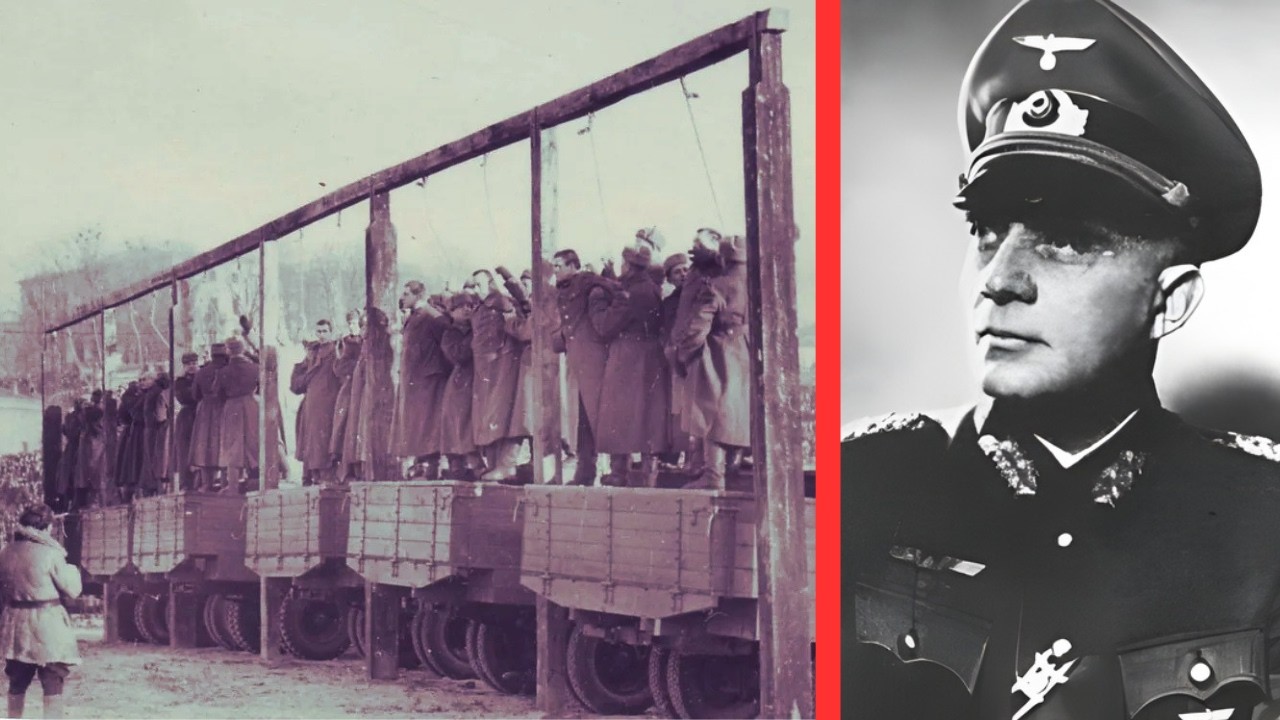 The execution concludes a tumultuous period for Bernhard, who was captured by the Red Army on May 8, 1945, the very day of Nazi Germany’s unconditional surrender. After months in captivity, he faced a Soviet military tribunal on December 29, charged with a series of grave war crimes committed in the Bryansk region during the German advance in 1941. The proceedings were brief, with the court finding him guilty and sentencing him to death within a single day.
Specific allegations against the general were severe, focusing on the immense suffering inflicted on Soviet prisoners of war and civilians. Prosecutors linked his command, Rear Army Area 532, to the catastrophic conditions following the encirclement of Bryansk, where hundreds of thousands of Red Army soldiers perished from starvation and neglect while in German custody. Bernhard was also accused of involvement in the massacre of approximately 7,500 Jewish civilians in the fields of Prokhnoi.
Historical records, however, introduce a complex layer to these charges. During a portion of the period in question, Bernhard was listed in the Führer Reserve, a pool of unassigned senior officers, potentially distancing him from direct, day-to-day command responsibilities. This ambiguity has led some observers to suggest he may have been a symbolic figure, a high-ranking officer made to answer for the collective brutality of the German occupation forces as the USSR sought justice and closure.

Friedrich Bernhard’s military career spanned both world wars, a trajectory emblematic of the persistent German officer corps. Born in 1888, he served in railway, infantry, and air force units during the First World War, even enduring three years as a prisoner of war in Russia after being shot down in 1917. He remained in the scaled-down Reichswehr after the Treaty of Versailles and rose through the ranks under the Nazi regime.
His final command placed him in the heart of the vicious war of annihilation on the Eastern Front. While his forces were officially part of the Ninth Army, their duties in rear areas often involved brutal anti-partisan warfare and the administration of occupied territory, zones where atrocities against the civilian population were widespread and systematic. The Ninth Army’s eventual destruction during the Soviet Operation Bagration in 1944 set the stage for Bernhard’s capture.

Details of the execution itself remain sparse, consistent with the opaque nature of many Soviet postwar proceedings. It is believed the hanging was carried out within the confines of a Bryansk prison, though some accounts suggest it may have been a public event designed to deliver a visceral message of vengeance to the local populace, who endured immense hardship under occupation. The method was likely slow strangulation by rope, a prolonged and gruesome fate.
The disposition of his body is unknown, a common epilogue for many German officers who vanished into the Soviet penal system. His death signifies more than the end of one man; it represents the fierce and often immediate justice meted out by a nation left in ruins. The Soviet Union, having suffered losses numbering in the tens of millions, exhibited little patience or mercy for those it deemed responsible.

This execution occurs amidst a vast and relentless wave of Soviet retribution. While the International Military Tribunal at Nuremberg tries the most prominent Nazi leadership, across the Soviet occupation zone, thousands of German military personnel and collaborators face their own reckonings in military tribunals. These trials are characterized by their speed and severity, driven by a national mandate for expiation.
The case of General Bernhard sits at the intersection of documented crime, command responsibility, and political necessity. Whether directly culpable for specific atrocities or condemned as a representative of the oppressive apparatus, his fate was sealed by the overwhelming tide of historical consequence. For the Soviet state, his execution served as both a judicial act and a powerful signal: those who brought terror to its soil would find no sanctuary in the postwar order.
As Europe struggles to emerge from the shadow of total war, the swift hanging of a German general in a shattered Russian city stands as a stark reminder that the conflict’s end did not bring instant peace, but rather a complex and often violent period of reckoning. The search for justice, revenge, and the establishment of a new moral order continues to be written in the most definitive terms. The story of Friedrich Bernhard, from his capture to his death on the gallows, encapsulates this brutal transition, a final, grim chapter in the cataclysm that was the Eastern Front.
