A seismic shift at the MLB trade deadline has seen a marquee starting pitcher land with a National League powerhouse after a shocking medical review derailed his path to the Bronx. The New York Yankees, poised to acquire Detroit Tigers ace Jack Flaherty, abruptly walked away from the deal due to significant concerns about the pitcher’s health, allowing the Los Angeles Dodgers to swoop in for a stunning last-minute acquisition.

The deal, which was reportedly all but finalized, collapsed when the Yankees’ front office reviewed Flaherty’s medical records. According to a report from The Athletic’s Ken Rosenthal, the Yankees backed out of negotiations because of a lower back issue that recently caused Flaherty to miss a start. The records revealed the right-hander had received two injections for the issue within a three-week span prior to the deadline.
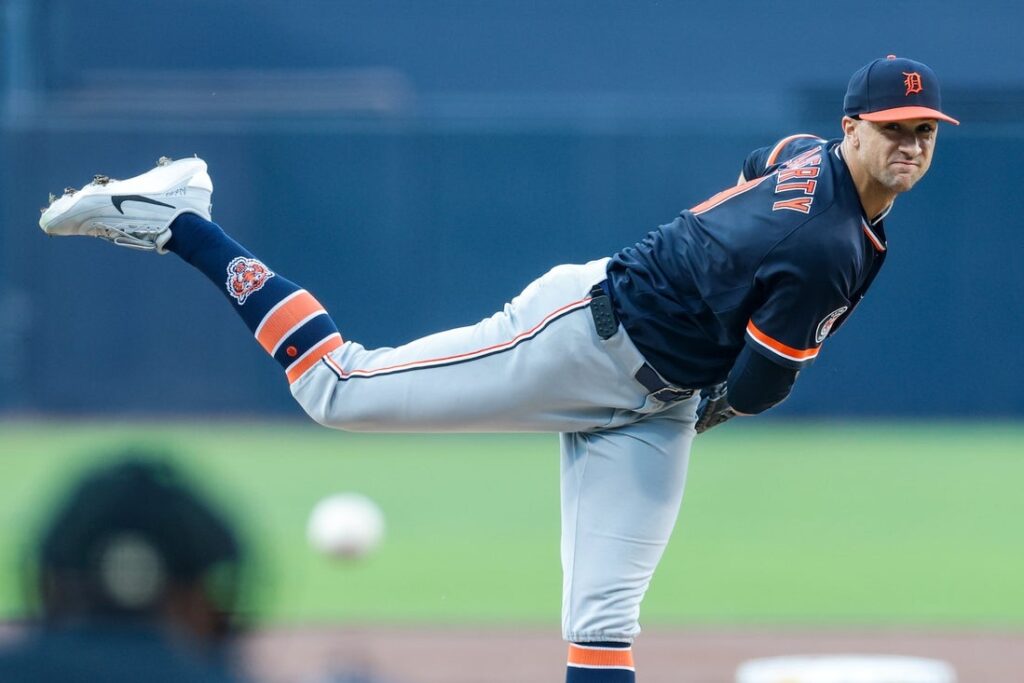
This medical red flag triggered immediate caution from Yankees General Manager Brian Cashman and his staff, evoking painful memories of past trade deadline acquisitions hampered by injury. The specter of Frankie Montas, acquired in 2022 only to contribute little due to shoulder problems, loomed large in the decision-making process. The organization’s history with Josh Donaldson, whose tenure was marred by persistent injuries after a trade, further cemented their reluctance.
“The Yankees backed out of Flaherty trade negotiations because of a lower back issue that caused him to miss a start this month,” Rosenthal’s report stated, highlighting the specific nature of the concern. For a pitcher whose mechanics and velocity are paramount, a recurring back problem represents a potentially catastrophic risk, especially for a team with deep postseason aspirations.

In the aftermath, Tigers President of Baseball Operations Scott Harris offered a contradictory public assessment, insisting Flaherty was healthy. “I can’t comment on medical stuff with trades,” Harris told reporters. “You would have to ask the other teams. Jack is healthy. If we didn’t trade him, he was going to start for us on Thursday.” This “he said, they said” dynamic underscores the high-stakes gamble of trade deadline medicine, where one team’s deal-breaking concern is another’s acceptable risk.
The Dodgers, armed with their own medical evaluations and a pressing need to bolster a rotation missing Yoshinobu Yamamoto and Clayton Kershaw for significant stretches, deemed the risk worthwhile. Los Angeles secured the 28-year-old Flaherty, who has been one of the most effective starters on the market this season. In 18 appearances for Detroit, Flaherty posted a sterling 2.95 ERA with 133 strikeouts, positioning himself as a frontline arm.
His recent form made the Yankees’ initial pursuit understandable. Over his last two starts, Flaherty dominated with a 1.53 ERA across 17.2 innings, showcasing the elite talent that made him a coveted target. For a Yankees rotation seeking stability behind Gerrit Cole and a resurgent Carlos Rodón, Flaherty represented a potential game-changer for October.
Instead, the Yankees’ pivot away from a starting pitcher led them to focus on bullpen depth, acquiring right-handers Phil Maton and Tim Hill, alongside their earlier blockbuster for slugger J.D. Martinez. The strategy appears to be one of calculated caution, prioritizing certainty over ceiling. However, the decision creates a glaring “what if” scenario that will be judged solely by postseason results.
The implications are immediate and profound for the National League landscape. The Dodgers, already a juggernaut, have added a potent weapon to their arsenal for a presumed playoff run. Flaherty immediately slots into a rotation that must navigate the remainder of the season and a deep October push. His health remains the pivotal variable; if he stays sound, the Dodgers’ calculus looks brilliant.
Conversely, the Yankees’ risk aversion will be scrutinized with every Flaherty start in Dodger blue, particularly if New York’s pitching depth is tested in the American League playoffs. The nightmare scenario for the franchise is a direct one: facing Flaherty in a potential World Series matchup where he outperforms the Yankees’ alternatives.
This eleventh-hour drama encapsulates the peril and pressure of the trade deadline, where multimillion-dollar decisions hinge on MRI scans and medical opinions. The Yankees, scarred by previous misfires, chose prudence. The Dodgers, in a relentless pursuit of another championship, embraced the gamble. The true verdict on which front office was correct will be delivered not in doctors’ offices, but on the diamond this October.
