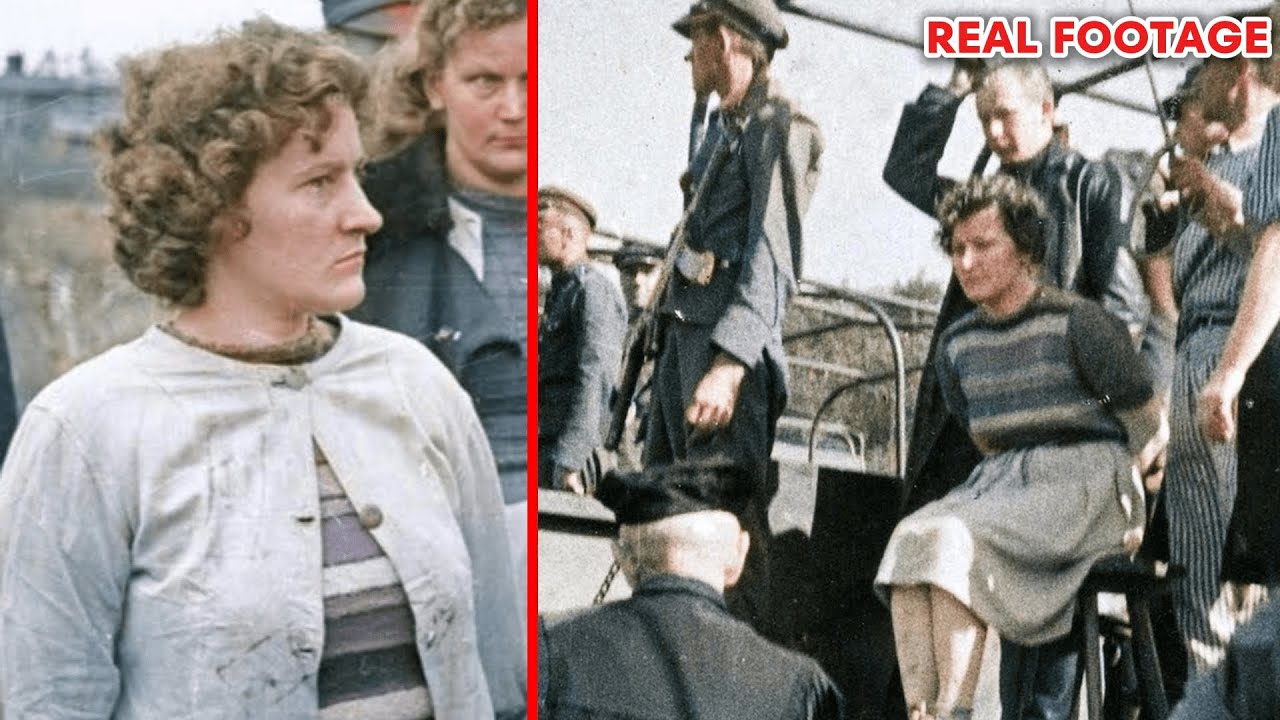
July 4, 1946. Gdańsk, Poland.
Tens of thousands of people gather beneath a blazing summer sky.
Military trucks roll slowly toward a line of specially constructed gallows.
Standing on the backs of those trucks are eleven condemned war criminals.
Among them is a 25-year-old woman.
Her name is Ewa Paradies.
Within minutes, she will be dead.
But the crimes that brought her here are so horrifying that even seasoned prosecutors struggled to describe them without emotion.
THE ORDINARY GIRL WHO BECAME A MONSTER
Born in 1920 in Pomerania, Ewa Paradies came from an ordinary Protestant family.
There was nothing remarkable about her childhood.
She left school young.
Worked factory jobs.
Lived the life of an average working-class German woman.
Had history taken a different course, she might have spent her life in complete obscurity.
Instead, she became one of the most feared female guards in the Nazi concentration camp system.
RECRUITED INTO THE WORLD OF DEATH
By 1944, Germany was losing the war.
The Nazi camp system desperately needed guards.
Women from Danzig and surrounding areas were recruited and sent for training.
Paradies arrived at Stutthof Concentration Camp, where she was trained as an SS overseer.
What happened next shocked even fellow Germans after the war.
INSIDE THE HELL OF STUTTHOF
By the final stages of World War II, Stutthof had become a place of starvation, disease, forced labor, executions, and mass murder.
Tens of thousands of prisoners suffered inside its fences.
Thousands died.
Bodies accumulated faster than crematoria could process them.
The smell of death hung constantly over the camp.
For many prisoners, survival depended entirely on the whims of guards like Ewa Paradies.
THE WOMAN WHO USED WINTER AS A WEAPON
Witness testimony later revealed acts of cruelty that horrified the courtroom.
According to survivors, Paradies forced female prisoners to strip naked during freezing winter weather.
As the women stood exposed to the cold, she allegedly poured ice-cold water over their bodies.
When the prisoners tried to warm themselves or move to escape the freezing conditions, they were beaten.
Some victims reportedly collapsed from exposure.
Others endured repeated abuse.
The cruelty became one of the most shocking accusations presented during her trial.
POWER WITHOUT MERCY
Former prisoners described Paradies as a guard who embraced her authority.
She was accused of participating in violence, abuse, and the mistreatment of prisoners even as Germany’s defeat became inevitable.
As the Third Reich collapsed around her, she continued serving in the camp system while thousands of prisoners died from starvation, disease, executions, and brutal conditions.
THE FALL OF THE THIRD REICH
In early 1945, Soviet forces advanced rapidly toward Stutthof.
The Nazis attempted to destroy evidence.
Documents were burned.
Prisoners were evacuated on deadly marches.
Chaos spread throughout the camp system.
When the war ended, Paradies attempted to disappear into civilian life.
Like many former camp guards, she hoped to escape justice.
She failed.
HUNTED DOWN
In May 1945, Polish authorities arrested her and transferred her to Gdańsk.
Soon she found herself standing trial alongside other notorious Stutthof personnel, including:
- Jenny-Wanda Barkmann
- Gerda Steinhoff
- Elisabeth Becker
- Wanda Klaff
The trial became one of the most significant postwar prosecutions of concentration camp personnel.
SURVIVORS TELL THEIR STORIES
Day after day, former prisoners entered the courtroom.
They described beatings.
Selections.
Humiliation.
Torture.
Deaths.
Witnesses specifically recounted Paradies’ alleged abuse of female prisoners during the freezing winter months.
The evidence accumulated relentlessly.
The defendants insisted they were innocent.
Many claimed they had merely followed orders.
The court rejected those arguments.
GUILTY
On May 31, 1946, the verdict arrived.
All thirteen defendants were convicted.
Eleven received death sentences.
Among them was Ewa Paradies.
She was twenty-five years old.
THE GALLOWS OF GDAŃSK
Polish authorities made a controversial decision.
The executions would not take place behind prison walls.
They would be public.
A visible demonstration that the crimes of the concentration camps would not go unanswered.
On July 4, 1946, enormous crowds gathered at Biskupia Górka Hill.
Special gallows had been constructed.
Military trucks positioned the condemned beneath waiting nooses.
Thousands watched in silence.
THE FINAL MOMENTS
The engines started.
The trucks moved forward.
The condemned were left hanging.
Among them was Ewa Paradies.
The young woman who had once been an unknown factory worker now faced the consequences of her actions before a crowd numbering in the tens of thousands.
Minutes later, she was dead.
A WARNING FROM HISTORY
The story of Ewa Paradies remains disturbing because it challenges a comforting illusion.
She was not a powerful politician.
She was not a famous military commander.
She was not born into privilege or extraordinary influence.
She was ordinary.
And that is precisely why her story continues to haunt historians.
It demonstrates how ordinary individuals can become participants in extraordinary cruelty when ideology, power, and dehumanization combine.
More than seventy years later, the ruins of Stutthof still stand as a reminder of what happened there—and of the thousands who never left alive.
