The final justice for the architects of the Third Reich descended into a grim spectacle of prolonged suffering and procedural failure, as newly examined details reveal the deeply flawed executions at Nuremberg. In the early hours of October 16, 1946, the world expected swift closure for ten of history’s most notorious war criminals. Instead, the proceedings inside the gymnasium of Nuremberg Prison became a chapter of botched executions, with multiple men taking up to twenty minutes to die.
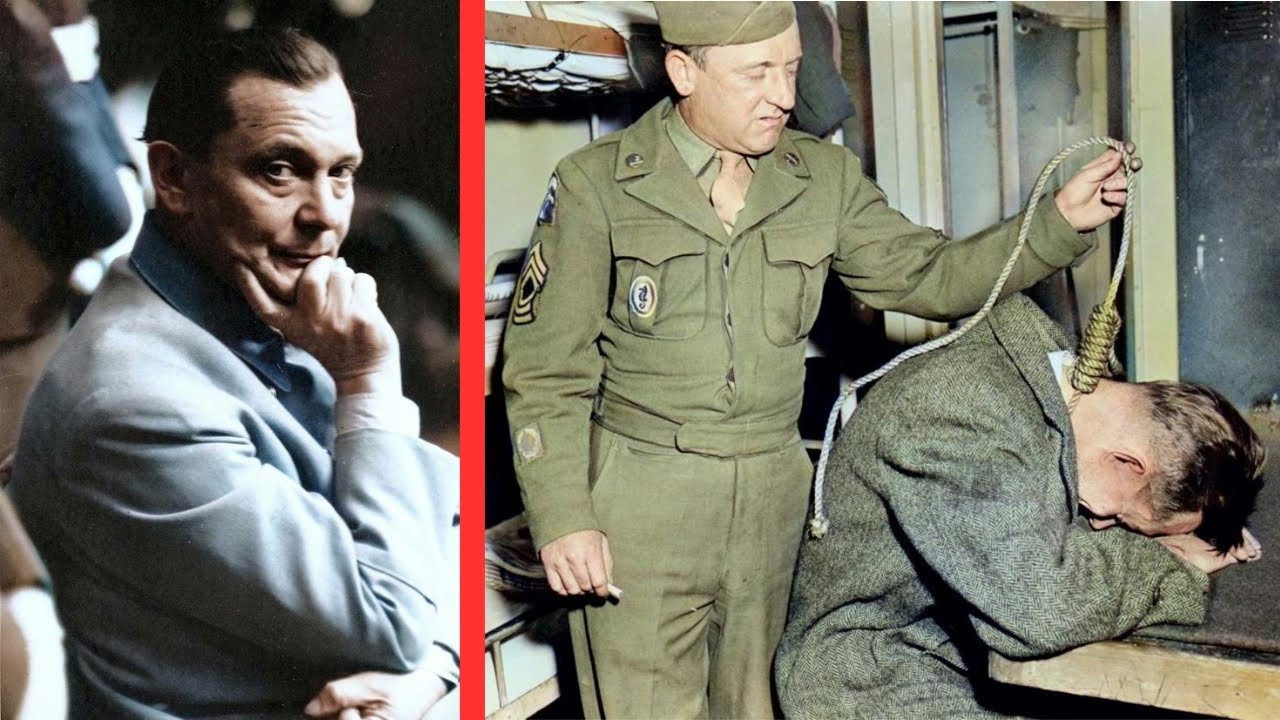 This catastrophic failure stemmed from a confluence of critical errors, beginning with the man tasked with pulling the lever. The appointed executioner was U.S. Army Master Sergeant John C. Woods, a man whose credentials were built on deceit. Woods had falsely claimed experience as a hangman in Texas and Oklahoma, states that used electrocution at the time.
His military record was equally troubling, having been previously discharged after an assessment of “constitutional psychopathic inferiority” and deemed “obviously poor service material.” This inexperienced and psychologically questionable individual was entrusted with the most significant executions of the 20th century, a decision that would have dire consequences.
Compounding Woods’ inexperience was the deliberate choice of execution method. The Americans employed the “standard drop,” a less reliable technique where the condemned fall a set distance regardless of their weight. This method often results in death by slow strangulation rather than the instantaneous neck fracture achieved by the British-preferred “long drop,” which calculates drop length based on body mass.
The very gallows were structurally inadequate for their grim purpose. The trap doors built into the wooden scaffolds were too small. As the condemned men plunged through, they struck the sides, slowing their descent and robbing the fall of the velocity needed for a quick death. One trap door also failed to latch open properly, instead swinging back violently.

This malfunctioning door struck Wilhelm Keitel and Wilhelm Frick on the head as they fell, leaving them severely bloodied before the noose even tightened. Photographs from the chamber later showed the gruesome results, with pools of blood collecting on the floor behind the execution curtain. The scene was one of brutal chaos, not clinical justice.
The suffering inflicted was extensive and documented by horrified official witnesses. Foreign Minister Joachim von Ribbentrop, the first to ascend the scaffold, took fourteen agonizing minutes to die. The intended quick snap of the rope never came, leading to death by asphyxiation. The subsequent executions followed a similarly gruesome pattern.
Perhaps the most disturbing fate was reserved for Julius Streicher, the virulently anti-Semitic newspaper editor. Witnesses reported he went down to the trap door “kicking and screaming.” After the drop, groans emanated from behind the curtain as his body swung wildly, indicating he was still conscious and struggling.

Executioner Woods then descended from the platform, stepped behind the curtain, and was seen to pull down on Streicher’s swinging body. This intervention finally ended the prisoner’s life, an act witnesses interpreted as manual strangulation. Later allegations suggested Woods had deliberately mis-tied the noose to ensure Streicher’s prolonged agony.
These allegations fit a pattern of reported behavior. Witnesses noted a small smile on Woods’ lips as he carried out his duties, and he was later said to harbor a deep hatred of Germans. His boast after the event—“I never saw a hanging go off any better”—stood in stark contrast to the horrific reality witnessed by military officials and journalists.
The macabre proceedings were also preceded by a stunning security failure. Hours before the executions, the highest-ranking defendant, Hermann Göring, cheated the gallows by ingesting a concealed cyanide capsule. An investigation suggested the poison was likely smuggled to him by a sympathetic American guard, a final act of defiance that robbed the tribunal of its most symbolic execution.

In a grim postscript, Göring’s lifeless body, clad in black silk pajamas, was later wheeled into the execution chamber and displayed to witnesses to confirm his death. His contorted face provided a silent testimony to his own chosen, yet still agonizing, end. This moment underscored the complete loss of control that had characterized the entire operation.
The Nuremberg hangings, intended to symbolize the unwavering moral authority and procedural rigor of the victors, instead descended into a spectacle that many feared mirrored the very brutality the trials sought to condemn. The flawed equipment, the inexperienced and possibly malicious executioner, and the inferior method created a perfect storm of suffering.
This failure left a complex and troubling legacy. While the guilt of the condemned was beyond doubt, the chaotic and painful nature of their deaths provided a grim counter-narrative to the ideals of justice. It served as a stark reminder that the machinery of retribution, even when wielded by the righteous, is vulnerable to human error, poor judgment, and the dark allure of cruelty.
The events of that October morning demonstrated that the mere act of punishing evil does not automatically purify the process. The flawed executions at Nuremberg remain a sobering historical footnote, a case study in how the pursuit of justice can be undermined by incompetence and a lack of humanity, even when applied to the most inhumane.
