In the final, chaotic months of World War II, American military authorities faced an immense and grim logistical challenge: delivering justice on an unprecedented scale. Their solution was found within the thick stone walls of a Bavarian prison with a darkly ironic history. Landsberg am Lech prison, where Adolf Hitler once comfortably dictated Mein Kampf, was transformed into the primary execution site for Nazi war criminals convicted by United States tribunals, earning the macabre designation “War Criminal Prison No. 1.”
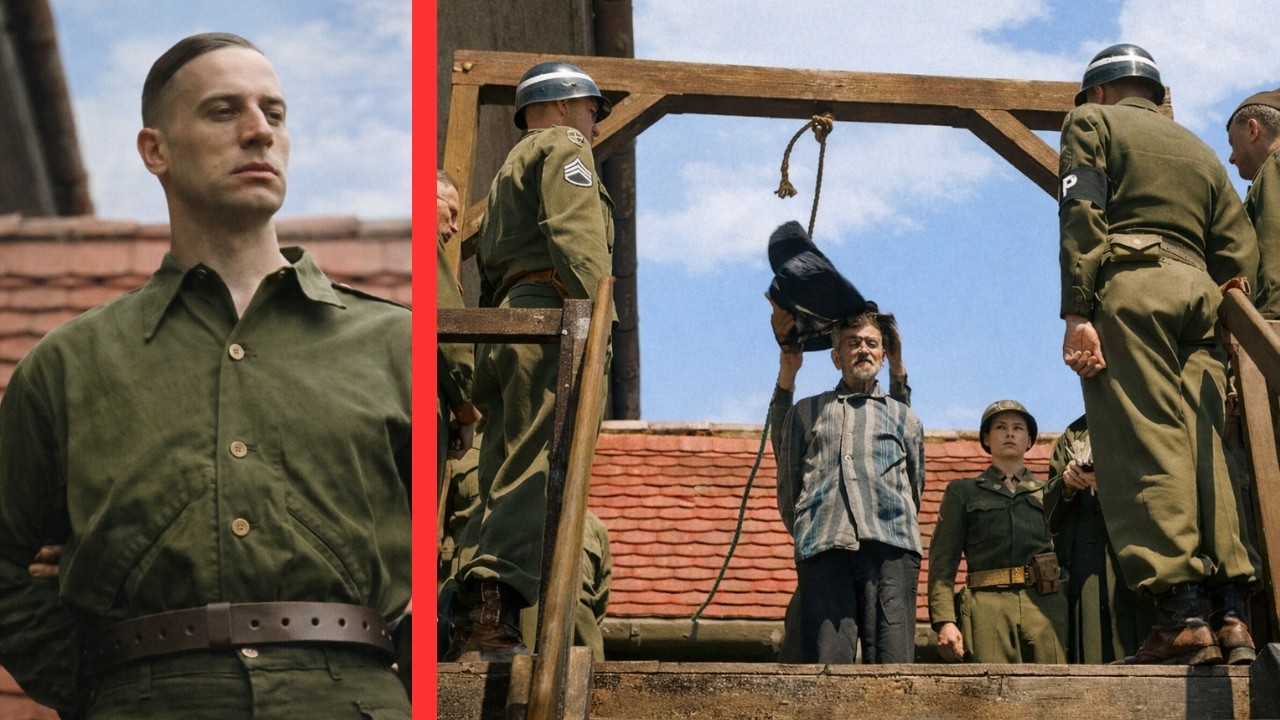 Between 1945 and 1951, the prison courtyard witnessed the hanging of 252 Nazis, a systematic and deliberate process of judicial retribution. This operation was not a spontaneous act of vengeance but a centralized, controlled program designed by the U.S. Army to efficiently carry out death sentences handed down for the century’s most horrific crimes. The choice of Landsberg was strategic, symbolic, and steeped in the brutal arithmetic of postwar reckoning.
The prison’s historical connection to the Nazi movement’s origins made it a profoundly symbolic venue. In 1924, a then-obscure Adolf Hitler served 264 days there for treason after the failed Beer Hall Putsch. His lenient imprisonment became a period of political myth-making. Two decades later, the Allies ensured the site would instead become an emblem of finality for his regime’s most devoted followers, turning a place of Nazi birth into a factory for its judicial demise.
Following Germany’s surrender, the victorious Allies were inundated with evidence of genocide and systematic atrocity. While the International Military Tribunal at Nuremberg tried the regime’s major architects, the U.S. Army conducted hundreds of its own subsequent trials, such as the Dachau trials, focusing on perpetrators directly involved in the machinery of death: SS camp guards, Einsatzgruppen killers, and complicit military officers.
 Thousands were prosecuted, with hundreds receiving the death penalty. Rather than scatter executions across the American occupation zone, military commanders centralized the grim task at Landsberg. This decision was driven by paramount concerns for security, administrative control, and secrecy, ensuring the volatile process remained insulated from public view and potential disruption by remaining Nazi sympathizers.
The legal standard applied was sweeping and historic. Courts operating under U.S. military law convicted individuals not solely for pulling a trigger, but for willingly serving within an extermination system. Guards who enforced lethal conditions, clerks who processed death transports, and doctors who selected victims for gas chambers were found collectively responsible for mass murder, a principle that generated many of the sentences carried out at Landsberg.
Hanging was the prescribed method, chosen deliberately over firing squads. American authorities were determined to frame these acts as the execution of criminals, not the honorable death of soldiers. The multiple gallows erected in the prison courtyard, built to U.S. Army specifications, allowed for the efficient, sequential carrying out of sentences, sometimes several in a single day.

The procedure was chillingly regimented. Condemned men were led from their cells, escorted by military police and a chaplain, to the wooden scaffold. After identity confirmation, they climbed thirteen steps, had hands and legs bound, and heard their sentence read. A black hood was placed over their head, the noose secured, and the trapdoor released. The chief executioner was often John C. Woods, the same man who hanged the Nuremberg defendants, whose notorious inefficiency sometimes led to prolonged, botched deaths.
Those executed represented a cross-section of the Nazi terror apparatus. Among them was Hitler’s personal escort doctor, Karl Brandt, a key architect of the T-4 “euthanasia” program that murdered a quarter of a million disabled people. SS doctors like Karl Gebhardt, Heinrich Himmler’s personal physician, who conducted brutal medical experiments on prisoners, also met their end at Landsberg.
 The prison’s physical attributes made it ideal. Its castle-like structure, deep within the U.S. zone, offered high security and isolation from German population centers. Its proximity to Dachau, where many trials were held, allowed for secure prisoner transfer. Other potential sites were rejected; Nuremberg’s prison had limited capacity, Munich was too politically volatile, and other facilities were damaged or insecure.
This centralized system allowed the U.S. to execute far more war criminals than the British or French in their zones, emphasizing a strict policy of individual accountability. The goal was both justice and deterrence, a clear signal to the German population, particularly in the Nazi heartland of Bavaria, that the ideology was extinguished and its crimes punished with finality.
The executions at Landsberg were a somber, secretive, and industrial-scale response to the industrialized murder of the Holocaust. Every death sentence in the American zone flowed to this single location, where the echoes of Hitler’s early ambitions were drowned out by the sound of falling trapdoors. It stands as a stark chapter in postwar history, where a site once integral to the rise of the Third Reich was repurposed to administer a grim, methodical closure.
