A public gallows towered over Biskupia Górka Hill in Gdańsk on July 4, 1946, as 22-year-old Elisabeth Becker, a former SS camp guard, was led before a crowd of 20,000 spectators to her death. Her public execution marked a brutal end for one of the youngest female guards tried in the aftermath of the Second World War, a deliberate spectacle of retribution staged by a nation seeking catharsis from unparalleled suffering.
 Becker, an ethnic German born in Gdańsk, was a product of Nazi indoctrination, having been a member of the League of German Girls in her youth. In 1944, seeking better pay and position, she answered a call for female guards at the nearby Stutthof concentration camp. Her tenure there was relatively short, lasting only a few months until the camp’s evacuation in January 1945, but it was marked by singular cruelty.
She rapidly gained a fearsome reputation among prisoners. Testimony and her own initial admissions revealed she personally selected at least thirty women deemed unfit for work, condemning them to death in the camp’s small gas chamber. This act of direct murder formed the core of the charges against her when she was arrested following the war and placed on trial in the first Stutthof trials conducted by the Polish Special Law Court.
 At her trial, Becker retracted her earlier confession, but the evidence was damning. She was found guilty of war crimes and sentenced to death by hanging. Notably, the court itself recommended her sentence be commuted to fifteen years’ imprisonment, acknowledging her shorter service and the fact that other guards tried alongside her had committed more widespread atrocities. Becker also appealed directly to Polish President Bolesław Bierut for clemency.

All appeals were denied. The decision to carry out the execution, and to do so publicly, was a calculated political and psychological act. Poland had endured unimaginable devastation under Nazi occupation, and the new authorities were determined to demonstrate that justice was being delivered in the most visible way possible. The execution of local collaborators and camp personnel, like Becker, was meant to provide a form of closure and a tangible symbol of Nazi defeat.
The gallows were constructed to be enormous, ensuring the thousands gathered—many of them survivors or relatives of victims—had an unobstructed view. The method of hanging was also specifically chosen to prolong the moment of death. Unlike a standard long-drop execution designed to break the neck instantly, the condemned were forced to stand on the back of a truck. A noose was placed around their necks, and the truck was then driven away, leaving them to strangle slowly, their struggles visible to all.
 Adding a layer of poetic justice, the executioner who placed the noose around Elisabeth Becker’s neck was reported to be a former Stutthof prisoner, a man who had once been under her authority. Alongside four other female guards from Stutthof, the 22-year-old met her end in this protracted manner, her death agonies lasting several minutes before her body went limp.
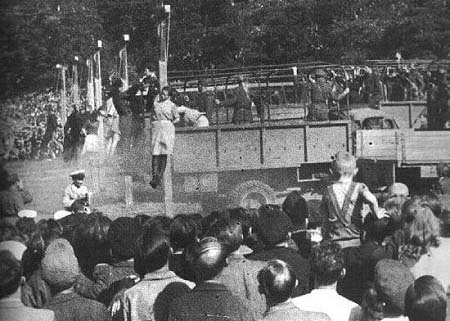
The massive, vengeful crowd watched on, a reaction described by observers as a mix of grim satisfaction and sadistic enjoyment, a raw reflection of the deep trauma inflicted by the occupation. The public hanging of Elisabeth Becker was not merely the execution of a war criminal; it was a violent ritual of national reckoning, a stark and brutal performance intended to draw a definitive line between the horrors of the past and a future under a new regime. It remains one of the most stark examples of postwar retribution, a moment where the abstract concept of justice was rendered in the most visceral and public terms imaginable.
