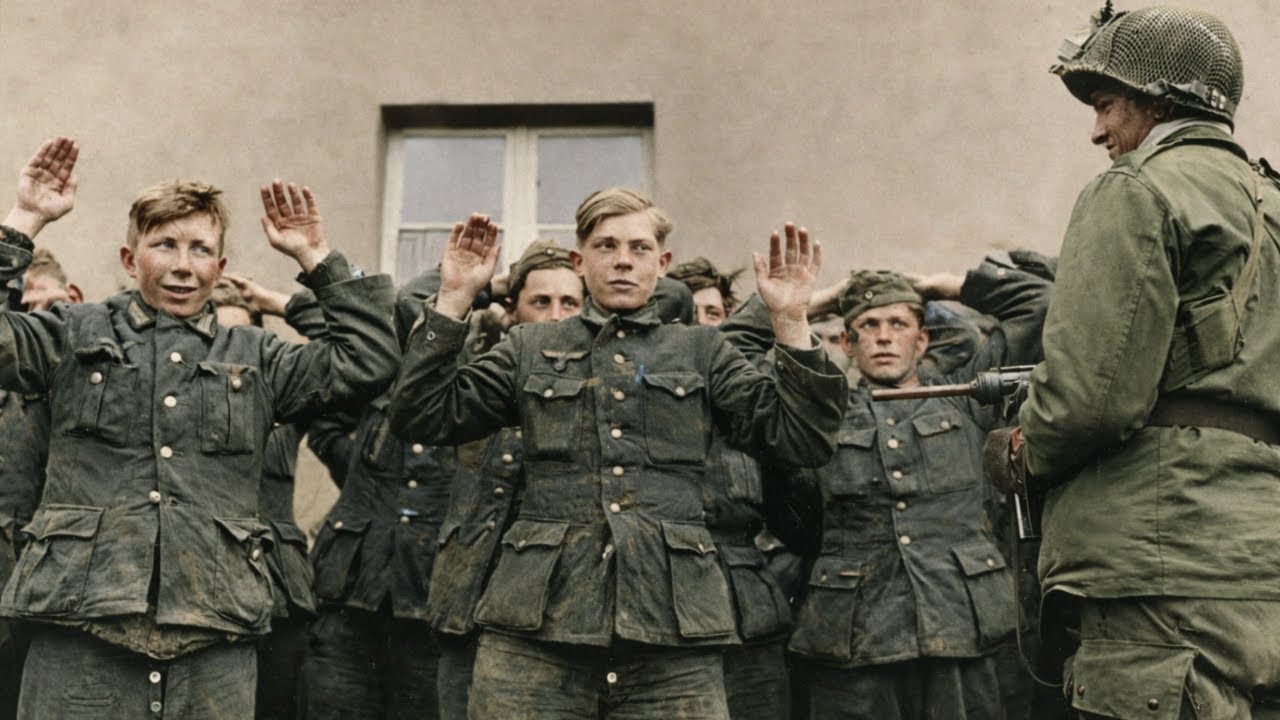
In the collapsing chaos of the Third Reich’s final days, the world witnessed a horrifying new low: children in oversized uniforms, armed with anti-tank rockets and rifles, being captured on the battlefield. These were the last soldiers of Nazi Germany, some as young as twelve, deployed as a desperate final measure against the advancing Allied armies. Their capture by American, British, and Soviet forces revealed the utter moral bankruptcy of a regime willing to sacrifice its own youth.
 As Soviet forces closed in on Berlin and Western Allies pushed deep into Germany, adult manpower had been utterly exhausted. Facing total annihilation, the Nazi command turned to its most indoctrinated resource: the Hitler Youth. What began in 1933 as a compulsory paramilitary youth organization, masquerading at times as a scouting movement, had by 1945 become a pool of over eight million boys psychologically prepared for fanatical sacrifice.
The transition from ideological training to frontline combat was brutally swift. One boy recounted receiving only a few hours of instruction on the Panzerfaust anti-tank weapon before being issued an SS uniform and sent directly to the front. These children were not volunteers in any meaningful sense; they faced the threat of execution for desertion, with their families often suffering similar punishment. Posters of hanged deserters in city streets served as a constant, grim warning.
When Western Allied soldiers encountered these child combatants, the reaction was often one of profound shock and pity. Photographs of captured boys, dwarfed by their helmets and gear, circulated globally, solidifying the image of the Nazi state as uniquely cruel. Allied troops, many of whom were fathers themselves, recognized the tragic reality: these were children forced into a war they did not choose.

Under the established laws of war, these uniformed and armed youths were considered legal combatants. This technicality is a primary reason they were captured rather than summarily executed upon surrender. As they engaged in direct combat, operating under military command structures, they were entitled to prisoner of war status upon capture. The Western Allies, in particular, adhered to this protocol, separating the minors from adult POWs and often treating them with a degree of compassion.
The contrast with the Eastern Front was stark and often fatal. The Soviet Red Army, which had suffered unimaginable brutality at the hands of the Nazis, frequently showed no such distinction. To many Soviet soldiers, a uniformed enemy holding a weapon was a legitimate target, regardless of age. Numerous child soldiers were shot on sight, a brutal reflection of the war’s savage nature in the east.

For the boys captured by the Americans and British, processing into POW camps was a surreal and terrifying experience. They were disarmed, detained, and removed from active combat zones primarily because they still represented a potential threat. Returning any enemy soldier to the fight, even a child, risked them taking up arms again. Inside the camps, however, they were generally safe. Many were released within weeks or months of Germany’s unconditional surrender in May 1945.
The aftermath for these children was a life defined by trauma. They returned to a homeland in ruins, often to discover their families had been killed in bombing raids or battles. They carried a complex burden of shame, having fought for a genocidal regime, yet also being its undeniable victims. This duality challenged early postwar narratives of collective German guilt, gradually fostering a view of these boys as casualties of Nazi indoctrination.

The deployment of child soldiers culminated in the apocalyptic Battle of Berlin. Boys armed with Panzerfausts were ordered to ambush Soviet tanks from ruined buildings, missions tantamount to suicide. This final, futile sacrifice underscored the regime’s nihilistic endgame: it was prepared to destroy Germany’s future to prolong its own existence by mere hours.
Historians now view the capture of these children not as a minor footnote, but as one of the most searing indictments of the Nazi regime. It demonstrated a state so morally corrupt and strategically bankrupt that it would willingly feed its own children into the inferno. The images of those captured boys stand as eternal testament to a system that, in its death throes, consumed the very generation it claimed to build its thousand-year future upon. Their story is a dark lesson on the ultimate cost of fanaticism and the human tragedy forged when a society weaponizes its youth.
