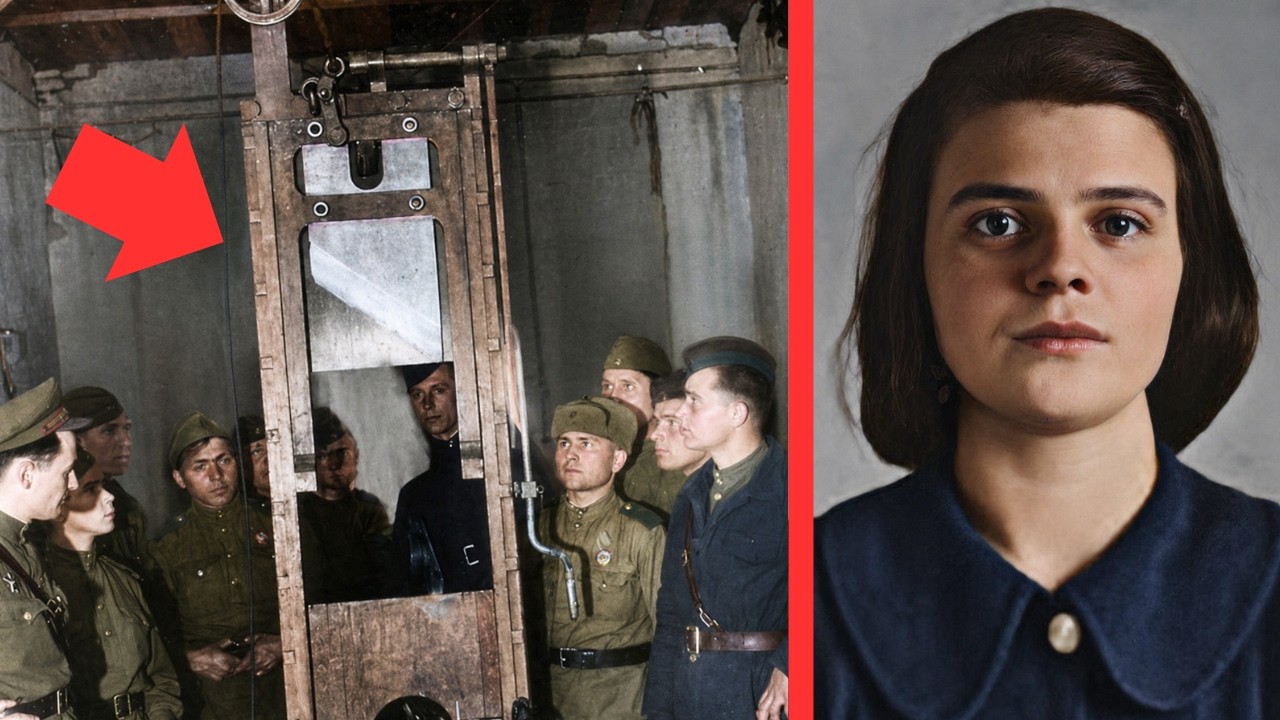
February 22nd, 1943.
Inside Munich’s Stadelheim Prison, a bell echoed through the cold corridors announcing another execution. A 21-year-old university student was led from her prison cell toward a waiting Nazi guillotine.
No screaming.
No begging for mercy.
No tears.
Sophie Scholl knew exactly what was about to happen.
Only hours earlier, Hitler’s infamous People’s Court had sentenced her to death for treason. Her crime was shockingly simple:
She had dared to oppose Adolf Hitler and expose the horrors of the Nazi regime through anti-war leaflets distributed at her university.
By nightfall, the Nazis would sever her head with a steel blade.
THE GIRL WHO ONCE BELIEVED IN HITLER
Today, Sophie Scholl is remembered as one of Germany’s greatest resistance heroes.
But as a child, she had actually joined the Nazi youth movement herself.
At just 12 years old, Sophie entered the League of German Girls — the female branch of the Hitler Youth. Young girls there were taught obedience, motherhood, cooking, and absolute loyalty to Nazi ideology.
Her brother Hans was even more devoted at first.
He became a standard bearer at major Nazi rallies and appeared to be a model member of Hitler’s youth movement.
But eventually, both siblings began realizing the terrifying truth:
The Nazis were brainwashing an entire generation.
Sophie started reading banned literature and questioning the dictatorship. Together with friends at the University of Munich, she helped create one of the most famous resistance groups in Nazi Germany — The White Rose.
THE LEAFLETS THAT SIGNED HER DEATH WARRANT
The White Rose secretly printed anti-Nazi pamphlets calling on Germans to resist Hitler’s regime.
The leaflets condemned the war, exposed Nazi atrocities, and appealed to morality, religion, and human conscience. In Nazi Germany, even possessing one of these papers could mean execution.
Sophie became one of the group’s key members.
Because she was a woman, the resistance believed she was less likely to be searched by the SS or Gestapo. But that illusion shattered on February 18th, 1943.
Sophie and Hans arrived at the University of Munich carrying a suitcase packed with forbidden leaflets.
They quietly placed stacks outside lecture halls for students to discover later. But then Sophie made one fatal mistake.
Seeing extra pamphlets still left over, she climbed to the top floor balcony and threw hundreds of leaflets down into the university atrium below.
Paper suddenly rained through the building like snow.
But someone saw everything.
A university janitor named Jakob Schmid — a loyal Nazi Party member — immediately reported the siblings to the Gestapo. Within minutes, Sophie and Hans Scholl were arrested.
THE NAZI JUDGE WHO SCREAMED DEATH SENTENCES
After brutal interrogation sessions, Sophie was dragged before the People’s Court.
Waiting for her was Roland Freisler — Hitler’s terrifying “screaming judge” notorious for humiliating defendants while sentencing them to death.
But Sophie refused to break.
Standing before the court, she boldly declared:
“What we wrote and said is believed by many others. They just don’t dare express themselves as we did.”
The verdict had already been decided long before the trial began.
Death by guillotine.
Sophie, her brother Hans, and their friend Christoph Probst would all be executed that very same day.
THE FINAL WALK TO THE GUILLOTINE
Back inside her prison cell, Sophie spoke calmly about her approaching death.
She reportedly said:
“What does my death matter if thousands are awakened through our actions?”
Shortly before 5 PM, guards arrived to collect her.
The prison bell rang again, informing every inmate inside Stadelheim that another execution was about to take place.
Waiting inside the execution chamber stood the “Fallbeil” — the German version of the guillotine.
Unlike the massive French guillotines used during the Revolution, this Nazi execution machine was compact, metallic, and designed for maximum speed and efficiency. The Third Reich used it to execute political prisoners by the thousands.
The executioner that day was Johann Reichhart.
Over his career, he would kill more than 3,000 people.
“THE BRAVEST PERSON I EVER SAW”
As Sophie entered the chamber, prison officials confirmed her identity.
Then Reichhart and his assistants grabbed the young woman and forced her beneath the blade. Unlike older guillotines, victims were not always strapped down. Guards simply held Sophie in place.
Seconds later, the executioner released the mechanism.
The heavy steel blade crashed downward and instantly sliced through Sophie Scholl’s neck. Her severed head reportedly fell directly into a bucket beneath the machine.
The entire execution lasted only seconds.
Later, Johann Reichhart allegedly said Sophie Scholl was:
“The bravest person I ever saw go to the guillotine.”
Only two minutes later, Hans Scholl was executed the same way.
Five minutes afterward, Christoph Probst was also beheaded.
Three young lives erased in less than ten minutes.
THE STUDENT WHO BECAME IMMORTAL
The Nazis intended to silence Sophie Scholl forever.
Instead, they transformed her into a symbol of courage, resistance, and moral defiance against tyranny.
Today, Sophie Scholl is remembered around the world as one of the bravest women of the 20th century — a university student who stood against one of history’s most brutal regimes and paid for it beneath the blade of a Nazi guillotine.
