KHARKOV CITY SQUARE, UKRAINE – DECEMBER 19, 1943: In a frozen public square packed with 50,000 onlookers, four men mounted wooden stools on the backs of trucks as nooses were tightened around their necks. Within minutes, the architects of a two-year reign of terror in this Ukrainian city dangled lifeless before the citizens they had tormented, marking a historic first reckoning for Nazi war crimes.
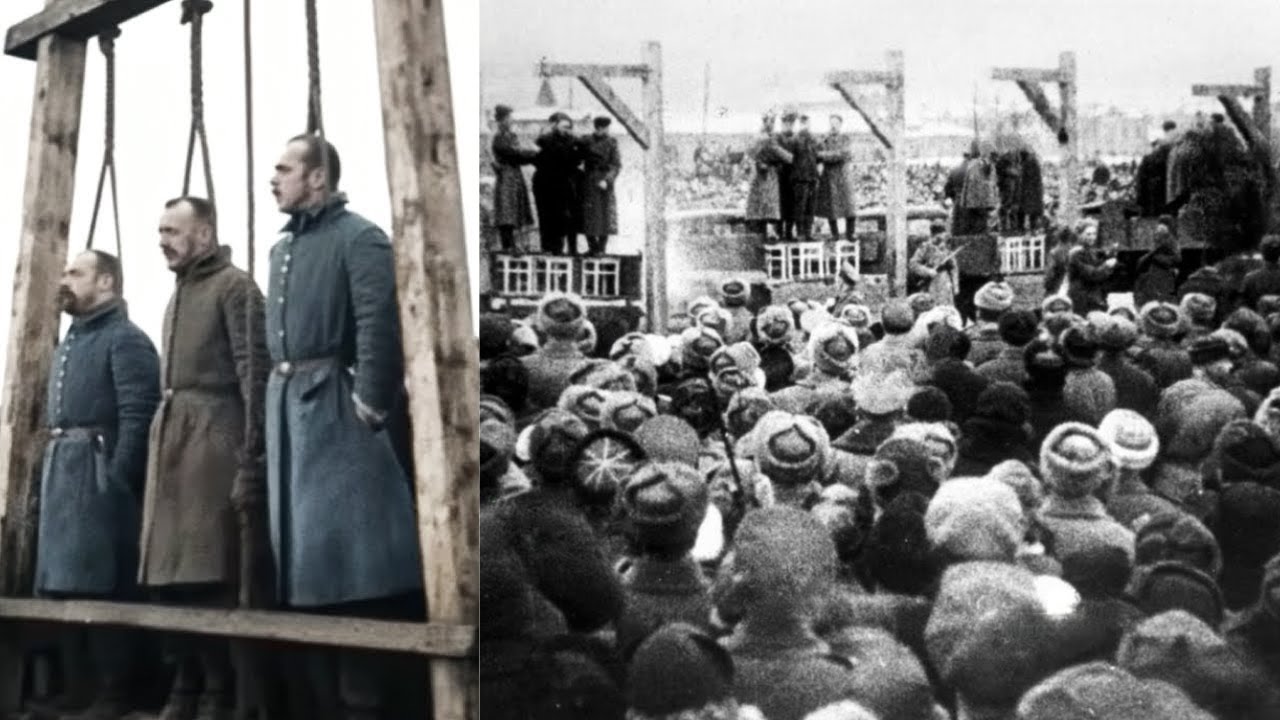 The execution of Germans Wilhelm Langheld, Hans Ritz, Reinhardt Retzlaw, and Soviet collaborator Mikhail Bulanov followed a landmark four-day public trial. It was the first time Allied forces tried and executed German personnel for atrocities during the ongoing World War II, setting a direct precedent for the Nuremberg tribunals to come. The crowd’s breath rose in clouds in the sub-zero air, their eyes fixed on the gallows.
Their crimes, confessed to in shocking detail during the proceedings, narrated a systematic campaign of extermination. The nightmare for Kharkov began with its capture by Nazi forces on October 24, 1941. The city, a vital industrial hub producing T-34 tanks and other war matériel, was a key strategic prize for Hitler’s war machine.
German occupation policy, guided by the criminal “Reichenau Order,” declared a war of annihilation against Jews, communists, and Slavic civilians deemed “subhuman.” What unfolded was a calculated horror. Days after the takeover, the murder of approximately 200 civilians, mostly Jews, hanged from city balconies, served as a grim public warning.
The slaughter escalated with industrial efficiency. On December 15, 1941, in temperatures of -15°C, an estimated 15,000 Jews were marched to the Drobitzky Yar ravine. SS Sonderkommando 4a, under Paul Blobel, systematically shot thousands. To conserve ammunition, German soldiers threw living children into the mass graves to freeze to death.
 By early 1942, a new tool of terror prowled the streets: the gas van. Modified to pipe carbon monoxide exhaust into an airtight rear compartment, these mobile chambers of death asphyxiated victims by the dozens. The German army simultaneously confiscated food supplies, starving the remaining population.
Medical facilities offered no sanctuary. The Gestapo executed 435 patients at a local hospital, nailed the doors shut, and incinerated the building with those inside. Wounded Soviet soldiers attempting to crawl from windows were shot by waiting troops. In March 1943, another 800 wounded Red Army soldiers were burned alive.
Throughout the region, more than 30,000 innocent civilians were shot, hanged, burned, or gassed. When Soviet forces permanently liberated Kharkov in August 1943, virtually the entire Jewish population had been eradicated. The discovery of mass graves set the stage for justice.
The trial, held in Kharkov’s House of Trade Unions, was a meticulously documented judicial process. Each defendant was provided counsel and all proceedings were translated into German. The courtroom heard testimony that laid bare the barbarity.

Wilhelm Langheld, 52, a German military official, admitted to fabricating cases that led to the execution of approximately 100 Soviet citizens. He coldly described a system of violence, recounting how a child clinging to its dead mother was shot by a lance corporal who “got tired of this.”
Hans Ritz, 24, an SS officer, supervised wholesale shootings. He beat prisoners with iron rods during interrogations. Reinhardt Retzlaw, 36, tortured civilians by plucking out hair and stabbing them with needles. He personally herded victims into the gas vans and helped burn the bodies.
Mikhail Bulanov, 26, a Soviet citizen, voluntarily served the Gestapo as a driver. He participated in gas van executions and helped lure sick children from a hospital with promises of safety, only to deliver them to pits where each was shot in the head.
 All four pleaded guilty. Their defense—that they were following orders—was rejected by the court, citing legal precedent. The military tribunal found them guilty of atrocities and sentenced them to death by public hanging.
On the morning of December 19, the sentences were carried out. American journalist Edmund Stevens, witnessing the scene, reported the condemned were hoisted onto the trucks. Bulanov fainted; Ritz and Retzlaw turned “pasty white.” Only Langheld, the old soldier, remained rigid.
At a signal, the trucks drove away. The four men dropped, but not far. The “short drop” method used meant death came not from a broken neck but from slow, agonizing strangulation that lasted up to twenty minutes. A loud cheer erupted from the immense crowd.
The Kharkov trial and executions sent a seismic message: there would be accountability for crimes against humanity. It demonstrated that the defense of superior orders held no weight in the face of such grotesque evil. The 30,000 souls lost in Kharkov’s streets, hospitals, and ravines were symbolically avenged.
This moment of raw justice, played out before a scarred city, stands as a dark but definitive milestone in international law. It proved that even amidst total war, a framework for prosecuting systematic atrocity could be built, paving the way for the global reckoning that would follow Germany’s defeat.
