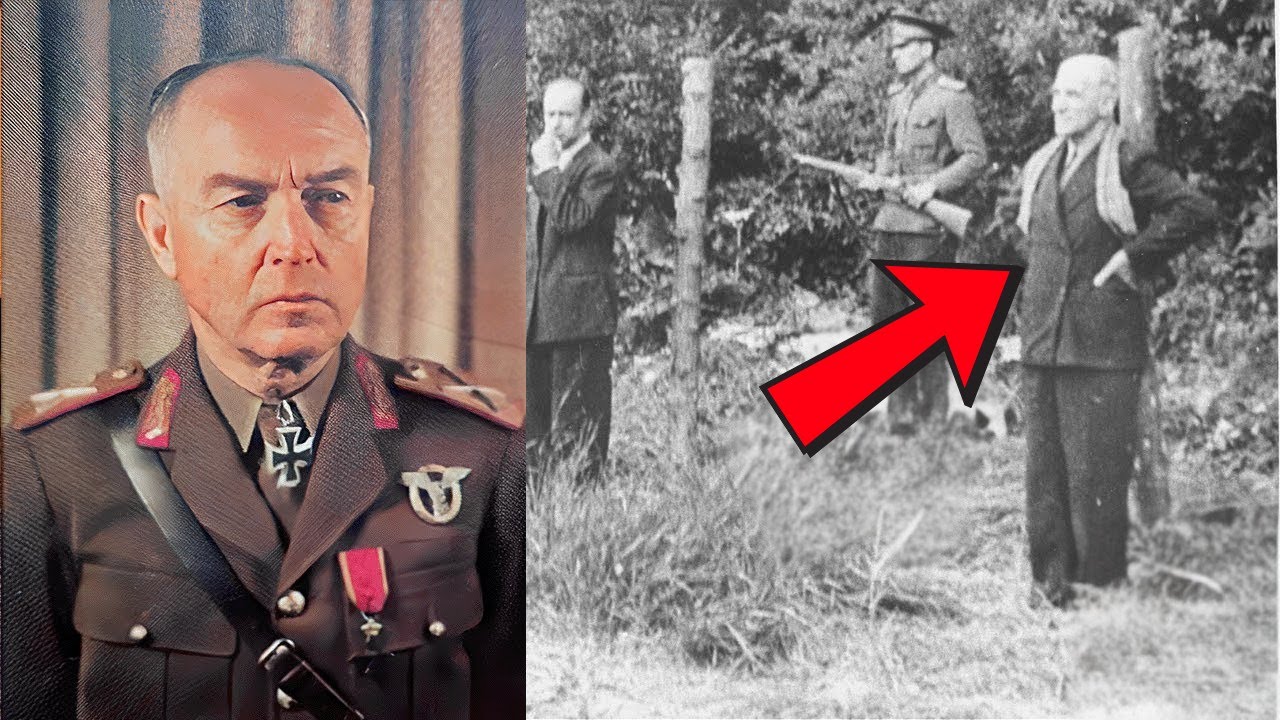
The final reckoning for one of World War II’s most brutal dictators came at dawn in a Bucharest prison yard. Ion Antonescu, the former Prime Minister and Conducător of Romania, faced a military firing squad on June 1, 1946, answering for crimes that stained his nation’s history with blood.
 His execution closed a dark chapter of genocide and alliance with Nazi Germany, but the path to that moment revealed a complex story of ambition, betrayal, and staggering violence. Antonescu’s regime was directly responsible for the deaths of hundreds of thousands of Jews and Roma, making Romania the second-largest perpetrator of the Holocaust.
The dictator’s rise was forged in early 20th-century conflict. A cavalry officer celebrated for crushing a peasant revolt with savage efficiency, Antonescu ascended through military ranks, earning a reputation for ruthless discipline. By September 1940, with King Carol II’s government collapsing, he was appointed Prime Minister.
Within 48 hours, Antonescu executed a ruthless coup, forcing the king’s abdication and installing himself as dictator with King Michael I as a powerless figurehead. Faced with the menace of Nazi Germany and the Soviet Union, Antonescu made a fateful calculation, aligning Romania irrevocably with Adolf Hitler.
This alliance sealed Romania’s complicity in the Holocaust. Antonescu’s primary motive was securing protection for his country, but the price was its soul. Romania’s oil fueled the Nazi war machine, and its soldiers joined the invasion of the Soviet Union in June 1941.
The siege of Odessa proved catastrophic, with nearly 100,000 Romanian casualties. When the city fell, a horrific retaliation was ordered. After a bombing at Romanian military headquarters on October 22, 1941, Antonescu blamed the Jewish population.

What followed was a three-day massacre of unimaginable brutality. Romanian forces, aided by German units and local collaborators, systematically murdered between 25,000 and 34,000 Jews. Victims were shot in mass graves or burned alive in locked warehouses.
Antonescu coldly dismissed the atrocity as a justified reprisal. He ordered the deportation of tens of thousands more on death marches to camps like Bogdanovka, where they were slaughtered. His own words captured his monstrous mindset, stating he did not care if all of them died so long as no Romanian officer perished.
As the war turned against the Axis, Romania suffered apocalyptic losses, with over 350,000 soldiers dying for Hitler’s cause. By August 1944, with Soviet forces advancing, King Michael I orchestrated a daring coup. Antonescu was arrested, and Romania switched sides, declaring war on Germany.
The deposed dictator was handed to Soviet authorities, enduring interrogation in Moscow’s Lubyanka prison before being returned to Romania for trial. In May 1946, he stood before the People’s Tribunal in Bucharest, charged with crimes against peace, treason, and crimes against humanity.

The ten-day trial presented overwhelming evidence of his role in the Holocaust. Antonescu admitted to and attempted to justify the deportations and the Odessa massacre, though he minimized his direct responsibility. The tribunal found him guilty on all counts.
Appeals and pleas for clemency, including one from his mother to King Michael, were swiftly rejected under pressure from the Soviet-backed government. The decree for his execution was signed.
On the morning of June 1, Antonescu was led to a clearing near Jilava Prison known as the Valley of the Peach Trees. He was accompanied by four other condemned officials, including his foreign minister and the governor of Transnistria.
Photographs show Antonescu standing with stern composure, his arms crossed. He refused a blindfold and, as the firing squad took aim, raised his hat in a final salute. A volley of shots ended his life instantly.

Subsequent investigations by the Romanian government concluded Antonescu was personally responsible for the deaths of approximately 400,000 people. A state report stated clearly that Romania bore responsibility for more Jewish deaths than any Axis ally except Germany itself.
In his final written statement, a letter to his wife, Antonescu urged her to withdraw to a convent and expressed a bitter belief that posterity would reconsider his deeds, accusing Romanians of ingratitude. His legacy remains a painful scar.
The political aftermath was profound. The war’s devastation and Antonescu’s fascist rule created conditions that helped usher in decades of communist dictatorship under Nicolae Ceaușescu, who later noted that without Antonescu’s barbarism, communism may not have taken root.
For the nation, the execution was a grim but necessary step in confronting a past defined by complicity in genocide. Romania would lose another 167,000 soldiers fighting against its former Axis allies, bringing total wartime casualties to over half a million.
The story of Ion Antonescu serves as a harrowing lesson on the consequences of absolute power, ideological hatred, and the tragic cost paid by nations when leaders choose tyranny over humanity. His death did not erase the atrocities, but it marked a definitive end to his rule of terror.
