The quiet man in the methadone clinic on Christmas morning in the early 1990s, standing in a line of the sick and the shaking, was a ghost of rock and roll royalty. He had once held the most coveted job in music, walking out in front of a quarter of a million people at the age of 20, his fingers gliding over some of the loveliest passages the Rolling Stones ever committed to tape. He had walked away from it all before he was 26.
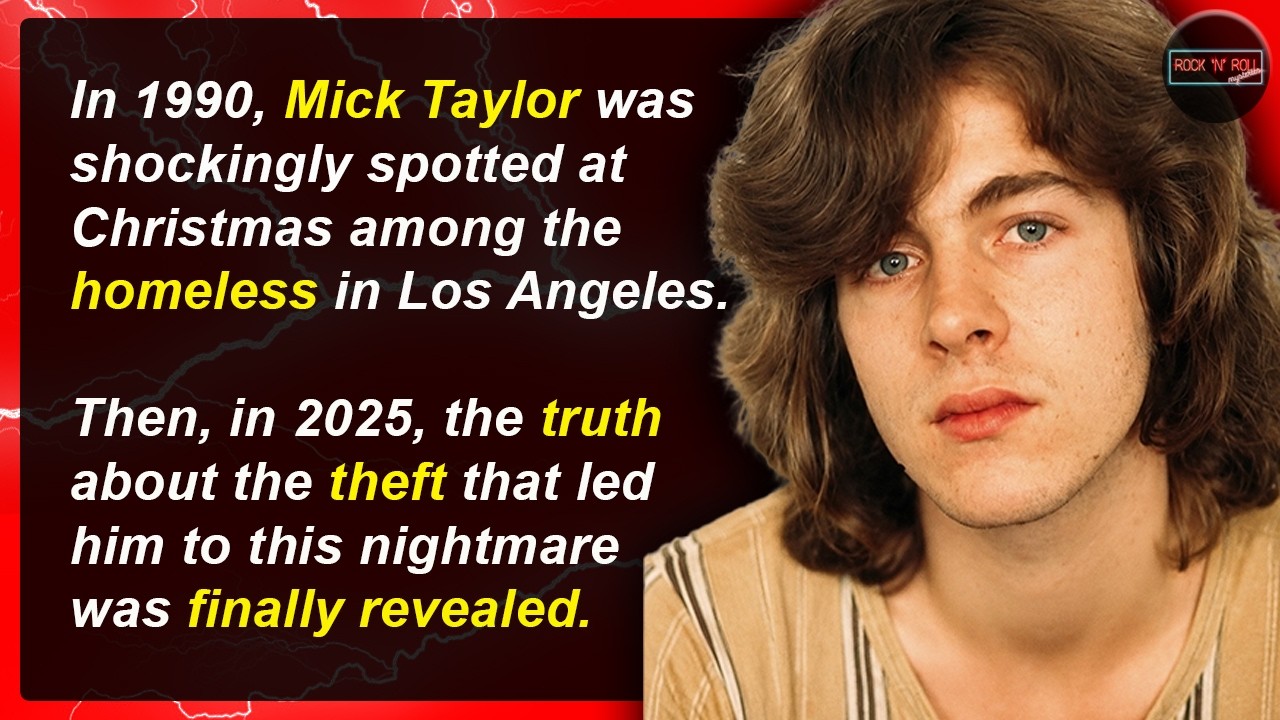
His name was Michael Kevin Taylor, known to the world as Mick Taylor, and the question of how a man goes from the peak of the biggest band on earth to a cue for methadone on the birthday of Jesus is not really a question about drugs at all. It is instead a question about a door, and about the courage or the foolishness of a young man who looked at paradise and decided to leave.
 Born on the 17th of January 1949 in Welwyn Garden City, one of those tidy optimistic English new towns laid out between the wars as an antidote to the soot of London, Taylor was raised a few miles down the road in Hatfield. His father worked as a fitter for the De Havilland Aircraft Company, and the family home was a working-class house with an ear turned toward music. His parents took him to see Bill Haley and the Comets, a band that shared a name with the aircraft his father worked on, and the boy came home completely rearranged.
At the age of nine, he picked up a guitar, taught his first chords by his mother’s younger brother, and he never really put it down again.
By his early teens, the Hatfield kid had become a local prodigy, playing in bands with names like the Juniors and the Strangers, and then a harder, more ambitious outfit rather modestly called the Gods. That band included a young keyboard player named Ken Hensley, later of Uriah Heep, and they were good enough that in 1966 they opened for Cream at the Starlight Ballroom in Wembley. Taylor, still a teenager, was already breathing the same rarified air as Eric Clapton, who was quite literally known as God.
He had bought his first Gibson Les Paul from Selmer’s in London in 1965, a guitar that would later become part of his legend.
The story of how he turned professional sounds like a fable, and like all fables, it has been improved with each retelling. On the 18th of April 1966, aged 17, he went to see John Mayall’s Bluesbreakers play a little hall called the Hop in his hometown. Eric Clapton was booked to appear but did not show up for one reason or another.
Taylor, with the balls of a teenager who knows exactly what he can do, walked up to Mayall and offered to fill in. He got up, played a set that made the older men on stage turn their heads, and then rather than bask in it, he slunk back into the crowd and left the building before Mayall could even ask his name. It was the first documented instance of a lifelong habit, Mick Taylor’s genius for the early exit.
The following year, when Peter Green quit the Bluesbreakers to build Fleetwood Mac, Mayall placed a guitarist wanted advertisement in Melody Maker. Out of all the strivers in England, the kid who had vanished from the Hop was the one who answered it. His debut with the band at an old blues club at the Manor House in North London brought the crowd bristling with the appetite people once had at public executions.
Word had gone round that some teenager was going to try to replace Eric, and either tragedy or comedy was anticipated, or both. However, he did not merely replace him. The crowd was awed, and so was everyone else.
Over three years, on albums such as Crusade and Bare Wires, Taylor built a style that was blues to the marrow, but shot through with jazz and Latin phrasing. It had a fluency and a sweetness of tone that had no obvious precedent in English rock. It was in these Bluesbreakers years in 1967 that he came into possession of the guitar that would become his most infamous, a sunburst 1959 Les Paul he bought from Keith Richards himself.
This was an instrument Keith had once played on the Ed Sullivan Show, so two years before Taylor joined the Rolling Stones, a piece of their history had come into his hands.
Then in the summer of 1969, the telephone rang with the offer that would both define and deform the rest of his life. The Rolling Stones had reached the end of the road with Brian Jones, their beautiful doomed founder, whose appetites had rendered him useless in the studio and unwelcome in the band he had started. Mayall and the Stones pianist Ian Stewart mentioned the name of the quiet kid from the Bluesbreakers, and Mick Jagger picked up the phone.
Taylor humbly assumed he was being hired for an afternoon. He believed he was a session man brought in to plug a gap, and he walked through the studio door without the hunger and nerves a lesser talent would have brought with him.
Jagger and Keith Richards heard something they wanted and asked him back the next day and the next, and then simply didn’t let him leave. He overdubbed guitar onto Live with Me and Country Honk for Let It Bleed, and onto the swaggering single Honky Tonk Women, released in Britain on the 4th of July 1969. He had joined the Rolling Stones almost by accident, and by his own admission, he was never quite a believer.
I sort of liked them, he would say, in a line no press officer would ever have scripted, but was never passionate about the Stones.
His initiation into the band was a baptism not of water, but of death. On the 3rd of July 1969, barely a month after Taylor’s first sessions, Brian Jones was found at the bottom of a swimming pool at his Sussex farmhouse, 27 years old and gone. Two days later, on the 5th of July 1969, the Rolling Stones went ahead with a free concert in Hyde Park that had been planned as a coming out party for their new guitarist and turned overnight into a wake for the old one.
A crowd estimated at a quarter of a million people spread across the London grass. Jagger, dressed in a white smock, read from Shelley and released hundreds of white butterflies into the summer air, although a good number of them were already dead in their boxes, a detail so morbidly poetic that perhaps only Shelley might have dared to invent it.
There, 20 years old, blinking in the heat and the enormity of it, stood Mick Taylor playing his first gig with the most dangerous band in the world at the funeral of the man whose throne he now occupied. It was a fittingly gothic overture, and everything that followed would carry the same doubleness, the coronation and the shadow together, the triumph never quite able to shake off the death that shared its stage. If Hyde Park was a funeral, Altamont on the 6th of December 1969 was something closer to a vision of hell.
The free California concert where Hell’s Angels beat the crowd with pool cues and a young man named Meredith Hunter pulled a gun and was stabbed to death near the lip of the stage while the Stones played on. All of it caught in the documentary Gimme Shelter. Taylor, five months into the job, watched the utopian promise of the decade die from a few feet away.
 Yet on stage, night after night, something extraordinary was happening. The live album Get Yer Ya-Ya’s Out, cut in New York and Baltimore in November 1969, caught a band suddenly and ferociously improved. The reason was the young man with the golden tone.
On the road, he was a curiosity as much as a musician, androgynous, cherubic, so pretty that Truman Capote, dispatched to profile the band in 1972, later dismissed him to Johnny Carson on television as pretty, a little Jean Harlow blonde type, but dumb. The band called him Little Mick, and the nickname carried a whiff of condescension he would spend years resenting. He was shy, sober-faced, monosyllabic with the press, and he let his hands do the talking because on stage, at least, they were more articulate than anyone else in the place.
The greatest moment arrived on Sticky Fingers in 1971, the record with Andy Warhol’s working zipper stitched into its sleeve. It was the first true Mick Taylor album, and the one on which the world finally understood what the Stones had stumbled into. During the sessions for Can’t You Hear Me Knocking, the band ran through what was meant to be a tight three-minute number and reached the point where it should have stopped.
Then Taylor kept going. I just felt like carrying on playing, he said, as if a masterpiece were merely a mood that had happened to take him. One by one, the others picked their instruments back up, Charlie Watts locking into a groove, Bobby Keys uncoiling a saxophone line, and Taylor climbing into a long weightless Latin-inflected solo that has since been ranked among the greatest ever recorded.
We didn’t even know they were still taping, Richards admitted years later. It was a seven-minute masterpiece captured by accident, the definitive statement of Taylor’s gift, and it was a gift he could not help undervaluing. I added some extra spice was all he would claim, before noting that Watts preferred the word finesse and that finesse was the better word.
Watts, for his part, put it more straightforwardly. He had such a good ear, the drummer said. On the same record were Sway and Moonlight Mile, two of the most gorgeous things the Stones ever made, both built substantially on Taylor’s playing and, in his view, on his uncredited writing.
That January, his daughter Chloe had been born to his partner Rose Millar. He was 22, a father, offering the sound of the biggest band alive, and almost nobody knew his name.
Then came the exile that gave the next album its title and its myth. Facing ruinous British tax bills, the Stones fled the country in 1971 and reassembled on the French Riviera at Nellcôte, a grand peeling villa that Keith Richards rented above the sea at Villefranche. It was in the humid basement of that house through the summer and autumn that they hacked out Exile on Main Street.
Taylor, who had been a Rolling Stone for barely 18 months, had by then run up a personal debt of some 22,000 pounds to the Inland Revenue, a fortune in 1971 for a young man who had walked in thinking he was there to play a single session. Taylor remembered the room without a scrap of romance. Very dingy and very damp, he called it.
The roof leaked, the power failed, the equipment sweated, and somehow the raw subterranean murk of the place bled into the grooves and made them immortal.
Nellcôte was less a studio than a court of beautiful ruin, awash in wine and heroin. Its rhythms were dictated by Richards’s deepening addiction and by a rotating cast of dealers, hangers-on, and Corsican gangsters who drifted through the rooms upstairs while the music was hammered out below. The scene left its marks.
At one point, drug dealers, furious over money Richards owed them for heroin, walked into the villa and stole a clutch of guitars. Among them was Taylor’s cherished 1959 Les Paul, the very instrument he had bought from Keef back in 1967. A theft whose consequences would echo bizarrely into his old age.
And yet, for all the chaos, the two guitarists were making the most sympathetic music of their lives, meshing so closely that on tracks like Ventilator Blues, one of only two Exile songs to earn Taylor a writing credit, you cannot easily tell where one man ends and the other begins. We did the most brilliant stuff together, Richards would say, and for once, nobody argued.
Taylor saw the strangeness of it clearly enough. He had a young family, as did Jagger and Richards, all their children born in the same year. And there was something absurd about mixing business with domesticity inside a house that was slowly poisoning everyone in it.
The poison, in the end, worked on Taylor, too. His own drug use had begun, in his recollection, as an occasional recreational thing. I never thought I would get addicted, he said, which is the epitaph of an entire generation.
And by the time the band was back in London in 1973, he was using heroin every day.
On the surface, the golden run continued. Goats Head Soup arrived in 1973, cut partly in Kingston, Jamaica, and carrying the aching Winter, a showcase for Taylor at his most lyrical. On the 1973 European tour, he took to playing alongside the opening act, the great keyboardist Billy Preston, stretching out into the jazz and Latin excursions the Stone’s own repertoire could not always contain.
 He filled his restlessness with side work, joining a young unknown named Mike Oldfield on stage at the Queen Elizabeth Hall in June 1973 for the live premiere of Tubular Bells at the invitation of Richard Branson, and lending his guitar to two albums by the flautist Herbie Mann. But underneath, the relationship with Richards was rotting.
When they began work on It’s Only Rock and Roll, Taylor found his contributions quietly sabotaged. Richards was abusive in the studio, discouraging him from playing and even surreptitiously erasing riffs he had already committed to tape. Bill Wyman watched the youngest Stone begin to get very, very moody and frustrated.
The producer, Andy Johns, remembered the grievance in blunt terms. The band, Taylor complained, won’t let me write any songs. Johns encouraged him to walk and would spend years regretting it.
It was the worst thing I ever did, the producer said.
By the autumn of 1974, the exit was inevitable, and only its manner remained to be chosen. Taylor chose one that was devastating. He took himself off on a six-week expedition down the Amazon, drifting through the river’s rhythms, about as far from Keith Richards as a man could reasonably arrange to be.
He had come to believe he had co-written songs on the new record, Till the Next Goodbye and Time Waits for No One among them. And when the journalist Nick Kent of the NME mentioned that he had seen the finished album sleeve and that it carried no writing credit for Taylor at all, the guitarist went silent for a moment and then muttered almost to himself, We’ll see about that. There was more resignation in it than fury.
In December 1974, at a party thrown by Eric Clapton in London, with Jagger and Ronnie Wood in the room, Mick Taylor told the singer he was quitting the Rolling Stones and walked out the door, giving the biggest band in the world roughly a day’s notice before it was due to begin a new album in Munich. The others were stunned. Nobody left the Rolling Stones.
When the money men asked for his gold Amex card, the finality of it landed. Jagger, wounded and imperial, told the press that they could no doubt find a brilliant six-foot-three-inch blonde guitarist who can do his own makeup, a line that was cruel and quite funny and really beside the point.
Richards, more tender than his reputation usually allowed, sent a telegram the next day thanking Taylor for the years, and in a phrase only Keith could have written, for all the turn-ons. According to Rose, her husband read it and simply started to cry. Publicly, Taylor was gracious to the point of blandness.
His formal statement issued on the 20th of December 1974 spoke of five and a half years of excitement and inspiration and nothing but respect for the four men he was leaving, and insisted implausibly that there was no animosity in it and that credits and royalties had played no part. Privately, the truth was messier, and it took him decades to tell it.
He had grown bored inside the gilded cage. I wanted more, and they wanted to remain the same, he said. He had watched the band tip into chaos and convinced himself it could not last.
And above all, he had come to understand that the world around the Stones was going to kill him, and that leaving was a matter of survival rather than petty pique. Years later, he would admit that Jagger had tried to talk him down, suggesting he simply take six months off, and that he had been too impulsive and too proud to listen. Maybe I should have listened, he said.
Four words that contain an entire second life he was never granted the chance to live. As for the songwriting wound that everyone else insisted was trivial, he never fully let it heal. Without my contribution, those songs would not have existed, he said of Sway and Moonlight Mile.
And whatever the legal reality, it is hard to listen to those records and call him a liar.
What followed was one of the strangest disappearing acts in the history of rock, a slow-motion vanishing that lasted the better part of 20 years. He married Rose Millar in 1975, and almost immediately the marriage began to come apart. He accepted an invitation from the former Cream bassist Jack Bruce to form a new jazzier band alongside the composer Carla Bley, but it toured Europe briefly and then fell apart in less than a year.
He was spotted by old Stones acquaintances living with a woman who dealt cocaine for a living, and in the most pitiful detail of all, selling off his gold discs to keep himself and his habit afloat. His self-titled solo album appeared in 1979 to respectful reviews and modest sales, reaching number 119 in America. And when his own label declined to fund a tour behind it, he simply withdrew, wounded and adrift.
There is a scene from these years that outstrips anything in the Stone’s own saga for sheer unbearable irony. His father lay dying of liver cancer in terrible pain and told his son he knew about the drugs and asked whether Mick might persuade the nurses to bring stronger relief. Taylor did.
 They gave the old man morphine, and the son sat at the bedside, an addict himself, watching his father slip away on the very chemical family that was also devouring him. Trying to balance the irony of the situation, he recalled. He worked when the work came.
He played gorgeous, understated guitar on Bob Dylan’s Infidels in 1983 alongside Mark Knopfler, toured Europe with Dylan the following year, cut the soaring solo on Joan Jett’s I Hate Myself for Loving You in 1988, and turned up to jam with the Grateful Dead at Madison Square Garden that same autumn. But the through-line of the decade was not the music. It was the needle.
He drifted through New York across the 1980s, sinking deeper. And in 1990, he moved to Los Angeles, where the bottom finally arrived. I joined the line of junkies, he said of that period, a man long past self-pity.
I was a virtual down and out. The lowest point was the methadone clinic on Christmas Day. The nurse and her cheerful little cup of lesser poison, and his bleak reply that junkies do not get Christmas.
It was from somewhere near that floor that he found the will to save himself. He resolved to go back to England to get clean, however brutal the cure. And in his mid-40s, more than two decades after that free concert in Hyde Park, he slowly and unglamorously dragged himself back into the land of the living.
It was the grinding and unheroic work of getting well.
In Los Angeles, he began a long and fruitful partnership with Carla Olson. A live recording of the two of them stretching Sway past the seven-minute mark showed that the tone, the phrasing, the impossible sweetness had all survived everything he had done to himself. He returned to England in the mid-1990s, released the album A Stones Throw in 1998, and settled into the unshowy life of a working blues guitarist, playing clubs and theaters and festivals for people who had never forgotten what his hands could do.
The old family, to its credit, never entirely let him go. He had jammed with Richards on stage and on record across the years. And in November 2009, he walked back into a London studio with Jagger to add new guitar and vocals to Plundered My Soul, a lost Exile outtake dusted off for the album’s reissue.
His playing slotted back into that ancient chemistry as if 35 years had not passed.
Then in 2012 came the fuller homecoming. For the band’s 50th anniversary, the Rolling Stones invited Mick Taylor back strictly as a guest. Across the 50 and Counting shows of 2012 and 2013 and the 14 on Fire Tour of 2014, he stood once more beside Jagger and Richards, most nights taking an extended luxuriant lead on Midnight Rambler that stopped whole arenas in their tracks.
He played Glastonbury with them in 2013. He played Hyde Park again on the same grass where he had once sent Brian Jones into the ether and begun his own strange journey 44 years earlier. There was something bittersweet in the billing, the man many believe was the finest guitarist the band ever had, returning as hired help to the group he had walked out of.
But he seemed by every account simply glad to be playing, heavier and grayer and finally mercifully still alive.
In the decades since, he has lived largely out of the spotlight, and in recent years in the Netherlands, far from the madness that nearly killed him. Even now, the old life keeps reaching out to find him. In 2025, he resurfaced in the press over that stolen 1959 Les Paul from Nellcôte, insisting that the guitar, identifiable by the fingerprint-like flame of its top and famous enough to have once been played by Keith Richards on the Ed Sullivan Show, now sits in the collection of the Metropolitan Museum of Art in New York, and demanding that the museum make it available for inspection.
The Met, for its part, denies he ever owned it. And so the ghosts and crimes of Exile on Main Street linger, unresolved more than half a century on. That same autumn, a false report of his death briefly circulated online and had to be swatted down by his own representatives, who confirmed with a certain weariness that Mick Taylor was very much alive and well, that he had simply joined the long list of the living wrongly buried.
Here is a man, it seems, who can never quite stop vanishing and can never quite be made to disappear. Whatever the ledgers finally say about who wrote what, the verdict of his peers has never wavered. Robert Palmer of the New York Times called him the most accomplished technician who ever served as a Stone.
And Jagger himself, asked to look back, conceded the point almost against his will, allowing that some people think that’s the best version of the band that existed. The tragedy and the glory of Mick Taylor turn out to be the same fact, which is that he possessed the rarest gift in the Stones and held it so lightly he was able to put it down and walk away. And perhaps that is the truest thing about him.
Rock and roll is thick with men who would have sold their souls to keep the seat he abandoned, who clung to fame long past the point of dignity, sometimes long past the point of life. Taylor looked at the same golden machine, understood exactly what it was worth, and decided his own survival was worth more, even though it cost him the music, the money, and his rightful place in the story. He got out of the Rolling Stones alive, which is more than one or two of them managed.
And if the price was a queue for methadone and a lifetime of what-ifs, he at least lived long enough to pick the guitar back up. The kid who slipped out of the Hop before anyone could catch his name has spent the rest of his life perfecting the exit, and presumably still is. In the end, that instinct, maddening and self-defeating and strangely noble, may have been the very thing that has kept him breathing.
