April 16, 1947.
A crowd gathers near the ruins of Auschwitz.
Among them stand former prisoners—men and women who somehow survived one of the darkest places ever created by human hands.
Before them stands a gallows.
And at its center is the man who once ruled this kingdom of death.
Rudolf Höss.
The architect of Auschwitz.
The commandant who oversaw the murder of hundreds of thousands of people.
The man who transformed mass killing into a carefully organized industrial process.
Today, he is about to face his own final judgment.
THE BOY WHO LEARNED TO OBEY
Born in 1901 in Germany, Rudolf Höss grew up in a strict Catholic household where obedience was everything.
His father demanded discipline.
Questions were discouraged.
Orders were meant to be followed without hesitation.
Years later, many historians would point to this upbringing as a crucial part of the man he became.
Because throughout his life, Höss would repeatedly hide behind the same excuse:
“I was only following orders.”
FROM FANATIC TO KILLER
After World War I, Germany descended into chaos.
Political violence exploded across the country.
It was in this atmosphere that Höss joined radical nationalist groups and embraced extremist ideology.
In 1923, he participated in the murder of a schoolteacher accused of betraying a nationalist activist.
He was arrested.
Convicted.
Sentenced to prison.
Yet even prison failed to change him.
Instead, it strengthened his commitment to violent extremism.
HITLER’S RISING STAR
By the 1930s, Höss had become a loyal follower of Adolf Hitler.
He joined the SS, the elite organization that would become one of the main instruments of Nazi terror.
His superiors admired him.
Not because he was particularly charismatic.
Not because he was a brilliant military leader.
But because he was efficient.
Reliable.
And willing to carry out any order without question.
THE MAN CHOSEN TO RUN AUSCHWITZ
In 1940, Nazi leaders assigned Höss to command a new concentration camp in occupied Poland.
Its name was Auschwitz.
At first, it held political prisoners and forced laborers.
But soon the camp’s purpose changed.
Dramatically.
As Nazi Germany launched its plan to exterminate Europe’s Jews, Auschwitz became the center of a vast killing operation.
And Rudolf Höss became the man responsible for making it work.
THE FACTORY OF DEATH
Under Höss’s supervision, Auschwitz expanded into a gigantic complex.
Railway lines delivered victims from across Europe.
New gas chambers were constructed.
Massive crematoria were built.
A system was designed for one purpose:
Killing as many people as possible, as quickly as possible.
Victims arrived believing they were being processed or disinfected.
Instead, they were led into gas chambers.
Moments later, Zyklon B pellets were released.
Within minutes, thousands were dead.
Their bodies were removed.
Burned.
And the process began again.
Day after day.
Month after month.
Year after year.
TRAINS OF DEATH FROM ACROSS EUROPE
By 1942 and 1943, trains arrived constantly.
Poland.
France.
The Netherlands.
Greece.
Slovakia.
And many other countries.
Entire families stepped off the trains.
Many were murdered within hours.
Others were selected for forced labor under conditions so brutal that death often followed quickly.
The victims included Jews, Poles, Roma, Soviet prisoners of war, and countless others targeted by Nazi racial policies.
THE HUNGARIAN ACTION
Even after leaving Auschwitz in late 1943, Höss returned in 1944 for one of the most intense killing operations in the camp’s history.
Within just eight weeks, approximately 420,000 Hungarian Jews were deported to Auschwitz-Birkenau.
Around 330,000 were murdered shortly after arrival.
The killing system operated at full capacity.
And once again, Höss was there to oversee it.
THE FALL OF THE THIRD REICH
By 1945, Nazi Germany was collapsing.
The Red Army approached Auschwitz.
The SS evacuated prisoners on brutal death marches.
Thousands died from exhaustion, starvation, and exposure.
As the regime crumbled, Höss attempted to disappear.
Using the false name Franz Lang, he hid on a farm in northern Germany and hoped to escape justice.
For nearly a year, it seemed he might succeed.
HUNTING THE ARCHITECT OF AUSCHWITZ
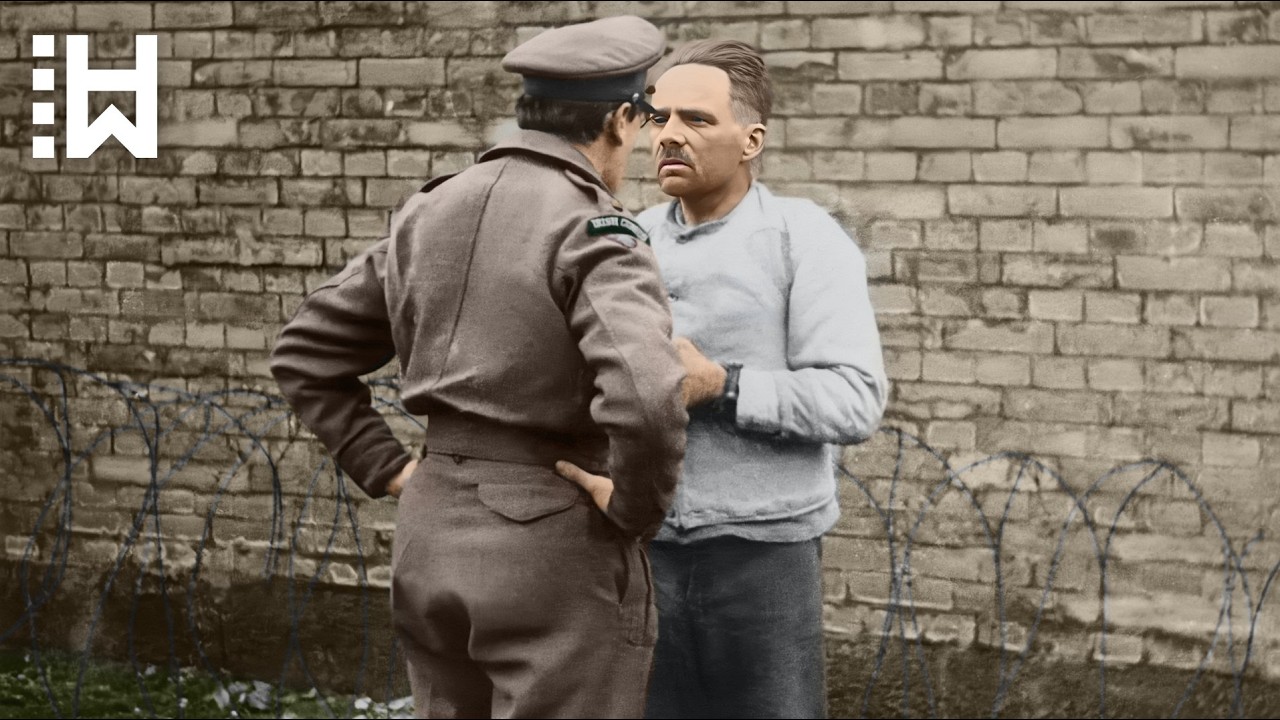
Then British investigators found him.
After tracking leads and pressuring members of his family, they arrested Höss on March 11, 1946.
What followed shocked many observers.
Unlike other Nazi leaders who denied everything, Höss openly described how Auschwitz operated.
Calmly.
Methodically.
Without emotion.
His testimony revealed horrifying details about the mechanics of industrialized mass murder.
“I WAS ONLY FOLLOWING ORDERS”
At his trial in Poland, Höss admitted his role.
But he insisted he had simply obeyed instructions from higher authorities.
The judges were unmoved.
The evidence was overwhelming.
The scale of the crimes was beyond imagination.
On April 2, 1947, the court sentenced him to death.
THE FINAL IRONY
Two weeks later, Rudolf Höss was led to the gallows.
The location was not chosen by accident.
He would die at Auschwitz.
The very place where he had overseen one of history’s greatest crimes.
Former prisoners watched as the sentence was carried out.
For many, it was the closest thing to justice they would ever receive.
THE END OF THE COMMANDANT
On April 16, 1947, Rudolf Höss was hanged at the age of 45.
The man who had once controlled a vast empire of barbed wire, gas chambers, and crematoria was gone.
His body was cremated.
His ashes were scattered.
But the memory of what happened under his command would never disappear.
A NAME FOREVER LINKED TO AUSCHWITZ
Today, Rudolf Höss remains one of the most infamous figures of the Second World War.
Not because he was a battlefield commander.
Not because he led armies.
But because he transformed genocide into a system.
A system that murdered hundreds of thousands of people with terrifying efficiency.
And a system whose horrors continue to haunt the world decades after his death.
