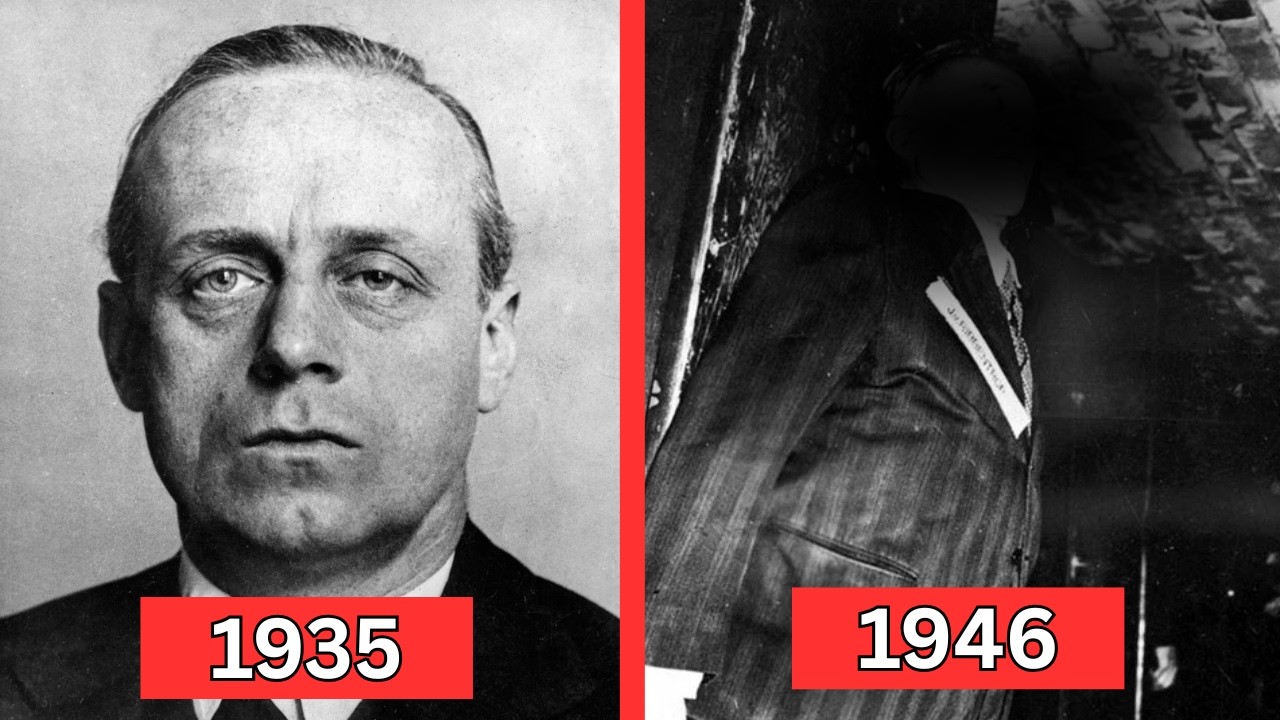
He never commanded an army.
He never led troops into battle.
He never fired a shot on the front lines.
Yet without him, Adolf Hitler might never have been able to launch the deadliest war in human history so easily.
His name was Joachim von Ribbentrop.
Hitler’s Foreign Minister.
Architect of secret treaties.
Master of political deception.
And one of the first Nazi leaders sent to the gallows after World War II.
FROM CHAMPAGNE SALESMAN TO NAZI ELITE
Before becoming one of the most powerful men in Nazi Germany, Ribbentrop worked in the wine and champagne business.
Many leading Nazis mocked him for it.
Even Hermann Göring reportedly sneered at him as nothing more than an “upstart champagne salesman.”
But Ribbentrop possessed a talent that proved invaluable to Hitler:
He knew how to flatter, manipulate, and climb his way to the top.
Within a few years, he had become one of Hitler’s closest advisers and one of the most influential figures in the Third Reich.
THE MAN WHO HELPED PREPARE HITLER’S WARS
As Foreign Minister, Ribbentrop became a key player in Hitler’s expansionist ambitions.
He helped facilitate the annexation of Austria.
He supported the dismantling of Czechoslovakia.
And he worked tirelessly to isolate Germany’s enemies while securing diplomatic advantages for the Nazi regime.
Prosecutors later argued that Ribbentrop was not a diplomat seeking peace.
He was a diplomat helping prepare Europe for war.
THE SECRET PACT THAT CHANGED HISTORY
In August 1939, Ribbentrop helped negotiate one of the most infamous agreements of the twentieth century:
The Molotov–Ribbentrop Pact.
Officially, the agreement promised ten years of peace between Nazi Germany and the Soviet Union.
But hidden inside were secret protocols dividing Eastern Europe into spheres of influence.
Poland was effectively marked for destruction.
With the threat of a two-front war temporarily removed, Hitler gained the confidence to invade Poland on September 1, 1939.
Days later, Europe was at war.
DIPLOMACY AS A WEAPON
While millions fought and died on battlefields across Europe, Ribbentrop continued working behind the scenes.
His Foreign Ministry coordinated with Nazi allies and occupied territories.
It transmitted directives.
It supported occupation policies.
And it helped implement the diplomatic framework that allowed Nazi Germany to expand its control across the continent.
According to the Nuremberg prosecutors, diplomacy under Ribbentrop became another weapon of the Nazi war machine.
HIS ROLE IN THE PERSECUTION OF EUROPEAN JEWS
One of the most damaging allegations against Ribbentrop involved the persecution and deportation of Jews.
Evidence presented at Nuremberg showed that his ministry pressured governments in countries such as Hungary, Romania, Slovakia, and Croatia to surrender Jewish citizens to Nazi authorities.
Documents demonstrated that Ribbentrop received reports concerning anti-Jewish measures and deportations.
The tribunal concluded that he knew these policies led to brutal persecution and death.
“I WAS ONLY FOLLOWING ORDERS”
At trial, Ribbentrop attempted to distance himself from Nazi crimes.
He claimed that Hitler kept many secrets from him.
He argued that he was merely carrying out instructions.
He insisted that many of his diplomatic actions were standard government practice.
The judges were unconvinced.
Too many documents carried his signature.
Too many critical decisions led directly back to him.
The evidence painted a very different picture.
THE VERDICT THAT SEALED HIS FATE
On October 1, 1946, Joachim von Ribbentrop was found guilty on all four counts before the International Military Tribunal:
• Conspiracy
• Crimes Against Peace
• War Crimes
• Crimes Against Humanity
Only a handful of defendants received convictions on all four charges.
The judges concluded that Ribbentrop had played a central role in advancing Hitler’s criminal policies.
The sentence was clear:
Death by hanging.
THE FIRST MAN TO FACE THE GALLOWS
Shortly after midnight on October 16, 1946, Ribbentrop became the first of the condemned Nazi leaders to be led to the execution chamber in Nuremberg Prison.
Witnesses described him as nervous but composed.
When asked to identify himself, he reportedly shouted:
“Joachim von Ribbentrop!”
Then he climbed the steps to the scaffold without hesitation.
HIS FINAL WORDS
Standing beneath the gallows, Ribbentrop delivered a final statement.
“God protect Germany.”
Then he added:
“My last wish is that Germany regain its unity and that understanding be reached between East and West. I wish peace to the world.”
Moments later, a black hood was placed over his head.
The noose was tightened.
The trapdoor opened.
A LONG AND PAINFUL DEATH
The execution did not go as planned.
According to witnesses, the drop was miscalculated.
Instead of dying instantly from a broken neck, Ribbentrop reportedly died from strangulation.
His death took several agonizing minutes.
The man who once helped shape the fate of Europe could do nothing but wait for the inevitable.
NO GRAVE. NO MEMORIAL.
After death was confirmed, his body was photographed, cremated, and his ashes were scattered.
The Allies wanted no grave that could become a shrine.
No monument.
No place for future admirers to gather.
Only oblivion.
THE DIPLOMAT WHO HELPED MAKE WAR POSSIBLE
To the judges at Nuremberg, Joachim von Ribbentrop was far more than a foreign minister.
He was one of the chief architects of Nazi foreign policy.
A man whose negotiations, signatures, and agreements helped pave the road to war, occupation, persecution, and unimaginable human suffering.
That is why his career did not end in a government office.
It did not end on a battlefield.
It ended beneath the gallows of Nuremberg.
