September 1939.
As Nazi Germany invaded Poland and plunged Europe into war, a new camp appeared near the Baltic coast.
Its name was Stutthof.
What began as a detention camp would soon become one of the most terrifying killing centers of the Nazi regime.
Over the next six years, tens of thousands of men, women, and children would enter its gates.
Many would never leave alive.
THE CAMP BUILT ON TERROR
From the very beginning, violence ruled Stutthof.
Prisoners were forced to build the camp themselves.
They cut trees.
Raised barracks.
Installed barbed wire fences.
All while being beaten, starved, and humiliated by guards.
As the war expanded, so did the horror.
The camp became part of the Nazi concentration camp system.
Forced labor.
Executions.
Phenol injections.
Gas chambers.
Typhus epidemics.
Starvation.
Death became a daily routine.
Survivors later recalled bodies stacked like firewood and prisoners collapsing from exhaustion while guards watched without mercy.
THE WOMEN WHO RULED THROUGH FEAR
Among the most feared figures at Stutthof were not only male SS officers.
Some of the camp’s most notorious abusers were women.
Women who beat prisoners.
Women who tortured children.
Women who personally selected victims for the gas chambers.
Their names would become infamous throughout postwar Europe.
THE “BEAUTIFUL SPECTER”
One of the most feared was Jenny-Wanda Barkmann.
Young.
Attractive.
Always concerned about her appearance.
Yet survivors described her as a sadistic guard who beat prisoners—including children—to death with her bare hands or a whip.
Prisoners gave her a chilling nickname:
“The Beautiful Specter.”
A name that reflected both her appearance and the terror she inspired.
THE GUARD WHO BOASTED ABOUT HER CRUELTY
Another notorious defendant was Wanda Klaff.
Witnesses testified that she routinely beat and kicked prisoners without reason.
When angry, she allegedly drowned women in mud or clubbed them to death.
Yet what shocked observers most was her attitude during the trial.
Instead of expressing regret, she proudly declared:
“I am very intelligent and I was very devoted to my work in the camps. I struck at least two prisoners every day.”
For many survivors, the statement revealed a complete absence of remorse.
THE WOMAN WHO SENT CHILDREN TO DIE
Then there was Elisabeth Becker.
According to testimony, she beat mothers and children before selecting them for transport to the gas chambers.
Witnesses described a woman who showed little sympathy for victims, even when entire families were being separated forever.
THE GUARD WHO TORTURED WOMEN IN THE SNOW
Ewa Paradies earned her own reputation for cruelty.
During freezing winter conditions, she reportedly forced female prisoners to strip naked and stand outside in the snow.
Then she poured cold water over them.
Anyone who moved was beaten.
For prisoners already weakened by starvation and disease, such punishment could be a death sentence.
THE CAMP OF HUNGER AND DEATH
By 1945, Stutthof had become a nightmare beyond imagination.
Food was deliberately inadequate.
Medical care was almost nonexistent.
Sick prisoners were often selected for execution rather than treatment.
One survivor recalled a horrifying scene in which a mother who had just given birth was forced to watch her newborn baby thrown into an incinerator.
The camp’s purpose was no longer merely imprisonment.
It was destruction.
THE DEATH MARCHES
As Soviet forces approached in 1945, the SS attempted to erase evidence of their crimes.
Thousands of prisoners were driven out of the camp on brutal death marches through snow and freezing temperatures.
Those who could not keep up were shot where they fell.
Many froze to death.
Others starved.
For countless prisoners, liberation came too late.
JUSTICE ARRIVES
After the war, Polish authorities launched investigations into the crimes committed at Stutthof.
Survivors came forward.
Witnesses testified.
Evidence piled up.
In April 1946, the first Stutthof Trial opened in Gdańsk.
The courtroom heard horrific accounts of torture, murder, beatings, and gas chamber selections.
The public expected remorse.
Instead, some defendants laughed.
THEY GIGGLED WHILE SURVIVORS TESTIFIED
Observers were stunned.
Several defendants appeared unconcerned.
Barkmann reportedly arrived in stylish clothing and changed hairstyles regularly during the proceedings.
Witnesses claimed she flirted with prison guards while survivors described atrocities.
For many in the courtroom, it was almost as shocking as the crimes themselves.
THE DEATH SENTENCE
On May 31, 1946, the verdicts were announced.
Eleven defendants were sentenced to death.
Among them were:
- Jenny-Wanda Barkmann
- Elisabeth Becker
- Wanda Klaff
- Ewa Paradies
- Gerda Steinhoff
Alongside several male guards and kapos.
Only when execution became unavoidable did some begin to cry and beg for mercy.
Their appeals came too late.
200,000 PEOPLE WATCHED THEM DIE
July 4, 1946.
Gdańsk.
One of the largest public executions in postwar Europe.
Newspapers announced the event in advance.
Crowds poured in from across the region.
Former prisoners arrived wearing the striped uniforms they had once worn inside Stutthof.
By the afternoon, nearly 200,000 people had gathered.
Then the condemned arrived.
Their hands and legs were bound.
Nooses were placed around their necks.
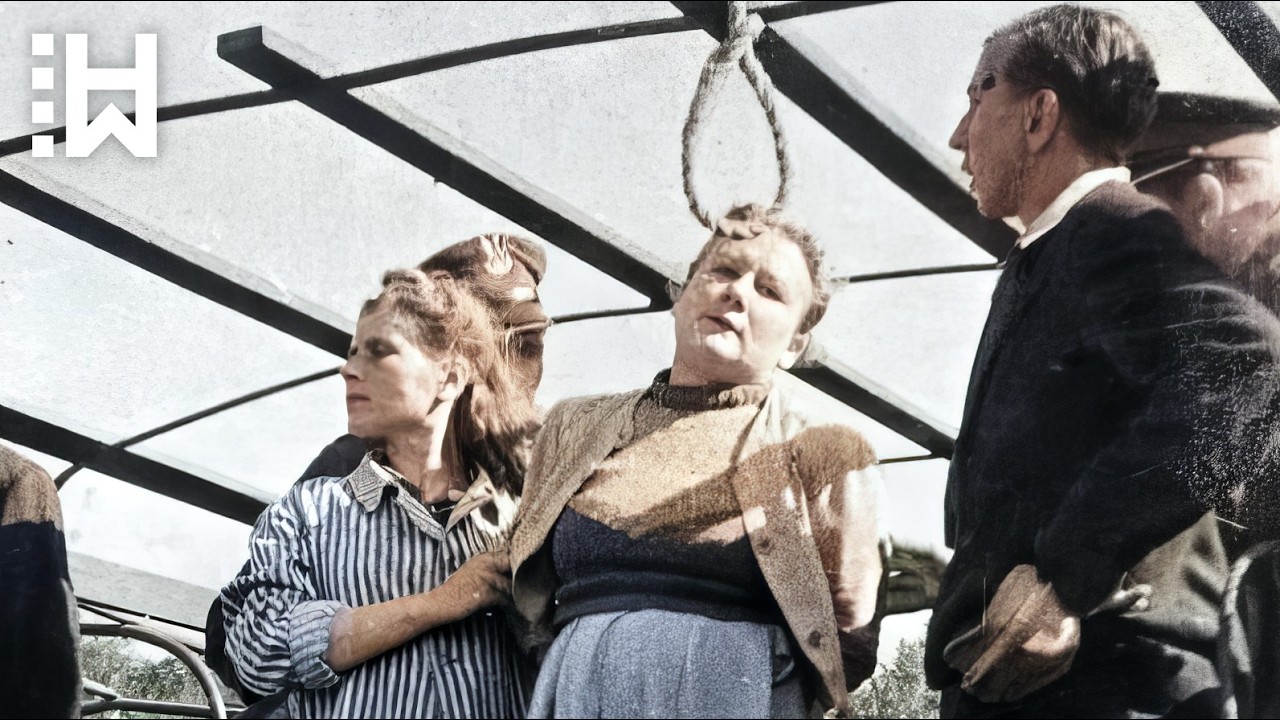
Open trucks served as makeshift gallows.
THE EXECUTION THAT SHOCKED POLAND
At exactly 5 p.m., the trucks began moving.
One by one.
The condemned were left hanging from the ropes.
This was not a long-drop execution.
Their necks did not break.
Death came slowly through strangulation.
Witnesses reported that some struggled for ten to twenty minutes.
Bodies twisted.
Legs kicked.
Crowds watched in silence.
Then the last movements stopped.
THE FURY OF THE CROWD
What happened next stunned even authorities.
As soon as the executions ended, spectators surged forward.
Some kicked the corpses.
Others tore pieces of clothing from the bodies as grim souvenirs.
Security forces eventually intervened and cleared the area.
THE END OF THE GUARDS OF STUTTHOF
Nothing could undo the suffering inflicted inside the camp.
Nothing could bring back the tens of thousands who died.
But for survivors, July 4, 1946, marked a symbolic end to a chapter of terror.
The guards who had ruled through fear.
The women who had beaten prisoners and selected victims for death.
The people who once held absolute power over life and death.
Now faced the consequences of their own actions.
And before a crowd of 200,000 people, the reign of the monsters of Stutthof finally came to an end.
