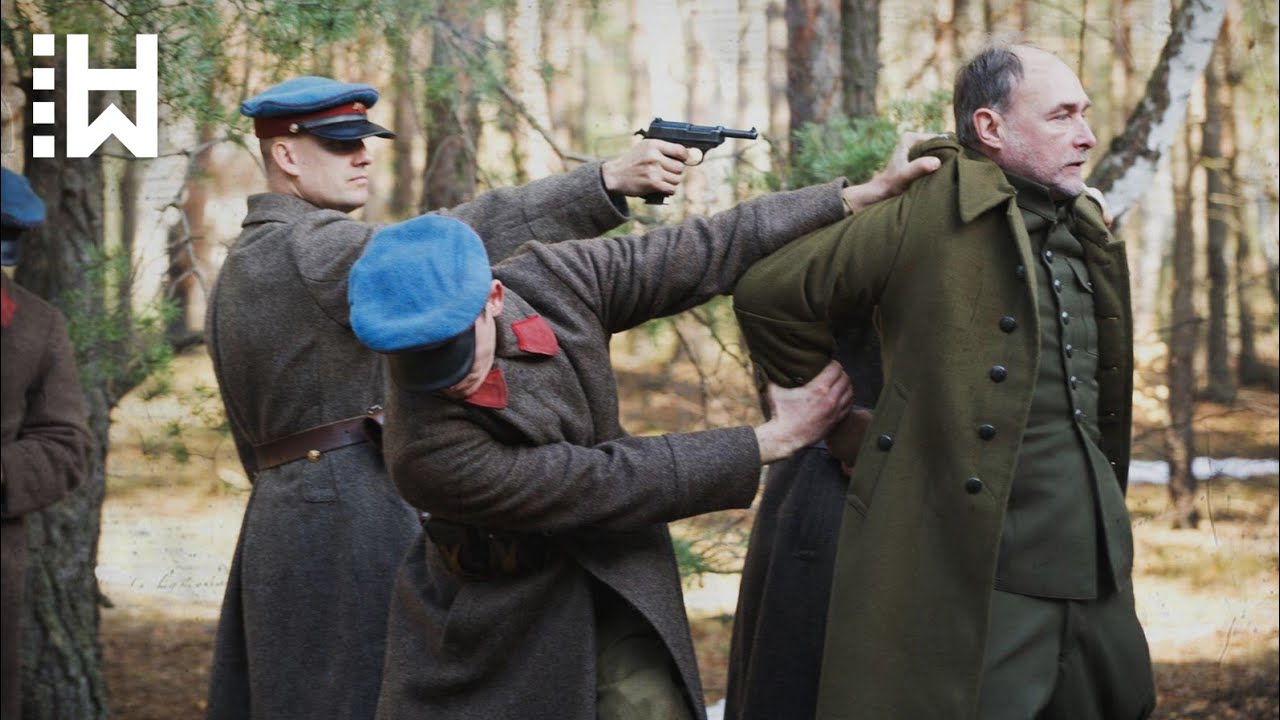
April 1940.
Deep inside the forests near Katyn Forest.
Under cover of darkness, trucks rolled silently through the Soviet woods.
Inside sat Polish prisoners:
- army officers
- professors
- priests
- judges
- doctors
- police commanders
Many believed they were being transferred to another prison camp.
Instead, they were being transported to execution sites already prepared with freshly dug pits.
Blindfolded.
Handcuffed.
Dragged one by one into soundproofed basement rooms.
Then came a single gunshot to the back of the head.
And another.
And another.
By the end of the operation, more than 22,000 Polish citizens would vanish into mass graves.
For decades, the Soviet Union denied everything.
But eventually, even Moscow could no longer bury the truth.
THE SECRET DEAL THAT DESTROYED POLAND
The road to the massacre began on August 23rd, 1939.
That day, Nazi Germany and the Soviet Union signed the:
Molotov–Ribbentrop Pact
officially a non-aggression treaty.
Secretly, however, it divided Eastern Europe into Nazi and Soviet spheres of influence.
Poland was effectively sentenced to destruction.
Germany would seize the west.
The Soviet Union would seize the east.
HITLER ATTACKED FIRST — STALIN STRUCK SECOND
On September 1st, 1939, Germany invaded Poland, launching World War II.
Polish forces fought desperately but were rapidly overwhelmed.
Then, on September 17th, the Soviet Union invaded from the east.
Joseph Stalin claimed Soviet troops were “protecting” local populations after the collapse of the Polish state.
In reality, he was enforcing his agreement with Adolf Hitler.
Poland was trapped between two totalitarian powers.
THE PRISONERS HANDED TO STALIN’S SECRET POLICE
After the invasion, Soviet forces captured or arrested between 240,000 and 250,000 Polish citizens.
Among them were roughly 10,000 Polish military officers.
Instead of being treated as ordinary prisoners of war, many were transferred directly to the:
NKVD — Stalin’s feared secret police.
The prisoners were classified as:
“counterrevolutionary enemies of the Soviet state.”
THE CAMPS OF FEAR
The Soviets established three major prison camps:
- Kozelsk
- Starobelsk
- Ostashkov
Inside overcrowded barracks, prisoners endured:
- food shortages
- interrogations
- constant surveillance
- psychological pressure
NKVD informers monitored every conversation.
Prisoners were questioned about:
- political beliefs
- foreign contacts
- family history
- loyalty to Poland
Most refused to cooperate.
That refusal would seal their fate.
STALIN APPROVES MASS EXECUTION
In March 1940, NKVD chief Lavrentiy Beria sent a secret memorandum to Stalin.
Beria described the Polish prisoners as:
“hardened and unrepentant enemies of Soviet authority.”
He recommended execution.
Stalin approved immediately.
Soon afterward, top Soviet officials signed the death order, including:
- Vyacheslav Molotov
- Kliment Voroshilov
- Lazar Kaganovich
The decision was now irreversible.
THE PLAN TO DESTROY POLAND’S ELITE
The victims were not only soldiers.
The Soviets deliberately targeted the intellectual backbone of Poland:
- professors
- lawyers
- engineers
- priests
- judges
- writers
- political leaders
The goal was chillingly simple:
Destroy the people most capable of rebuilding an independent Poland in the future.
THE TROIKA OF DEATH
Responsibility for the operation fell to an NKVD “troika” of senior officers:
- Vsevolod Merkulov
- Bogdan Kobulov
- Leonid Bashtakov
Their task:
Compile death lists.
Approve executions.
Keep everything secret.
THE EXECUTION FACTORIES
Beginning in April 1940, prisoners were removed from camps in small groups during nighttime operations.
They were told they were being transferred.
Instead, they were transported to NKVD prisons and execution chambers.
Inside soundproofed rooms, each prisoner was:
- identified
- handcuffed
- led into an adjoining chamber
Then a bullet entered the base of the skull.
The bodies were dragged away immediately.
The next prisoner entered.
The killing continued hour after hour.
Night after night.
THE EXECUTIONER IN LEATHER
One witness later described a horrifying figure entering the execution room:
A man wearing:
- a leather cap
- a long leather apron
- gloves reaching above the elbows
The man was:
Vasily Blokhin — chief executioner of the NKVD.
One of history’s deadliest killers.
THE MAN WHO KILLED THOUSANDS WITH HIS OWN HANDS
Blokhin personally supervised and carried out mass executions with industrial precision.
At the Ostashkov operation, he aimed to kill 300 prisoners every night.
He used a German-made Walther pistol.
Partly because it was reliable.
Partly because Soviet leaders hoped German ammunition might confuse future investigators if the graves were discovered.
Each victim received a single shot to the back of the head.
The floor was hosed clean after every killing.
Then the process repeated.
THE BODIES VANISHED INTO THE FORESTS
Outside, trucks waited behind the prison buildings.
The corpses were loaded under cover of darkness and transported to burial pits near places like:
- Katyn
- Mednoye
- Kharkiv
Mass trenches up to ten meters long were prepared in advance.
Excavators flattened the ground before dawn to erase evidence.
THE DEADLIEST EXECUTIONER IN HISTORY
Blokhin worked almost without pause for nearly a month.
According to records, he averaged roughly one execution every three minutes.
By the end of the operation, around 22,000 Polish prisoners were dead.
Blokhin alone allegedly carried out around 7,000 personal executions across 28 nights — a number that may make him the single deadliest individual executioner in recorded history.
For his “service,” the Soviet state awarded him the:
Order of the Red Banner.
THE MASS GRAVES DISCOVERED BY THE NAZIS
In 1943, after Germany invaded the Soviet Union during Operation Barbarossa, German forces discovered mass graves in the Katyn Forest.
Thousands of Polish officers still wore uniforms.
Documents found on the bodies dated from spring 1940.
The Germans publicized the discovery internationally, hoping to divide the Allied powers.
STALIN BLAMES HITLER
The Polish government-in-exile demanded an investigation by the International Red Cross.
Stalin reacted furiously.
The Soviet Union accused Poland of collaborating with Hitler and immediately blamed the massacre on the Germans.
For decades, Soviet propaganda insisted the killings happened in 1941 after the Nazi invasion.
Even during the Nuremberg trials, Soviet prosecutors attempted to blame Germany.
The case quietly collapsed due to lack of evidence.
THE EXECUTIONERS WHO EVENTUALLY FELL
Most perpetrators escaped punishment.
But a few eventually met violent ends themselves.
After Stalin’s death:
- Beria was arrested and executed in 1953
- Merkulov was executed
- Kobulov was executed
Blokhin initially retired with honors.
But during Nikita Khrushchev’s de-Stalinization campaign, he was stripped of his rank.
Alcoholic and mentally unstable, he died in 1955.
Officially:
Suicide.
THE LIE THAT LASTED HALF A CENTURY
For nearly 50 years, the Soviet Union buried the truth beneath censorship and propaganda.
Only in 1990 did Soviet leader Mikhail Gorbachev officially admit NKVD responsibility.
Two years later, Boris Yeltsin released key Politburo documents proving Stalin had personally approved the executions.
The massacre could no longer be denied.
THE FOREST THAT NEVER FORGOT
Today, Katyn remains one of the darkest symbols of Soviet terror.
A place where forests hid mass graves…
…where entire layers of Poland’s intellectual and military leadership vanished into the earth…
…and where one of the greatest lies of World War II survived for half a century before finally collapsing under the weight of the dead themselves.
