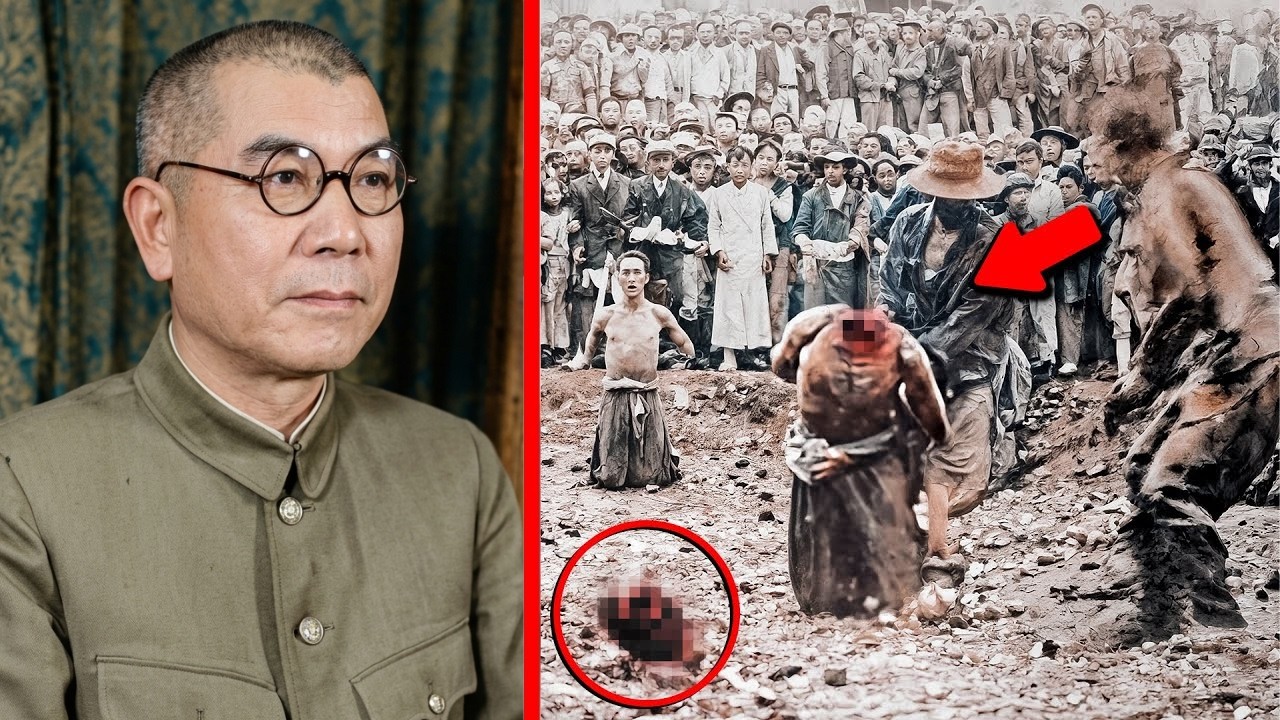
December 23rd, 1948.
Sugamo Prison, Tokyo.
Just after midnight, a 56-year-old Japanese general was led from his prison cell by American military police.
He had been informed only 15 hours earlier that he would be dead before sunrise.
He did not scream.
He did not collapse.
He simply walked forward in silence toward a wooden gallows built specifically for seven condemned war criminals.
His name was Akira Muto.
And the road that brought him to those final 13 steps stretched across:
- the Rape of Nanking
- the destruction of Manila
- the deaths of hundreds of thousands of civilians across Asia
THE FARM BOY WHO BECAME AN IMPERIAL STRATEGIST
Akira Muto was born on December 15th, 1892, in Hakusui village, Kumamoto Prefecture, on Japan’s southern island of Kyushu.
It was rural country:
Rice fields.
Mountain fog.
Old samurai traditions lingering long after the swords disappeared.
His family pushed him toward the military because, in early Imperial Japan, the army was one of the few paths to status and power.
He entered the Imperial Japanese Army Academy and graduated in 1913.
By 1920, he had completed the elite Army Staff College.
Ambitious.
Disciplined.
Quietly ruthless.
THE YEARS HE SPENT STUDYING GERMANY
In 1923, Muto was sent to Germany as a military attaché.
For three years, he studied the defeated Weimar Republic:
Its military doctrine.
Its political instability.
Its simmering nationalism.
According to the account, he watched a humiliated nation rebuilding itself through rage and militarism.
When he returned to Japan in 1926, he was no longer just an officer.
He had become an imperial strategist who believed Japan deserved an empire as powerful as those of Europe.
THE MAN WHO PUSHED JAPAN TOWARD TOTAL WAR
By the mid-1930s, Muto had risen into the planning structure of the Imperial Japanese Army.
He served within the Kwantung Army in occupied Manchuria — the aggressive military force driving Japanese expansion in China.
Then came July 7th, 1937:
The Marco Polo Bridge Incident near Beijing.
What began as a clash between Japanese and Chinese troops rapidly escalated into full-scale war.
According to the account, Muto strongly supported expanding the conflict into total invasion.
He wanted northern China absorbed piece by piece into the Japanese Empire.
THE RAPE OF NANKING
By December 1937, Japanese forces reached Nanking, the capital of Nationalist China under Chiang Kai-shek.
What followed became one of the most infamous atrocities of the 20th century:
The Rape of Nanking.
Muto had been promoted to vice chief of staff of the Central China Area Army under General Iwane Matsui.
According to prosecutors, Japanese discipline inside the city effectively collapsed.
For weeks, soldiers carried out:
- mass executions
- rape
- torture
- looting
- arson
Witnesses described:
- infants bayoneted in cribs
- civilians beheaded in killing contests
- bodies dumped into the Yangtze River until the water darkened with corpses
Estimates of the dead range from roughly 100,000 to more than 300,000 people.
“HE DID NOT NEED TO PULL THE TRIGGER”
Muto later claimed the atrocities were the actions of uncontrolled subordinates.
But prosecutors argued he stood near the top of the command structure that enabled the massacre.
He did not personally stab civilians.
He did not personally fire rifles.
But he helped create the system, approved the operations, and failed to stop the slaughter once it began.
THE GENERAL WHO HELPED PLAN WAR AGAINST AMERICA
Instead of punishment, Muto received promotion.
By 1941, just before Pearl Harbor, he had become lieutenant general and director of the Military Affairs Bureau inside Japan’s War Ministry.
He operated in the same circles as wartime Prime Minister Hideki Tojo.
According to the account, Muto helped shape the policies and strategic directives that brought Japan into war against:
- the United States
- Britain
- the Netherlands
THE SECOND MASSACRE — MANILA
In 1944, Muto was transferred to the Philippines as chief of staff to General Tomoyuki Yamashita and the Japanese 14th Area Army.
By then, Japan was collapsing militarily.
American forces under General Douglas MacArthur were closing in.
Then came the Battle of Manila in February 1945.
What followed became known as:
The Manila Massacre.
By the end of the battle, at least 100,000 Filipino civilians were dead.
Many were murdered directly by Japanese forces.
THE CITY TURNED INTO A KILLING FIELD
The atrocities in Manila shocked even veteran war correspondents.
According to testimony and evidence presented later:
- hospital patients were bayoneted in their beds
- refugees inside churches were burned alive
- women and children were butchered inside shelters
- civilians were used as human shields
Thousands of non-combatants died building by building, street by street.
Muto argued later that much of the worst violence had been committed by Japanese naval forces under Admiral Sanji Iwabuchi.
The tribunal acknowledged partial truth in this claim.
But prosecutors argued the army carried out parallel atrocities across the Philippines under the broader military command structure in which Muto held authority.
THE TOKYO TRIALS
After Japan surrendered on September 2nd, 1945, American occupation authorities arrested Muto and transferred him to Sugamo Prison in Tokyo.
He was indicted before the International Military Tribunal for the Far East — commonly called the Tokyo Trials.
The proceedings lasted more than two years.
Muto faced charges including:
- waging aggressive war
- atrocities against civilians
- mistreatment of prisoners of war
- responsibility for mass killings in China and the Philippines
THE DEFENSE THAT FAILED
In court, Muto remained composed.
He argued:
- the Nanking atrocities were beyond his control
- Manila’s worst massacres were committed by the navy
- he had simply been following military orders
The judges rejected the defense.
Chinese prosecutors introduced military documents and witness testimony from Nanking survivors.
American prosecutors presented evidence from Philippine civilians and surviving POWs.
On November 12th, 1948, the sentence was announced:
Death by hanging.
THE 13 STEPS TO THE GALLOWS
On December 22nd, 1948, the condemned prisoners were informed they would die within hours.
The execution chamber inside Sugamo Prison had been built to American military specifications:
A wooden scaffold.
Steel beams.
Trapdoors beneath the feet of the condemned.
Each prisoner climbed 13 wooden steps — a traditional number rooted in old English hanging customs.
Muto climbed his steps silently.
A black hood covered his face.
The rope was positioned beneath his left ear to ensure the “long drop” would snap the neck instantly.
At 12:01 a.m. on December 23rd, 1948, four trapdoors opened simultaneously.
Akira Muto dropped into darkness.
THE ASHES THROWN INTO THE PACIFIC
After the executions, American authorities made a highly unusual decision.
The bodies were cremated under armed guard.
The ashes of Muto and the other executed war criminals were loaded onto a U.S. Army aircraft.
Then, over the Pacific Ocean east of Yokohama, the ashes were scattered into the sea.
The reason was political.
American authorities feared any grave or memorial could become a shrine for Japanese ultranationalists.
So they left nothing behind.
No grave.
No tomb.
No relics.
THE NAME THAT STILL DIVIDES ASIA
For decades, the details surrounding the disposal of the ashes remained secret.
Only in 2021 did documents uncovered in U.S. archives fully confirm what happened.
Today, Akira Muto’s name remains controversially enshrined at Yasukuni Shrine alongside other convicted Class-A war criminals.
The issue continues to inflame tensions between Japan, China, and Korea even decades later.
And so the farm boy from Kumamoto who studied strategy in Germany, helped oversee the destruction of Nanking, and served during the annihilation of Manila ultimately vanished into the Pacific wind —
his body erased,
his empire destroyed,
but the memory of the massacres still haunting Asia nearly a century later.
