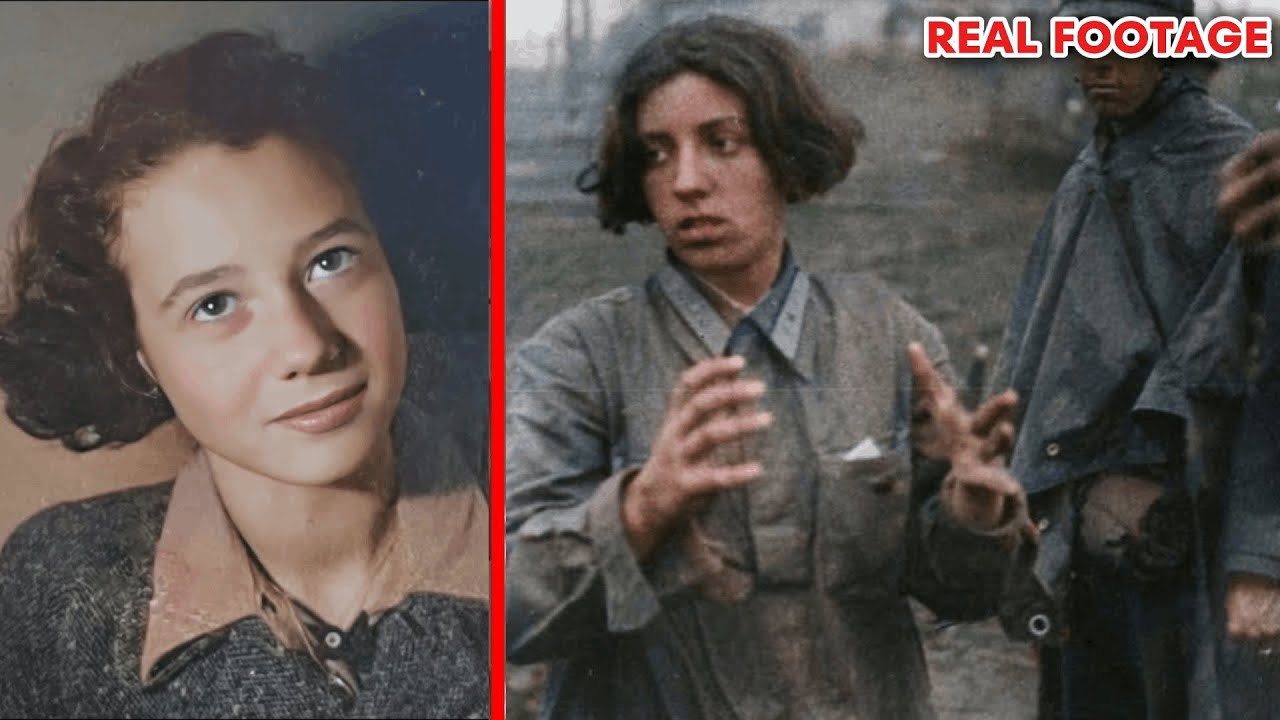
June 29th, 1945.
A displaced persons camp near Bergen-Belsen, Germany.
Two months after liberation, a 45-year-old woman named Elisabeth Polak lies dying in a makeshift hospital bed.
Her body has finally given up.
Typhus.
Starvation.
Forced labor.
Three years of systematic destruction by the Nazi camp system.
Beside her sits her 15-year-old daughter, Dita.
Watching silently as her mother takes her final breath.
When Elisabeth dies, Dita Kraus becomes an orphan.
But the tragedy did not begin there.
That was only the end.
Because before she became known around the world as “The Librarian of Auschwitz,” Dita was just a little girl from Prague who did not even know she was Jewish.
And then the Nazis took everything.
THE CHILD WHO DIDN’T KNOW SHE WAS JEWISH
Dita Kraus was born Edith Polachová in Prague in 1929 into a secular, educated Jewish family.
Her father, Hans, was a lawyer.
Her mother, Elisabeth, created a warm and loving home filled with books and music.
They celebrated Christmas.
Not Hanukkah.
They considered themselves Czech first.
Then one day in second grade, Dita found a note on her school desk.
It read:
“You are a Jew.”
She did not even understand what the word meant.
THE DAY HER CHILDHOOD ENDED
March 15th, 1939.
Germany invades Czechoslovakia.
Suddenly, being Jewish becomes the only thing that matters.
Her father loses his law career.
The family is evicted from their apartment.
Their possessions disappear.
Their comfortable life collapses piece by piece.
Soon Jewish children are banned from public schools.
Dita’s education continues illegally through secret tutors.
At only 10 years old, she is already learning that the law no longer protects people like her.
THE MAN WHO WOULD SAVE CHILDREN IN HELL
At a Jewish sports field in Prague, Dita meets a charismatic youth leader named Fredy Hirsch.
He is energetic.
Disciplined.
Obsessed with hygiene, education, and dignity.
Dita admires him immediately.
Years later, inside Auschwitz itself, Hirsch will become one of the few people trying to preserve humanity for Jewish children.
THE “MODEL GHETTO”
In November 1942, 13-year-old Dita and her parents are deported to Theresienstadt.
The Nazis present the ghetto as a “humane Jewish settlement” for propaganda purposes.
In reality, it is overcrowded, disease-ridden, and deadly.
Approximately 33,000 prisoners die there from starvation and disease.
Another 88,000 are eventually deported east to extermination camps.
THE CHILDREN WHO REFUSED TO STOP BEING HUMAN
Despite the horror, prisoners inside Theresienstadt try desperately to preserve culture and education.
Children stage plays.
Attend secret classes.
Create artwork.
Dita sings in the children’s opera Brundibár.
Art teacher Friedl Dicker-Brandeis encourages the children to draw their feelings.
Many of those drawings still survive today.
Most of the children who created them do not.
THEN CAME AUSCHWITZ
December 1943.
Dita, now 14, is loaded onto a cattle train bound for Auschwitz-Birkenau.
The journey is hell:
- no toilets
- no water
- no space to lie down
- crying children
- terrified parents packed together in darkness
When the train doors finally open, floodlights blind the prisoners.
Dogs bark.
SS guards scream:
“Schnell! Raus!” — “Move! Get out!”
Dita has arrived at the largest killing center in human history.
THE FAMILY CAMP WITH AN EXPIRATION DATE
Unlike most Auschwitz prisoners, Dita’s transport is sent to a special section known as the “Czech Family Camp.”
Families are temporarily allowed to remain together.
Children are not immediately sent to the gas chambers.
But there is a horrifying reason for this:
The Nazis are using the camp for propaganda.
Every transport is secretly given a six-month lifespan.
After six months, everyone will be murdered.
The prisoners know it.
The guards know it.
Everyone knows.
THE TATTOO
Upon arrival, Dita’s head is shaved.
Her clothes are taken.
Her identity disappears.
Then the Nazis tattoo a number onto her arm:
No longer Edith.
No longer Dita.
Just a number.
HER FATHER STARVES TO DEATH
Only six weeks after arriving at Auschwitz, Dita’s father dies from starvation.
The Nazi food rations are scientifically designed to kill slowly.
Watery soup.
A crust of bread.
Barely enough calories to survive.
Hans Polak wastes away until his body simply shuts down.
Dita must tell her sick mother the news by shouting through a quarantine wall.
“Father is dead!”
She is 14 years old.
BLOCK 31
Inside Auschwitz, Fredy Hirsch manages to create something extraordinary:
A children’s barrack known as Block 31.
It is not safe.
Nothing in Auschwitz is safe.
But for a few hours each day, children can draw, sing, hear stories, and pretend they are still human beings.
And hidden inside Block 31 are a handful of forbidden books.
THE LIBRARIAN OF AUSCHWITZ
The tiny “library” contains perhaps 8 to 12 books total.
Among them:
- an atlas
- books by H.G. Wells
- stories by Czech writers
- works secretly used to teach children the alphabet
If the SS discover these books, everyone in the barrack could be executed.
Fredy Hirsch asks Dita to become their librarian.
She is only 14 years old.
Every day, she hides the books in specially sewn pockets during inspections.
Every day, discovery could mean death.
THE MOMENT MENGELE WALKED IN
One day, SS doctor Josef Mengele personally inspects Block 31.
The “Angel of Death.”
The man infamous for medical experiments on prisoners and children.
As guards search for contraband, terror sweeps the room.
The books are hidden only inches away.
If Mengele finds them, everyone dies.
By sheer luck and distraction, the inspection ends before the books are discovered.
Afterward, Mengele warns Dita that he is watching her closely.
One mistake, he says, and she could end up dissected alive on his autopsy table.
THE NIGHT 3,800 PEOPLE VANISHED
March 8th, 1944.
The first transport from the Czech Family Camp reaches its six-month deadline.
That night, approximately 3,800 men, women, and children are taken to the gas chambers.
All are murdered.
Among them is Fredy Hirsch.
Half the children Dita knows disappear in a single night.
And now she realizes something horrifying:
Her own transport arrived in December.
Which means June will be her turn.
A CHILD WAITING FOR HER EXECUTION DATE
Imagine being 14 years old and knowing the exact month you are expected to die.
Every sunrise becomes torture.
Every day becomes a countdown.
Dita later describes living with constant terror while still trying to comfort younger children around her.
SELECTED FOR FORCED LABOR
In May 1944, Dita and her mother are selected for forced labor instead of immediate execution.
They are transported to Hamburg and forced to clear rubble after Allied bombing raids.
The work is brutal:
- freezing conditions
- bleeding hands
- starvation
- beatings
- exhaustion
Workers who collapse are often left to die.
BERGEN-BELSEN: THE CAMP OF DISEASE
By March 1945, Dita and her mother are transferred again — this time to Bergen-Belsen.
Unlike Auschwitz, Bergen-Belsen has no gas chambers.
Instead, prisoners die slowly from disease, starvation, and total collapse.
The camp is overflowing far beyond capacity.
Corpses pile up faster than they can be buried.
Typhus spreads everywhere.
Lice cover the prisoners’ bodies.
People sleep beside the dead.
LIBERATION… TOO LATE FOR MANY
On April 15th, 1945, British forces liberate Bergen-Belsen.
The soldiers are horrified.
More than 10,000 unburied corpses lie scattered throughout the camp.
Even hardened troops vomit from the smell and the sight.
Dita survives typhus.
Her mother does not.
THE ORPHAN
On June 29th, 1945, Elisabeth Polak dies two months after liberation.
She is only 45 years old.
Dita stands over her body completely alone.
Her father is dead.
Most of her family is dead.
Most of the children she cared for in Auschwitz are dead.
She is 15 years old.
BUILDING A LIFE AFTER HELL
After the war, Dita reunites with Otto Kraus — a former teacher from Block 31 who also survived Auschwitz.
They marry.
Move to Israel.
Raise children.
Build careers as educators.
Outwardly, she survives.
But the Holocaust never truly leaves her.
THE MEMORIES THAT NEVER STOPPED
Even in old age, Dita continues remembering the screams from the gas chambers.
The starving children.
The smell of death.
The mothers holding babies upward inside the chambers, trying desperately to shorten their suffering.
These are not abstract historical facts.
They are memories she carried for more than 80 years.
THE GIRL WHO PROTECTED BOOKS IN A DEATH CAMP
People often focus on the symbolism of Dita’s secret library.
The courage.
The books.
The resistance.
But behind that story is something much darker:
A child whose entire adolescence was consumed by systematic terror.
A girl who watched her father starve to death.
Who watched children disappear into gas chambers.
Who survived four camps before becoming an orphan at 15.
THE LAST CHAPTER
Dita Kraus lived until 2025.
She died in Jerusalem at the age of 95.
She outlived Hitler.
Outlived the Third Reich.
Outlived most of the men who tried to erase her existence.
But she never escaped what they did to her.
Because survival is not the same thing as healing.
And the little girl from Prague who once asked, “What is a Jew?” never truly got her childhood back.
