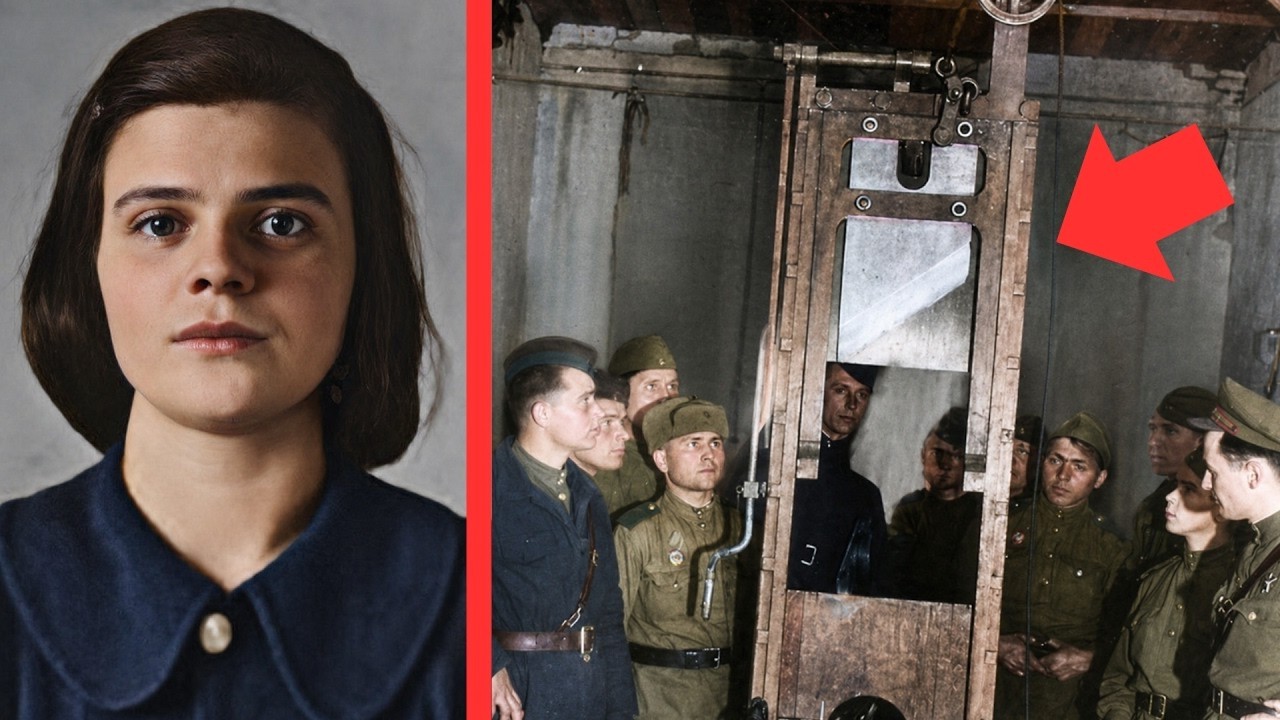
February 22nd, 1943.
5:00 p.m.
Stadelheim Prison, Munich, Nazi Germany.
A 21-year-old university student walks slowly down a prison corridor toward a guillotine.
She is wearing a white blouse and a dark skirt.
Witnesses later say she looks astonishingly calm.
Only four days earlier, she had been sitting in a university lecture hall.
Now the Nazi state is preparing to cut off her head.
Her name is Sophie Scholl.
And Adolf Hitler’s regime considered her one of the most dangerous enemies in Germany.
Not because she carried a weapon.
Not because she commanded an army.
But because she distributed leaflets telling Germans the truth.
THE FINAL WALK
Earlier that afternoon, Sophie looks out her prison window at the bright February sky.
Then she quietly says words that would later become legendary:
“Such a fine, sunny day.”
Moments later, as guards escort her toward execution, she reportedly adds:
“What does my death matter if through us thousands of people are awakened and stirred to action?”
At 5:00 p.m., executioner Johann Reichhart positions her beneath the guillotine blade.
Seconds later, Sophie Scholl is dead.
Her brother Hans is executed immediately afterward.
Then their friend Christoph Probst.
All three are killed within minutes.
The entire process — arrest, interrogation, trial, conviction, execution — has taken only 96 hours.
THE GIRL WHO ONCE LOVED THE HITLER YOUTH
What makes Sophie Scholl’s story so unsettling is that she did not begin as a resistance hero.
She began as an ordinary German teenager.
Born in 1921 in southern Germany, Sophie grew up in a religious, educated middle-class family.
Like millions of German children, she initially found Nazi youth organizations exciting.
Camping.
Songs.
Uniforms.
Adventure.
At age 12, she joined the League of German Girls — the female branch of Hitler Youth — with what she later described as “girlish enthusiasm.”
She became a squad leader.
She marched.
She sang Nazi songs.
At first, she believed.
THE FIRST CRACKS
But slowly, reality began destroying the illusion.
One of Sophie’s close childhood friends was Jewish.
Suddenly, Nazi racial laws declared that friend inferior.
At a youth meeting, Sophie once suggested reading works by Jewish-German poet Heinrich Heine.
The group leader reacted with outrage because Heine was Jewish.
Sophie reportedly fired back:
“Whoever doesn’t know Heine doesn’t know German literature.”
The contradiction became impossible to ignore.
The regime claimed to defend German culture…
…while banning some of Germany’s greatest writers.
THE FATHER WHO WARNED THEM
Sophie’s father, Robert Scholl, openly criticized Hitler at home long before most Germans dared.
He warned his children that Nazism would lead Germany into catastrophe.
At first, they dismissed him as old-fashioned.
But then the Gestapo arrested Sophie’s brother Hans for participating in an outlawed youth movement.
The Nazi state suddenly became personal.
Fear entered the Scholl household.
So did anger.
THE UNIVERSITY THAT CHANGED EVERYTHING
In 1942, Sophie enrolled at Ludwig Maximilian University in Munich.
There she entered a circle of students and professors who secretly despised the Nazi regime.
The group became known as:
The White Rose.
Unlike many resistance movements, the White Rose did not plan bombings or assassinations.
Its weapon was words.
THE LEAFLETS THAT TERRIFIED HITLER’S REGIME
Using a typewriter and mimeograph machine, the White Rose produced anonymous anti-Nazi leaflets.
The pamphlets condemned dictatorship, war crimes, and the mass murder of Jews.
At a time when most Germans stayed silent, the students wrote openly:
“The German people slumber on in their dull, stupid sleep.”
Another leaflet declared:
“Every honest German is ashamed of his government these days.”
The words were explosive.
Not because the information was secret.
But because somebody inside Germany dared say it publicly.
THEY KNEW ABOUT THE HOLOCAUST
One of the White Rose leaflets explicitly referenced the mass murder of Jews in occupied Poland.
It stated:
“300,000 Jews have been murdered in this country in the most bestial way.”
This matters enormously to historians.
Because it proves ordinary Germans could know.
The White Rose had no classified intelligence.
No spies.
No military secrets.
They simply paid attention to reality.
SOPHIE BECOMES THE MOVEMENT’S SECRET WEAPON
Sophie played a crucial role in distributing the leaflets.
Young women attracted less suspicion from police than military-age men.
She traveled by train carrying stacks of illegal pamphlets hidden in suitcases.
Every trip risked arrest and execution.
Still, she continued.
STALINGRAD CHANGES EVERYTHING
By early 1943, Germany’s catastrophic defeat at Stalingrad shattered the myth of Nazi invincibility.
The White Rose sensed weakness.
Their sixth leaflet directly attacked Hitler over the disaster:
“330,000 German men have been senselessly and irresponsibly driven to death.”
The group called on university students to rise up against dictatorship.
It was their boldest act yet.
And it would destroy them.
THE LEAFLETS FALL FROM THE SKY
February 18th, 1943.
Hans and Sophie arrive at Munich University carrying approximately 1,700 leaflets in a suitcase.
They move quickly through empty corridors placing stacks outside lecture halls.
Students will discover them when classes end.
The operation is nearly complete.
Then Sophie notices they still have extra copies left.
THE MOMENT THAT SEALED HER FATE
In one of the most famous moments of German resistance history, Sophie reportedly climbs to the upper gallery of the university atrium.
Then she pushes the remaining leaflets over the railing.
Thousands of papers flutter downward like snow across the marble floor below.
It is a spectacular visual act of rebellion.
And a catastrophic mistake.
THE JANITOR WHO BETRAYED THEM
A university custodian named Jakob Schmid sees the leaflets falling.
He is a loyal Nazi Party supporter.
He locks the exits and detains Hans and Sophie until the Gestapo arrives.
Within minutes, the White Rose is finished.
THE INTERROGATION
At first, Sophie denies everything.
But the Gestapo discovers draft leaflets in Hans’s apartment.
The evidence becomes overwhelming.
Then something remarkable happens.
Instead of begging for mercy, Sophie openly accepts responsibility.
She reportedly tells investigators:
“Many people believe what we wrote. They just don’t dare express themselves as we did.”
THE TRIAL FROM HELL
February 22nd, 1943.
The three students appear before Roland Freisler, the infamous chief judge of the Nazi People’s Court.
Freisler screams at defendants.
Humiliates them publicly.
Between 1942 and 1945, he helps sentence thousands to death.
The trial lasts only a few hours.
The verdict is predetermined from the start.
SOPHIE’S FINAL DEFIANCE
Despite facing execution, Sophie refuses to submit.
At one point she tells the court:
“Somebody, after all, had to make a start.”
Then she says something even more dangerous directly to Freisler:
“You know the war is lost. Why don’t you have the courage to face it?”
In Nazi Germany, words like that could kill you.
And they did.
“LONG LIVE FREEDOM”
After sentencing, the prisoners are given brief final meetings with family members.
Then they are taken one by one to the guillotine.
Hans Scholl’s last words reportedly echo through the execution chamber:
“Long live freedom!”
Seconds later, the blade falls.
THE REGIME THAT FEARED PAPER
The Nazis believed executing the students quickly and secretly would erase them from history.
Instead, it immortalized them.
Copies of the White Rose leaflets are smuggled out of Germany to Britain.
The Royal Air Force later prints millions of copies and drops them over German cities from aircraft.
The words that got Sophie Scholl executed begin raining from the sky across the Third Reich.
THE GIRL WHO BECAME A SYMBOL
Today, Sophie Scholl is one of the most respected figures in German history.
Schools, streets, and memorials across Germany bear her name.
A memorial at Munich University marks the exact spot where the leaflets fell into the atrium.
Students still walk across bronze replicas of those papers every day.
THE MOST TERRIFYING PART OF HER STORY
What makes Sophie Scholl’s story so powerful is not that she was superhuman.
It is that she was ordinary.
She liked music.
Books.
Hiking.
She once joined Nazi youth groups herself.
Then step by step, she chose conscience over comfort.
Truth over safety.
Morality over survival.
THE QUESTION SHE LEFT BEHIND
Sophie Scholl was only 21 years old when the guillotine blade fell.
She never saw Nazi Germany collapse.
Never saw Hitler dead.
Never saw the world learn she had been right all along.
But her story still leaves behind one terrifying question:
If an ordinary student could risk everything to speak out against evil…
…why did so many millions of others remain silent?
