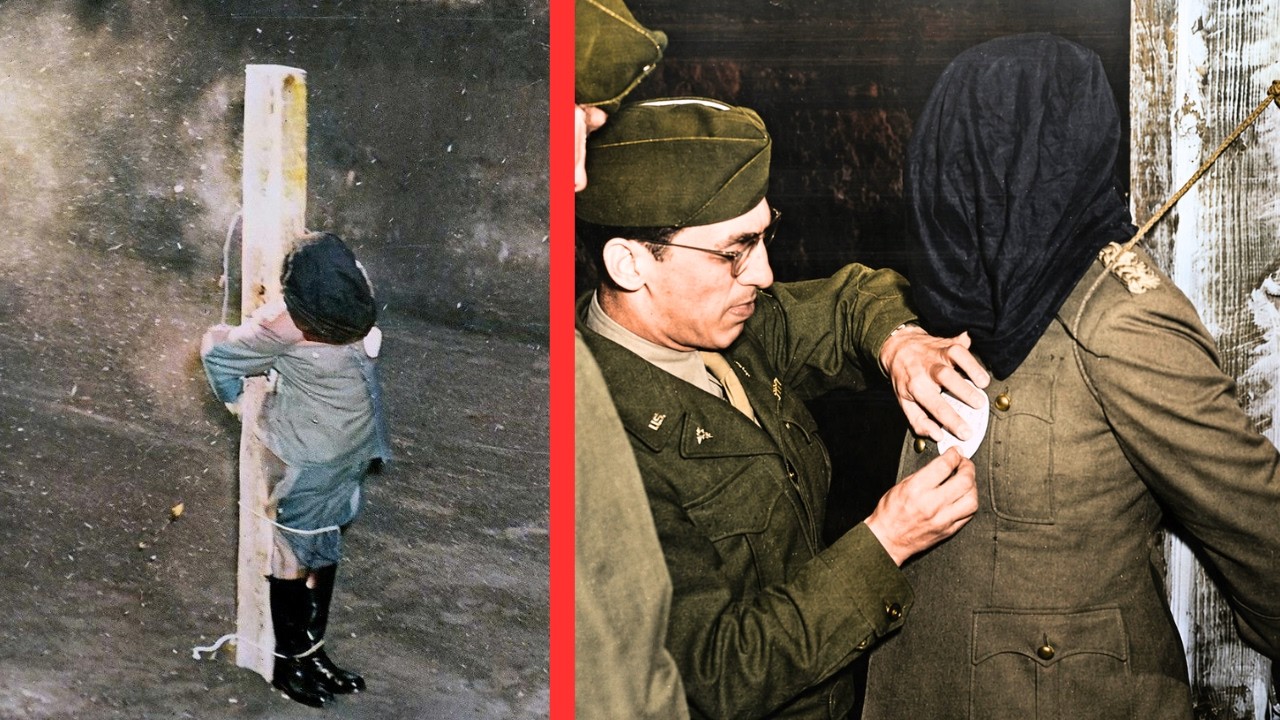
December 1st, 1945.
Shortly before 8:00 a.m.
A 54-year-old German general was marched toward a military firing range.
A priest walked beside him to hear his final confession.
Ahead stood a wooden execution stake planted deep into the ground.
Within minutes, American soldiers would raise their rifles and shoot him dead.
The condemned man was:
General Anton Dostler.
Unlike many Nazi war criminals hanged on gallows after World War II…
…Dostler died before a firing squad.
And the reason why reveals a dark distinction between military execution and criminal punishment in the aftermath of the war.
THE CAREER SOLDIER WHO SERVED IN TWO WORLD WARS
Anton Dostler was not a fanatical street Nazi.
He was a professional German officer with decades of military service behind him.
He fought in World War I.
Later, during World War II, he climbed steadily through the Wehrmacht command structure.
He served as:
- Chief of Staff of the German 7th Army
- Commander of the 57th Infantry Division
- Commander of the 163rd Infantry Division
- Commander of the Venetian Coast region in occupied Italy
By 1944, he was a senior German military figure overseeing occupied territory.
And he believed absolutely in obeying orders.
THE AMERICAN COMMANDO MISSION THAT ENDED IN MASS EXECUTION
On March 22nd, 1944, fifteen American soldiers landed behind German lines near La Spezia, Italy.
Their mission:
Destroy a critical railway tunnel and disrupt German transportation routes.
The men were operating openly in full American military uniforms.
That detail would later become crucial.
Because under the laws of war, uniformed soldiers captured behind enemy lines were prisoners of war — not spies.
THE ORDER THAT TURNED A GENERAL INTO A WAR CRIMINAL
A few days after landing, the Americans were captured by German troops and Italian Fascists.
They were transferred to the headquarters of the German 135th Fortress Brigade.
The German officer overseeing them, Colonel Almers, reportedly understood immediately that the prisoners could not legally be executed.
But then the situation changed.
During interrogation, one captured American officer revealed details about the commando mission.
The information reached General Dostler.
Dostler then consulted his superior:
Field Marshal Albert Kesselring.
And soon afterward came the fatal order.
HITLER’S “COMMANDO ORDER”
Dostler insisted the prisoners be executed under Hitler’s infamous “Commando Order” issued in 1942.
The order demanded that enemy commandos captured behind German lines be shot immediately — even if they were in uniform.
It directly violated international law.
Colonel Almers reportedly protested.
He knew the executions would be illegal.
But Dostler insisted the order be carried out anyway.
EVEN GERMAN OFFICERS REFUSED TO SIGN THE ORDER
One of the most revealing details came from inside Dostler’s own staff.
According to reports, one officer refused to sign the execution order because he believed it was criminal.
For that refusal, he was dismissed.
The executions moved forward.
All 15 American prisoners were shot.
Their bodies were dumped into a mass grave.
THE DEFENSE THAT FAILED: “I WAS ONLY FOLLOWING ORDERS”
After Germany’s collapse, Anton Dostler was arrested and brought before an American military tribunal.
His defense centered around one argument:
He was only obeying orders from Field Marshal Kesselring.
But prosecutors destroyed that defense.
Because multiple German officers had already recognized the executions were illegal.
And the Americans had been wearing proper U.S. Army uniforms.
The tribunal ruled the murders were war crimes.
Dostler was sentenced to death.
THE FINAL MORNING OF GENERAL DOSTLER
On December 1st, 1945, Anton Dostler was led to a firing range shortly before 8:00 a.m.
He wore German military uniform.
A black hood covered his face.
Guards tied him tightly to a wooden stake so firmly he could barely move.
Nearby, the firing squad prepared their rifles.
Moments later, the command was given.
Gunfire erupted.
The bullets struck Dostler simultaneously.
He died instantly.
Unlike many executions by hanging, there was no need for a final coup de grâce shot.
WHY WAS DOSTLER SHOT INSTEAD OF HANGED?
This question has fascinated historians for decades.
Because most famous Nazi war criminals — including those at Nuremberg — died on the gallows.
But Anton Dostler faced a firing squad.
The reason lay in military tradition.
FIRING SQUAD WAS CONSIDERED A “SOLDIER’S DEATH”
At the time, firing squad executions were traditionally reserved for military officers and soldiers.
It was viewed as a formal military punishment rather than criminal humiliation.
Dostler had been:
- A career army officer
- A uniformed general
- Tried by a military tribunal
So the Americans treated his execution as a military sentence.
WHY THE NUREMBERG NAZIS WERE HANGED INSTEAD
The distinction became even clearer when compared with the Nuremberg Trials.
Top Nazi leaders such as Joachim von Ribbentrop and Wilhelm Keitel were tried before an international criminal tribunal.
They were treated as criminal conspirators rather than battlefield officers.
Therefore, they were hanged like civilian criminals.
Dostler’s case was different.
He was condemned specifically through military justice.
THE AMERICANS DID NOT WANT A REVENGE EXECUTION
Some historians believe the Americans deliberately avoided hanging because they wanted to demonstrate fairness rather than vengeance.
After all, it had been American soldiers whom Dostler helped execute illegally.
A humiliating public hanging might have appeared vindictive.
Instead, the military tribunal followed established military customs.
The message was important:
The Allies claimed they were enforcing law — not mob revenge.
THE EXECUTION THAT HELPED SHAPE POSTWAR JUSTICE
Anton Dostler became one of the first German generals executed for war crimes after World War II.
His trial also became historically significant for another reason:
It helped establish that “following orders” was not an acceptable defense for illegal killings.
That principle would later appear again during the Nuremberg Trials and countless war crimes prosecutions afterward.
THE GENERAL WHO DIED A SOLDIER’S DEATH
In the end, Anton Dostler was not executed as a common criminal.
He died standing before rifles as a condemned military officer.
But the firing squad did not erase his crimes.
Because the men he ordered killed had also been soldiers.
Uniformed prisoners protected by the laws of war.
And in the ruins of postwar Europe, the Americans wanted the world to understand one thing clearly:
Even generals could be executed for murdering prisoners.
