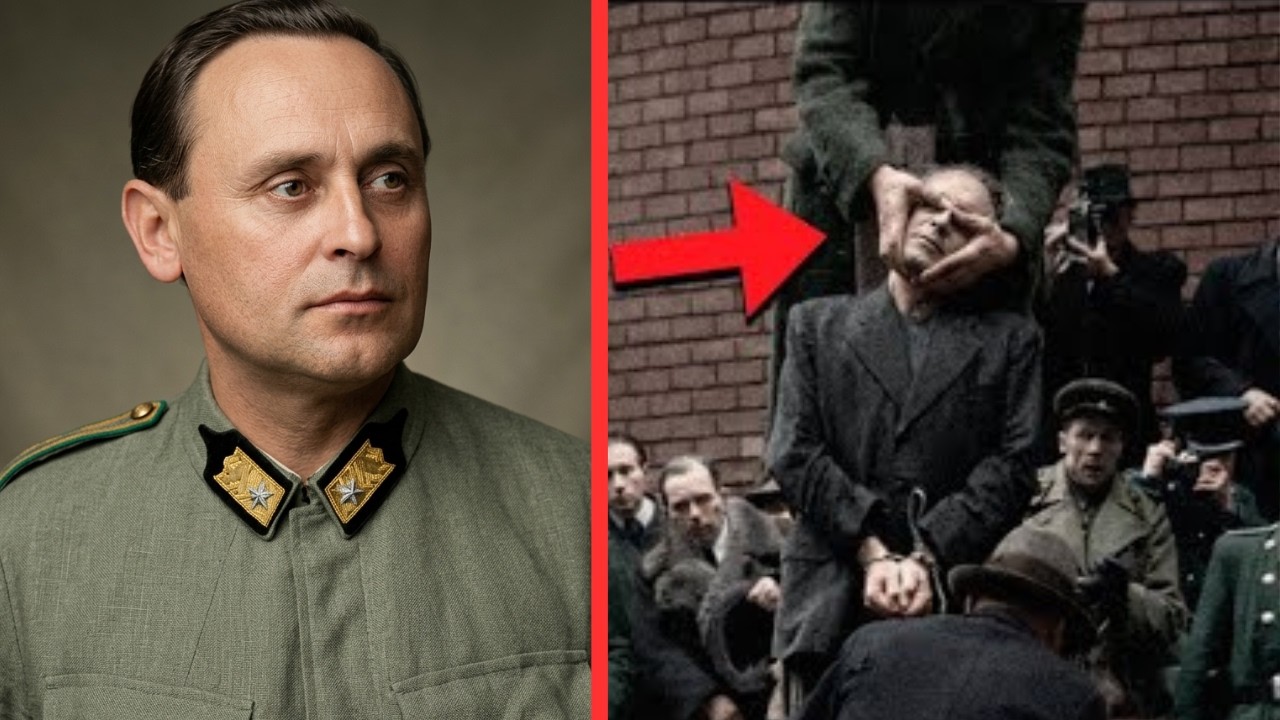
March 12th, 1946.
A freezing prison yard in Budapest.
A wooden execution pole stands waiting in silence.
A man in a heavy dark coat slowly walks toward it with his hands tied behind his back.
Only months earlier, he had called himself “Leader of the Nation.”
He had shaken hands with Adolf Hitler.
He had claimed God personally chose him to save Hungary.
Now guards are tying his legs to the pole.
A rope tightens around his neck.
In minutes, he will die slowly in front of witnesses as photographers secretly capture the execution.
His name was Ferenc Szálasi — the fascist dictator many later called:
“The Hungarian Hitler.”
But what made his story truly terrifying was not just how he died.
It was how a deeply religious, disciplined military officer transformed into the leader of one of Hungary’s bloodiest regimes — a man whose followers shot Jewish families into the icy Danube River while he prayed and spoke about Christian destiny.
THE QUIET SOLDIER WHO BECAME A FANATIC
Ferenc Szálasi was born in January 1897 in the town of Kassa.
His father was a soldier. His mother, a deeply religious Catholic woman with Slovak roots, reportedly raised him with strict faith and discipline.
As a young man, Szálasi joined the Hungarian Army and quickly rose through the ranks.
He fought on the front lines during World War I, earned medals for bravery, and built a reputation as an intelligent and disciplined officer.
Even many of his enemies later admitted something strange about him:
He was personally honest.
He did not drink heavily.
He avoided corruption.
He lived modestly and reportedly prayed every day.
That was what made him so dangerous.
Szálasi was not a violent street thug or greedy criminal.
He was a true believer.
THE MAN WHO TURNED HATRED INTO A RELIGION
During the 1930s, something changed inside him.
Obsessed with nationalism, religion, and anti-Semitic conspiracy theories, Szálasi created his own ideological movement called “Hungarism.”
He believed Hungary had been humiliated after World War I and claimed Jews secretly controlled politics, banking, capitalism, Marxism, and modern society itself.
Unlike Hitler, whose racism focused heavily on biology, Szálasi wrapped his hatred inside religious language.
He convinced himself he was carrying out God’s mission.
In 1935, he left the army and entered politics full time.
Soon he created the Hungarian National Socialist Party, which eventually evolved into the infamous Arrow Cross Party — Hungary’s fascist movement allied with Nazi Germany.
Its symbol was a green cross with arrows pointing outward in four directions.
To supporters, it looked ancient and sacred.
To victims, it became a symbol of terror.
THE DAY HITLER HANDED HIM HUNGARY
For most of World War II, Hungary walked a dangerous line.
Hungarian leader Miklós Horthy allied himself with Hitler but resisted deporting Hungarian Jews to extermination camps for years.
Then everything collapsed in October 1944.
As Soviet armies approached Hungary, Horthy secretly tried negotiating peace and withdrawing from the war. Hitler reacted immediately.
German forces kidnapped Horthy’s son, occupied Budapest, and forced Horthy from power at gunpoint during Operation Panzerfaust.
Hitler then installed Ferenc Szálasi as Hungary’s new ruler.
From the beginning, Szálasi pushed the country deeper into fanaticism and violence.
THE SHOES ON THE DANUBE
When Szálasi took power, around 200,000 Jews were still alive in Budapest.
Most would not survive the winter.
Arrow Cross gangs roamed the streets wearing green uniforms and armbands.
Jewish families were dragged from homes, beaten, robbed, and marched toward the Danube River.
Then came one of the most horrifying killing methods of the Holocaust.
Victims were forced to remove their shoes beside the freezing riverbank.
Shoes were valuable during wartime, so the killers collected them before executions.
Groups of prisoners were tied together.
Then Arrow Cross gunmen shot one person so the bodies would collapse into the icy Danube and pull the others in with them.
Thousands vanished beneath the freezing water.
Today, bronze shoes along the Danube memorialize the victims murdered under Szálasi’s regime.
THE FANATIC WHO KEPT PRAYING
Between October 1944 and March 1945, Arrow Cross forces murdered between 10,000 and 15,000 Hungarian Jews inside Hungary itself. Tens of thousands more were sent on death marches toward Austria.
Many froze to death.
Many starved.
Others were shot beside the roads when they became too weak to walk.
Roma communities were also hunted.
Yet despite the slaughter unfolding around him, Szálasi reportedly continued speaking about religion, Christian rebirth, and divine destiny.
He did not personally shoot victims.
He signed the orders.
THE DICTATOR RUNS FOR HIS LIFE
As Soviet forces closed in on Budapest, Szálasi did what many dictators eventually do:
He fled.
First toward western Hungary.
Then Austria.
Then Germany.
By May 1945, he was hiding in a small Alpine town when American troops arrived.
Unlike Hitler, Szálasi did not commit suicide.
He surrendered quietly.
For months, American interrogators questioned him about the war and the Arrow Cross regime.
Witnesses later said he showed almost no remorse.
He continued blaming Jews for Hungary’s destruction and spoke endlessly about destiny and faith.
THE TRIAL OF THE “HUNGARIAN HITLER”
In October 1945, the Americans handed Szálasi over to the new Hungarian government.
He was flown back to Budapest in chains and locked inside a prison beneath buildings once connected to his own regime.
His trial began in February 1946 inside Budapest’s Music Academy because the ordinary courts were overwhelmed with war crimes cases.
The courtroom had no heat.
Judges, witnesses, and even Szálasi wore heavy winter coats during proceedings.
The charges included:
- War crimes
- High treason
- Responsibility for mass murder
Survivors of the Danube killings testified against him.
Documents and signed orders linked him directly to deportations, executions, and loyalty pledges to Nazi Germany until the final days of the war.
Still, Szálasi defended himself with religion.
He insisted he had acted according to divine mission and Christian duty.
The court was unmoved.
On March 1st, 1946, he was sentenced to death by hanging.
THE EXECUTION ON THE WOODEN POLE
March 12th, 1946.
Inside Budapest’s Markó Prison yard, four leading Arrow Cross officials were brought out for execution — including Szálasi himself.
Before his death, a Catholic priest gave him final sacraments.
Then guards led him to the pole.
Unlike modern gallows, Hungary used the old Austrian pole hanging method.
It was slow.
Primitive.
And brutal.
Szálasi’s back was pressed against the wooden pole.
His legs were tied.
His arms were already bound behind him.
A rope tightened around his neck and attached to a hook above.
Then the small support steps beneath him were removed.
There was no long drop to break the neck instantly.
Instead, Szálasi slowly strangled to death against the pole while photographers documented the scene.
A second hidden photographer secretly took 32 unauthorized black-and-white photographs that would remain hidden for decades.
He was 49 years old.
THE FAKE GRAVE THAT HID HIM FROM HISTORY
But the strangest part came after his death.
Hungarian authorities feared Arrow Cross loyalists might transform Szálasi’s grave into a fascist shrine.
So they erased him.
Secret police altered the burial records and buried him under a fake identity:
“Ferenc Lukács.”
For more than 60 years, almost nobody knew where the “Hungarian Hitler” was actually buried.
Even more bizarre, official approval paperwork for rejecting his final appeal reportedly arrived three days after he had already been executed and buried.
The government wanted him gone so quickly they did not even wait for the paperwork to finish.
THE MAN WHO PRAYED WHILE HIS REGIME MURDERED THOUSANDS
Ferenc Szálasi remains one of the most disturbing figures of World War II because he shattered the stereotype of what evil is supposed to look like.
He was disciplined.
Religious.
Personally modest.
Considered honest by many who knew him.
And yet he still helped oversee the murder of thousands.
Even as the rope tightened around his neck, he reportedly believed God stood beside him.
That is why his story still haunts history today:
Because sometimes the most dangerous monsters are not violent criminals screaming with rage…
…but quiet believers absolutely convinced they are righteous.
