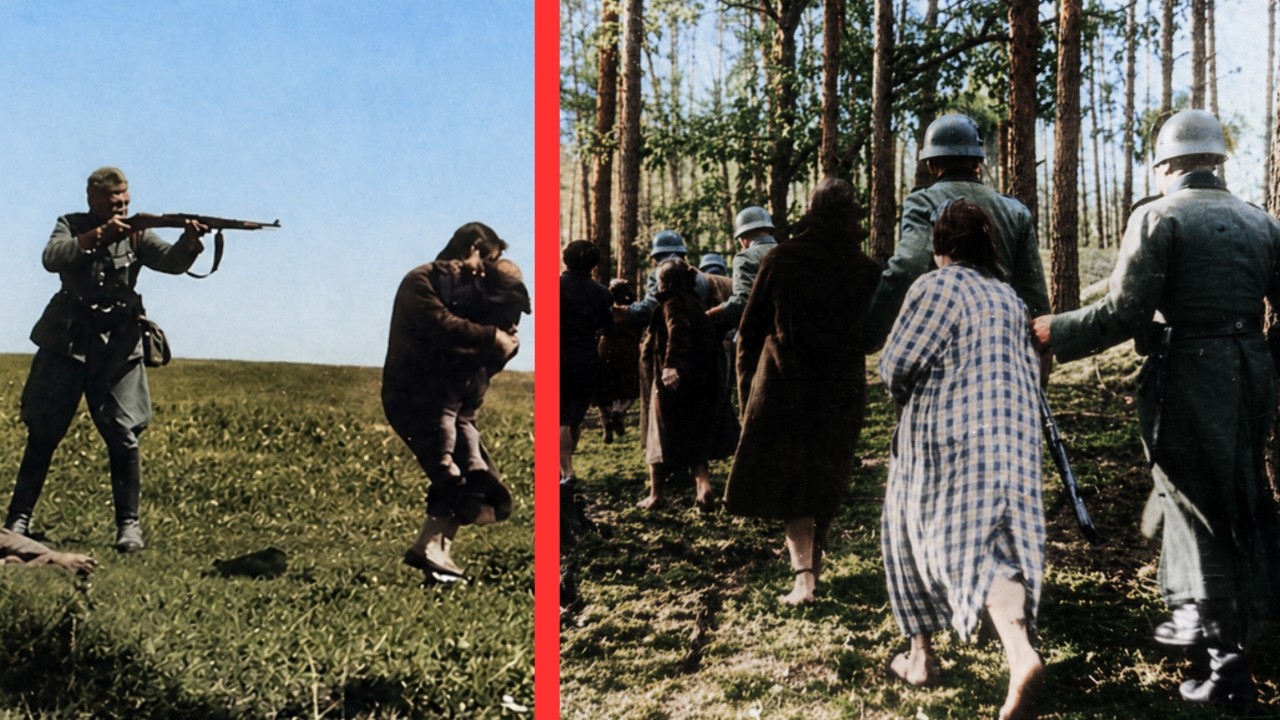
They were among the most feared and ruthless killers of World War II. But one of the darkest truths about the SS was that they did not only target soldiers or resistance fighters. Women, teenage girls, and even children often found themselves staring down the barrels of SS rifles with no chance of survival.
Inside Nazi ideology, gender meant nothing.
If someone was labeled a “racial enemy” or suspected of supporting resistance groups, the SS believed they deserved death. Jewish women, Slavic civilians, Roma families, and countless others across occupied Europe became targets of mass executions carried out with terrifying efficiency.
The SS had originally begun as Adolf Hitler’s personal bodyguard unit, but under Heinrich Himmler it evolved into one of the most powerful and terrifying organizations in Nazi Germany. The SS controlled concentration camps, death squads, racial policy, and brutal anti-partisan operations across Europe.
As German forces advanced into Eastern Europe, mobile SS killing units known as the Einsatzgruppen followed directly behind the army.
Their mission was horrifyingly simple:
Eliminate anyone considered dangerous to the Nazi regime.
Entire villages were rounded up. Men, women, and children were forced into open fields or forests while mass graves were prepared nearby. Witnesses later described how women were ordered to undress before being marched to the edge of giant pits. Then executioners delivered gunshots directly into the backs of their heads.
Thousands disappeared this way in Ukraine, Belarus, Poland, and other occupied regions.
In many massacres, entire communities were erased in a single day.
The SS training system encouraged absolute obedience and emotional detachment.
Nazi propaganda constantly portrayed Jews, Slavs, and other targeted groups as “subhuman.” Once victims were stripped of humanity in the minds of the killers, mass murder became easier for many SS men to commit repeatedly without hesitation.
But women were not only executed for racial reasons.
Across occupied Europe, especially in regions with active resistance movements, the SS suspected many women of helping partisans by hiding food, delivering messages, sheltering fighters, or supporting sabotage operations. Often little or no evidence was required before entire villages were punished collectively.
The SS deliberately used terror as a weapon.
Public shootings of women and elderly civilians were designed to spread fear throughout occupied populations and send a brutal message that no one was safe.
One of the most horrifying examples took place in the French village of Oradour-sur-Glane.
After resistance fighters reportedly killed an SS commander, German SS troops rounded up civilians in retaliation. Around 240 women and 205 children were locked inside the village church. The building was then set on fire, and anyone trying to escape was cut down with machine-gun fire outside. The village was virtually wiped out in only a few hours.
Inside concentration camps, the killings continued.
Female prisoners considered too weak or sick to work were often shot immediately. Some SS guards randomly opened fire on prisoners simply to terrorize them. Guards like Irma Grese became infamous for their cruelty toward women inside the camps.
As Nazi Germany began collapsing in 1945, the violence spread even further.
In Berlin and other German cities, SS death squads started targeting their own civilians. Women accused of hiding husbands or sons who refused to fight were sometimes executed for “cowardice” or “treason.”
By the end of World War II, millions of women across Europe had suffered under the SS system of terror.
For the SS, women were not protected by age, innocence, or gender. If they were seen as enemies, they could disappear forever with a single gunshot beside a mass grave.
