For eight seasons, Charlie Sheen was the highest-paid man on television, earning nearly $2 million per episode to play a hedonistic jingle writer named Charlie Harper on CBS’s Two and a Half Men. The line between the actor and the character was so blurred that millions of viewers believed they were watching Sheen play himself on a Malibu beach set. In the winter of 2011, that illusion shattered in a public meltdown that became a global spectacle, ending his tenure on the show and nearly destroying his career.
Now, sober and in his sixties, Sheen has finally broken his silence, releasing a memoir titled The Book of Sheen and a two-part Netflix documentary, AKA Charlie Sheen, in September 2025.
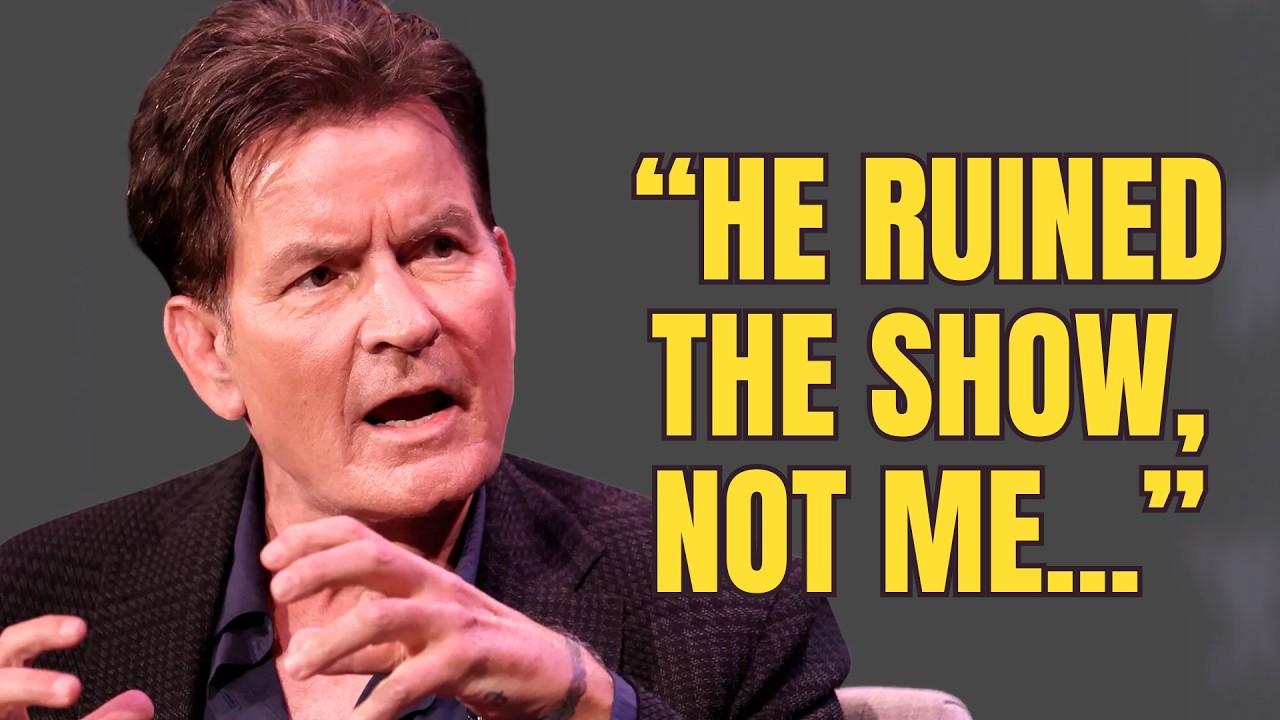 The documentary’s director admitted that Sheen initially resisted the project, but when he finally sat before the cameras, the man who once bragged about having “tiger blood” appeared less like a rock star and more like a weary father confronting his past. “I can’t imagine being my dad,” Sheen said, his voice catching with emotion. “I have really hurt the people I love.”
The confession was a stark departure from the swaggering figure who once summed up his downfall with a gambler’s arithmetic, claiming there were 55 ways to handle his situation and he chose number 56. To understand the magnitude of that choice, one must revisit the origins of the show and the creative partnership that made it possible.
The series was the brainchild of Chuck Lorre, a former rock guitarist turned battle-tested comedy writer with credits on Roseanne, Grace Under Fire, and Dharma & Greg. Working with his long-time partner Lee Aronsohn, Lorre conceived a premise rooted in ancient archetypes: two brothers forced to live together under one roof. One was a carefree bachelor who wrote advertising jingles, lived in a gorgeous beach house, and never met a cocktail or a woman he didn’t like.
The other was his uptight divorced brother, a chiropractor who arrives on the doorstep with his young son and nowhere else to go. Lorre later revealed that Alan was designed to be “the biblical Job,” the good man who can’t catch a break, while Charlie was modeled on Dionysus, the Greek god of wine and revelry.
For the role of the god of wine, there was really only one name. Charlie Sheen, born Carlos Estévez in 1965, was the son of Martin Sheen and had grown up surrounded by cameras. He soared through Platoon, Wall Street, and Major League, becoming one of the biggest young stars in Hollywood.
In his memoir, he admits that taking his father’s stage name was partly an escape hatch from his own academic and athletic failures. By the late ’90s, however, movie roles had cooled and tabloid headlines had heated up. Then came an unexpected lifeline: in 2000, he replaced Michael J.
Fox on the ABC comedy Spin City, a job many believed was impossible. Sheen won a Golden Globe for it, a detail that would prove painfully ironic a decade later when he watched someone else step into his shoes.
When Lorre pitched him the new show, Sheen was intrigued but cautious, demanding to see a finished script before committing. Lorre and Aronsohn locked themselves away and wrote the pilot, which carried the gloriously unbroadcastable working title Most Chicks Won’t Eat Veal. Sheen read it and said yes, and the character even shared his first name.
From the very first episode, the line between Charlie Sheen and Charlie Harper was almost impossible to find, even down to the bowling shirts that looked like something the actor might wear to the grocery store. Viewers knew about his appetite for nightlife, his complicated romances, and his history with substances, but on screen, all of that was turned into charming comedy. Charlie Harper lived the life that a certain kind of man fantasized about, and he never seemed to pay the bill.
Off screen, the bill was quietly mounting. But in 2003, none of that seemed to matter. Lorre had found his leading man, and the leading man had found what may have been the perfect role of his life.
Now he needed a brother. Jon Cryer was not an obvious choice. Audiences loved him as Ducky in Pretty in Pink, but his television career had been a string of cancellations, and the industry had stuck him with a brutal nickname: “show killer.”
Sheen didn’t care. The two men had first crossed paths in the ’80s auditioning for a movie that never got made, and they had worked together in the 1991 spoof Hot Shots. Sheen pushed for Cryer, Lorre agreed, and Cryer went in and nailed the role of Alan, insecure and fussy and somehow lovable.
The chemistry between the two men was obvious from the very first read.
Here is a delicious footnote: that same spring, Cryer had a choice between two pilots. One was Two and a Half Men. The other was a science fiction series called Battlestar Galactica, where he would have played the scheming scientist Gaius Baltar.
He chose the brother on the beach. Somewhere in an alternate universe, Ducky is fighting Cylons and Two and a Half Men lasted half a season. The final piece was the “half man.”
Lorre had seen a young boy named Angus T. Jones in the 2002 baseball movie The Rookie, and he was so convinced that he made an unusual decision: Jones was the first and only child actor to audition for the role of Jake. The boy was so relaxed and having such a good time that the decision was an easy one.
In the pilot, little Jake shuffles around in his pajamas, pestering his uncle’s poker buddies, while Charlie tries to win a hand.
 The supporting cast fell into place, too. Holland Taylor replaced Blythe Danner as the icy mother Evelyn, and Conchata Ferrell, hired as the housekeeper Berta, was asked to use an Eastern European accent. She suggested something closer to a trailer park instead.
The producers loved it so much that a character planned for only two episodes stayed for 12 seasons, rolling her eyes at the Harper brothers all the way to the end. When the show premiered on CBS in September 2003, it found its audience almost immediately. Before long, it was the biggest comedy on television.
The formula was deceptively simple: Charlie lounged at the piano, Alan fretted over his child support, Jake raided the refrigerator, Berta delivered insults, and Evelyn swept in like a cold front. Fans came for the jokes and stayed for the family.
For many viewers, especially those who had lived through a divorce or two, there was something oddly comforting about two grown brothers muddling through life under one roof. Jon Cryer won an Emmy in 2009, and Sheen’s paycheck kept climbing until, by the eighth season, he was reportedly earning $1. 8 million an episode, the highest salary on television.
Years later, Cryer explained the math with a touch of wonder: the studio had pre-sold a couple of extra seasons, so it was worth their while to spend this astonishing amount of money on Charlie. The money was astonishing. So, as it turned out, was what it was covering up.
Behind the laughter, Sheen’s private life was coming apart. His marriage to Denise Richards ended in a bitter divorce, and his marriage to Brooke Mueller turned volatile, culminating in his arrest in Aspen on Christmas day of 2009.
He was back on drugs, and in his memoir he does not pretend otherwise. But he does reveal something that surprised even long-time fans: when CBS chief Les Moonves pressed him to clean up, Sheen says he did give up the illegal substances. What he refused to give up was a testosterone cream he had been using to get in shape, which he admits he was slathering on in mind-altering gobs.
He believes it poured gasoline on everything that followed. With grim humor, he admits that “drugs” and “responsible” were two words he never made a habit of putting in the same sentence. It is a strange and rather sad confession: the most famous meltdown of the decade, by his own account, may have been fueled in part by something he bought to look better in a bowling shirt.
In late January of 2011, Sheen was rushed to the hospital after a wild party at his home. He entered rehab, his third stint in a single year, and production on the eighth season ground to a halt. What followed was a spectacle the world had never quite seen before.
Sheen took to radio shows, television interviews, and a brand new Twitter account, declaring that he had tiger blood, that he was winning, and that he was on a drug called Charlie Sheen. He aimed his fiercest insults at Chuck Lorre, calling him, among other things, a “contaminated little maggot.” Lorre was wounded far more deeply than most people realized.
He privately offered to walk away from his own show. “If for some reason I’m now the Antichrist,” he told fellow producers, “I’m happy to leave.” CBS refused to let him.
On March 7th, 2011, Warner Brothers fired Sheen, citing what it called “dangerously self-destructive conduct.” The highest-paid man on television was out of a job, and he had talked his way out of it. The person caught most painfully in the crossfire was Jon Cryer.
In the documentary, he recalls Sheen insisting from his hospital bed that he would be back next week, ready to work. Cryer was actually drafting a public statement of support for his old friend when his publicist told him what Sheen had just called him in the press: a traitor, a turncoat, and a troll. That one had to sting.
It was the kind of line Charlie Harper might have tossed at Alan, except this time nobody was laughing. Meanwhile, Lorre went hunting for a replacement. His first choice was Hugh Grant, who met with the producers and with Cryer before backing away.
Grant later explained that there was not yet a script for the new character, and he was not willing to sign on blind. “I’m too scared to sign up without a script,” he said. Cryer joked that Grant had been a cast member of Two and a Half Men for exactly 2 hours and 15 minutes.
Grant, for his part, admitted that he regretted it a little once he learned just how much American television stars get paid. Most of us would have regretted it, too. The job went to Ashton Kutcher instead.
 In the ninth season premiere, Charlie Harper was given a funeral attended by a parade of furious ex-girlfriends, and viewers learned that he had met his end in front of a train in Paris. Then Kutcher appeared on the deck as Walden Schmidt, a heartbroken internet billionaire. Kutcher had reportedly told his agent he would take the job if he could get a deal close to Sheen’s own salary.
Curiosity alone delivered nearly 29 million viewers, the largest audience in the show’s history. Sheen, watching from the outside, did not take it quietly, firing off insults at his replacement. Kutcher shrugged them off.
“Charlie Sheen has become like a parent on Charlie Brown to me,” he said. “Wah, wah, wah, wah.” Years later, a sober Sheen offered an apology that showed real insight.
“I was stupidly mean to him,” he admitted, “because I overlooked the reality and difficulty of taking over a show.” He had, after all, once stepped into Michael J. Fox’s shoes himself.
He knew exactly how hard it was. He simply forgot for a while during the worst year of his life. Those record ratings did not last, and many long-time fans could explain why.
Walden was a sweet, lovesick billionaire, not a rogue. The friction that powered the original show was gone.
Kutcher was likable, but likable had never been what the show was selling. Without a big brother to resent and lean on, Alan slowly changed from the long-suffering Job of Lorre’s original design into an outright freeloader. Lorre himself acknowledged that Alan had morphed over the years and become much broader.
There was a darkly funny irony in all of this, too: in 2012, Kathy Bates won an Emmy for playing the ghost of Charlie Harper. Even dead, the character was still collecting trophies. To be fair, the new era had its defenders, and Cryer won a lead acting Emmy that same year.
But for a great many viewers who had spent eight years in that beach house, something essential had left with Charlie. The show still had two men on the deck. It no longer had two brothers.
And it turned out the brothers had been the whole point.
Then the half-man grew up. In November of 2012, a 19-year-old Angus T. Jones, by then reportedly earning around $350,000 an episode, appeared in a video for a Christian ministry and stunned his own employers.
“If you watch Two and a Half Men, please stop watching Two and a Half Men,” he pleaded. “I’m on Two and a Half Men and I don’t want to be on it. Please stop filling your head with filth.”
He soon apologized to his colleagues, but the damage was done. After the 10th season, he was gone. The writers tried to fill the hole.
They introduced Charlie’s long-lost adult daughter, played by Amber Tamblyn, and eventually had Alan and Walden marry each other so that Walden could adopt a child. By then, the title barely described the show at all. The little boy in pajamas had become a young man who wanted out, and the family that viewers had loved had quietly scattered.
Watching those last seasons now feels a little like visiting a childhood home after strangers have repainted every room. When the series finale finally arrived in February of 2015, rumors swirled that Sheen would come back. In truth, Lorre did reach out.
His plan was for Charlie Harper to reappear, very much alive after years held captive by his stalker Rose, and then be flattened by a falling piano. Sheen was not interested in that ending. Instead, he pitched a spin-off called The Harpers, starring himself and Jon Cryer.
 Nobody jumped at the idea. After everything that had happened, few people in that building were ready to trust him again. So the finale went ahead with a double filmed from behind, a piano dropping from the sky, and then Chuck Lorre himself turning to the camera to say “Winning,” just before a second piano fell on him.
Lorre may have meant it as a wink, but many fans found it bitter rather than funny.
After 12 seasons and more than 260 episodes, the show that had begun with two brothers trading jokes at the piano ended with an old feud played out in slapstick. For Sheen, the years after were a long climb out of the rubble. He landed a new sitcom, Anger Management, which ran for 100 episodes.
In November of 2015, he went on national television to reveal that he was HIV-positive. And in late 2017, he got sober and stayed that way. For a man who once bragged that nobody could process him with a normal brain, it was a quiet and remarkable victory.
With a clear head, the regret came into focus. In 2021, he said he had essentially traded an early retirement for a hashtag and called his old behavior “desperately juvenile.” He described those months as an ocean of stress and a volcano of disdain, and then said the most important thing of all: “It was all self-generated.
That is the sad story at the heart of it.”
There was no villain who stole Two and a Half Men from Charlie Sheen. In his own telling, he handed it away, one furious tweet at a time, while a show that millions of people loved and a cast that had once been like family paid the price right alongside him. And yet, there was one more scene.
In 2023, Chuck Lorre called Sheen’s representative and offered him a role on his new Max comedy, Bookie, playing a heightened version of himself. “I was nervous,” Lorre recalled, “but almost as soon as we started talking, I remembered we were friends once.” At the table read, the two men hugged.
Lorre said Sheen proceeded to kill it as if they had not missed a beat. Sheen made only one real request, Lorre said: he did not want to play an addict. Then the two of them had an idea.
They would recreate the poker game from the 2003 pilot with nearly all of the original players.
Lorre picked up the phone and called Angus T. Jones. This time, the boy who once shuffled around the table in pajamas sat down and played a hand, and Sheen joked that the kid had grown some.
“We did 170 episodes together before it all fell apart,” Lorre said of Sheen. “For one evening at least, it came back together.” The only person missing from that table was the brother.
Jon Cryer did take part in Sheen’s documentary, and he did not hold back. “When I started, I had hair,” he quipped about working beside Sheen for eight years. But he also offered a diagnosis that stopped Sheen cold.
“He’s a guy that doesn’t believe he deserves the things he has,” Cryer said. Sheen later admitted, “Suddenly, I felt like I was on a couch in Jon’s therapy office, and he was dead on.” He sent Cryer a note of thanks and, by his account, never heard back.
And he publicly asked his old co-star to send his new number.
Cryer, for his part, has been gentle but clear. “It’s kind of a roller coaster when you have Charlie in your life,” he said. “And I just haven’t decided to get back on that roller coaster.”
Perhaps that is the saddest revelation of all. A man was handed the role of a lifetime, a loyal brother, a devoted audience, and a fortune, and some part of him never believed he deserved any of it. The beach house is gone now, but for millions of viewers, those first eight seasons still play on.
Two brothers at a piano, one of them grinning as if he had already won. The tragedy is that he had won, and he threw it all away.
