The obsidian blade descended in a flash of black glass, and the heart of the captured warrior was torn from his chest, still beating, as the drums of Tenochtitlan drowned out the final gasp of the condemned. This was not a random act of violence but the climax of a meticulously choreographed spectacle known as the Flaying of Men, a ritual that defined the second month of the Aztec calendar and horrified the Spanish conquistadors who witnessed its aftermath. The victim, a prisoner of the Flower Wars, had just spent the last agonizing hour fighting for his life against the empire’s most elite soldiers, armed only with a club edged in feathers, and now his skin would be worn as a suit by his captor for the next twenty days.
The scene unfolded in the heart of the Aztec capital, a city of such grandeur and cleanliness that it left European soldiers questioning whether they were dreaming. On the second day of the month dedicated to Xipe Totec, the Flayed Lord, the great stone wheel was positioned in the central plaza, a massive circular carving depicting the glory of Aztec conquest. The prisoner, having been bathed, purified, and dressed as the living embodiment of the god of renewal, was led to the stone with a rope tied around his waist, its length just enough to allow him to circle the perimeter.
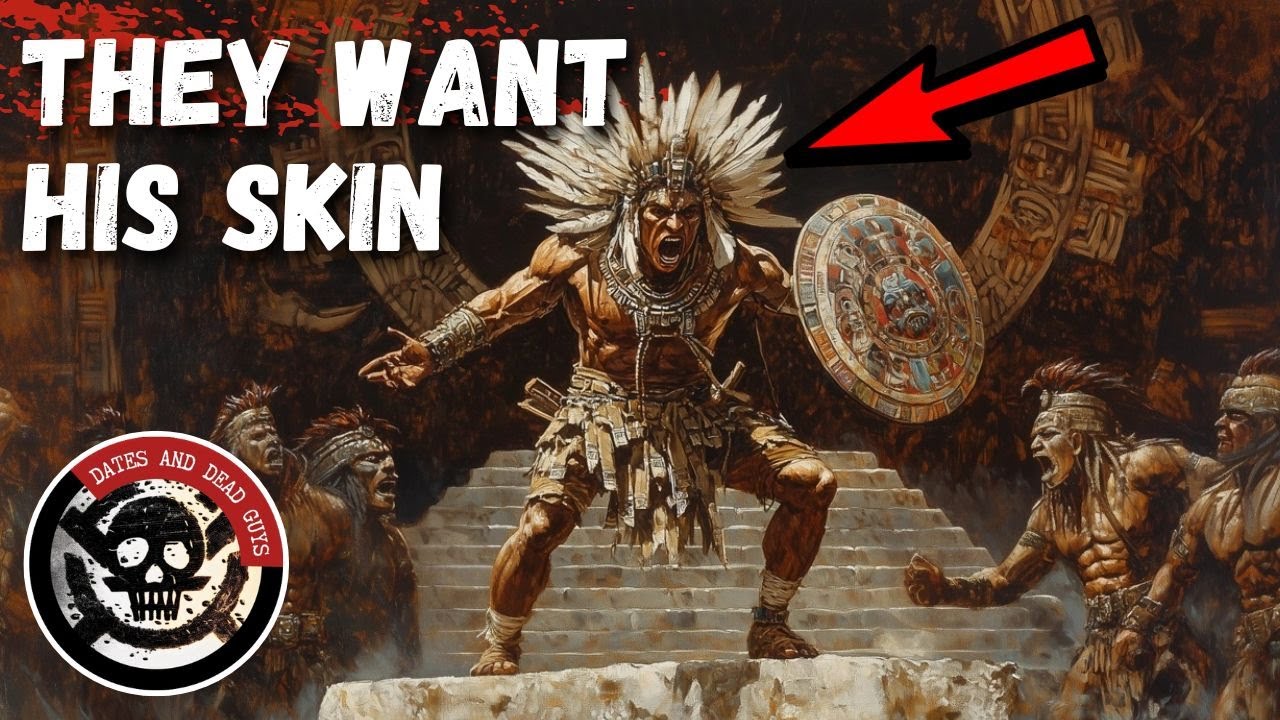 He was given a shield and a macuahuitl, but the wooden sword was stripped of its obsidian blades, leaving only a harmless club adorned with feathers, a cruel mockery of the weapon that had likely felled him in battle.
The crowd, a sea of thousands, chanted and swayed as the priests took their positions, their faces painted and their bodies adorned with the regalia of the gods. The high priest, distinguished by golden armbands and a headdress of quetzal feathers, rose from his seat and approached the stone, walking around it twice to sanctify the ground. He checked the prisoner’s bonds, ensuring they were secure, and then offered him a sip of divine wine, a final comfort before the ordeal began.
The prisoner, according to Aztec accounts, was expected to behave with courage, to praise his own city and his gods, for he was fulfilling a sacred duty that transcended his own mortality.
Then came the warriors. Four of the empire’s most feared fighters, dressed in the skins of eagles and jaguars, ascended the platform, their macuahuitls gleaming with obsidian shards sharper than surgical steel. The first warrior approached, shield raised, and the prisoner hurled wooden balls at him, a desperate and futile gesture that was easily deflected.
The fight began in earnest, the prisoner swinging his feathered club with all the strength he could muster, but the warriors were trained from birth to kill, and their blades found his legs, slicing deep into muscle and tendon. The prisoner stumbled, blood pooling on the stone, but he did not fall immediately, and the crowd roared with a mixture of bloodlust and respect for his defiance.
Aztec history records the tale of Tlalhuicol, a captive from the neighboring city of Tlaxcala, who killed eight warriors and wounded more than twenty others with his feathered club before he finally collapsed from exhaustion and blood loss. His story was told for generations as the epitome of warrior courage, but even he could not overcome the relentless assault of the eagle and jaguar knights. The ritual was designed not for the prisoner to win but to die with honor, to provide a spectacle that reinforced the power of the Aztec state and its divine mandate.
When the prisoner finally fell, disarmed and bleeding, the priests seized him and dragged him to the sacrificial stone at the base of the Templo Mayor, where the high priest performed the fatal incision.
The heart, still pulsing, was placed into a painted gourd shaped like a jaguar or an eagle, an offering to the gods who demanded blood as tribute. The warrior who had originally captured the prisoner in the Flower Wars stood nearby, and he was given a portion of the victim’s blood to drink, a symbol of his martial prowess and his connection to the divine. The body was then cut into pieces, and the limbs were distributed to the captor and his family, who would consume the flesh in a ritual act of cannibalism, believing that they would inherit the courage and strength of the fallen warrior.
This was not a secret practice but a public and celebrated part of the ceremony, one that the Spanish chroniclers described with a mixture of revulsion and disbelief.
The sacrifices continued until every prisoner lined up in front of the skull rack had been defeated and killed, their heads added to the thousands already mounted on the wooden structures that dominated the city center. The skull racks, or tzompantli, were a terrifying display of Aztec power, a constant reminder to enemies and allies alike of the blood debt owed to the gods. But the ritual of the Flaying of Men did not end with death.
The most haunting aspect of the ceremony was yet to come, as the priests and warriors who had captured the victims began the process of flaying, carefully removing the skin from the bodies in large, intact sheets.
The skinned ones, known as the Xipime, would then don the skins of their victims, wearing them like suits for the next twenty days. The skin was still fresh, and it clung to their bodies, the hands of the dead dangling from their wrists and the faces of the dead hanging over their own. They were the living image of Xipe Totec, the god of renewal, who shed his own skin to feed the earth and ensure the growth of new life.
 To the Aztecs, the act of wearing the skin symbolized the shedding of the old to make way for the new, the seed emerging from the husk of the corn, but to the Spanish, it was an abomination that defied comprehension.
The Xipime paraded through the streets of Tenochtitlan, engaging in mock battles and soliciting gifts and donations from the citizenry, who were obligated to give generously to fund the grand feast at the end of the month. They were said to smell like dead dogs, as they were forbidden from bathing for the entire twenty-day period, and the skin slowly rotted on their bodies, attracting flies and spreading a stench that permeated the city. The sight of these walking corpses, their faces obscured by the flayed visages of the dead, was a spectacle that the Aztecs revered but that left the Spanish conquistadors utterly horrified, their accounts of the ritual reading like descriptions of a nightmare.
Bernal Diaz del Castillo, a soldier in Hernán Cortés’s expedition, wrote extensively about the Aztec practices, describing the flaying and the wearing of skins with a level of detail that suggests he either witnessed it firsthand or heard it from reliable sources. He wrote of the temple walls stained with blood, of the priests with their hair matted and their robes crusted with gore, and of the skull racks that held the heads of thousands of sacrificial victims. Yet, even as he recoiled in horror, he also expressed awe at the city itself, marveling at its size, its cleanliness, and its sophisticated infrastructure, a stark contrast to the squalor of many European cities of the time.
The Flaying of Men was only one of eighteen monthly ceremonies in the Aztec calendar, each dedicated to a different deity and each involving its own form of sacrifice. Some months saw captives burned alive, others saw them shot with arrows, and still others saw them drowned, their bodies offered to the rain god Tlaloc. The scale of human sacrifice in the Aztec Empire is a subject of intense debate among historians, with estimates ranging from 20,000 to over 80,000 victims per year, a number that, if accurate, would make the Aztecs the most prolific sacrificers in human history.
The Spanish, who were themselves no strangers to violence, were so horrified by what they saw that they used it as a justification for the conquest and the destruction of the Aztec civilization.
The victims were not always prisoners of war. Some were volunteers, individuals who believed that dying on the sacrificial stone was an honor and a guarantee of a place in the highest level of the Aztec afterlife. Others were slaves, purchased specifically for the purpose of sacrifice, and still others were children, whose tears were believed to bring rain.
The Aztecs believed that the gods had created the world through self-sacrifice, and that the sun would not rise unless it was nourished with human blood. This belief system, while alien to the European mind, was deeply held and permeated every aspect of Aztec life, from the grandest temple ceremony to the most mundane daily activity.
The Flower Wars, which were fought specifically to capture prisoners for sacrifice, were a unique institution in the history of warfare. The Aztecs would agree with their enemies, such as the Tlaxcalans, to meet on a designated battlefield at a designated time, and they would fight a limited engagement with the primary goal of capturing prisoners rather than killing the enemy. These wars were not about territorial expansion or political dominance but about feeding the insatiable appetite of the gods.
The prisoners taken in these wars were treated well, often for months or even years, before their sacrifice, and they were expected to participate in their own death ritual with dignity and courage.
The city of Tenochtitlan, built on a lake in the Valley of Mexico, was a marvel of engineering and urban planning. It was home to over 250,000 people, making it one of the largest cities in the world at the time, larger than most European capitals. The city was connected to the mainland by causeways, and it featured a complex system of canals, aqueducts, and floating gardens known as chinampas, which provided food for the massive population.
The Aztecs had a sophisticated understanding of sanitation, and the city was kept remarkably clean, with public baths and a system for waste disposal that was far ahead of its time. The Spanish soldiers, who were accustomed to the filth of European cities, were astounded by the cleanliness of Tenochtitlan.
 The Aztecs were also skilled astronomers, mathematicians, and artists. They developed a complex calendar system that was more accurate than the Julian calendar used in Europe, and they built massive pyramids and temples that rivaled the great monuments of Egypt and Rome. Their art, particularly their sculpture and featherwork, was highly sophisticated, and their codices, or painted books, recorded their history, religion, and knowledge in intricate detail.
The Spanish, however, saw these achievements as the work of the devil, and they systematically destroyed Aztec artifacts, codices, and temples in an effort to eradicate the native religion and culture.
The destruction of the Aztec civilization was swift and brutal. Cortés, with a small force of Spanish soldiers and a large number of native allies who were enemies of the Aztecs, laid siege to Tenochtitlan in 1521. The siege lasted for months, and the city was eventually starved into submission, its population decimated by disease, hunger, and violence.
The Spanish then razed the city to the ground, building Mexico City on its ruins, and the Aztec Empire was no more. The practice of human sacrifice, which had been so central to Aztec religion and culture, was brutally suppressed, and the surviving Aztecs were forced to convert to Christianity and adopt Spanish customs.
But the memory of the Flaying of Men and the other Aztec rituals did not die. It lived on in the accounts of the Spanish chroniclers, in the surviving Aztec codices, and in the archaeological remains that continue to be unearthed in Mexico City to this day. The stone wheel, the sacrificial stones, and the skull racks have all been found, and they serve as a chilling reminder of a civilization that was both magnificent and terrifying.
The Aztecs were a people of profound contradictions, capable of building a city of incredible beauty and sophistication while also practicing ritual violence on a scale that is almost incomprehensible to the modern mind.
The ritual of the Flaying of Men, in particular, stands out as one of the most brutal and haunting practices in human history. The image of a man, stripped of his skin, being worn as a suit by his captor, is a visceral and disturbing one, and it speaks to a worldview that is fundamentally alien to our own. For the Aztecs, the skin was not just a physical covering but a symbol of renewal and rebirth, a way of connecting the living to the dead and the human to the divine.
The act of wearing the skin was a form of communion, a way of absorbing the power and courage of the sacrificed victim and ensuring that his death had meaning.
The Aztecs believed that the world was a precarious place, constantly threatened by the forces of chaos and destruction. The gods had created the world through sacrifice, and they demanded that humans repay that debt in kind. The sun, the moon, the rain, the corn, all of these were gifts from the gods, and they could be taken away at any moment if the gods were not properly appeased.
Human sacrifice was not a perversion but a necessity, a way of maintaining the cosmic order and ensuring the survival of the world. This belief was so deeply ingrained that even the victims themselves often accepted their fate, seeing their deaths as a noble and honorable act.
The Spanish, of course, saw things very differently. They viewed the Aztec practices as the work of Satan, and they used them as a justification for the conquest and the forced conversion of the native population. The accounts of the conquistadors, such as Bernal Diaz, are filled with descriptions of the horrors they witnessed, and these accounts were used to portray the Aztecs as savages who deserved their fate.
 The irony is that the Spanish themselves were responsible for atrocities that rivaled those of the Aztecs, including the massacre of native populations, the destruction of their cultures, and the enslavement of millions. The conquest of the Americas was one of the bloodiest episodes in human history, and the Spanish were no more moral than the people they conquered.
The legacy of the Aztecs is a complex and contested one. On the one hand, they were a brilliant and innovative civilization that made significant contributions to human knowledge and culture. On the other hand, they practiced ritual violence on a scale that is difficult to reconcile with our modern sensibilities.
The Flaying of Men is a reminder that human beings are capable of both great beauty and great cruelty, and that the line between civilization and savagery is often thinner than we would like to believe. The Aztecs were not monsters, but they were products of a worldview that is fundamentally different from our own, and it is important to understand that worldview if we are to truly comprehend their history.
As the skin rotted on the bodies of the Xipime, and the city of Tenochtitlan prepared for the next month’s ceremonies, the Aztecs were unaware that their world was about to end. The Spanish had already arrived on the shores of the Gulf of Mexico, and they were marching toward the capital with an army of native allies who had been subjugated by the Aztecs for generations. The Aztecs, who had conquered and dominated their neighbors for centuries, had made many enemies, and those enemies were now aligning with the Spanish in a desperate bid for freedom.
The fall of Tenochtitlan was not just the result of Spanish military superiority but also of the deep-seated resentment that the Aztec Empire had engendered among its subjects.
The siege of Tenochtitlan was a brutal and protracted affair, marked by disease, starvation, and desperate hand-to-hand combat. The Aztecs fought with a ferocity that surprised even the Spanish, and they inflicted heavy casualties on the invaders. But in the end, they were overwhelmed by superior numbers and technology, and the city fell.
The last Aztec emperor, Cuauhtémoc, was captured and tortured, and the city was systematically destroyed. The temples were torn down, the codices were burned, and the population was decimated by smallpox and other European diseases to which they had no immunity. The Aztec civilization, which had been at its height just a few years earlier, was wiped from the face of the earth.
The story of the Flaying of Men is a story of a civilization that believed it was fulfilling a divine mandate, a civilization that saw death as a necessary part of life, and a civilization that was ultimately destroyed by the very forces it sought to appease. The Aztecs believed that the gods demanded blood, and they gave it in abundance, but in the end, it was not enough. The gods, whether they were the old ones of the Aztec pantheon or the new ones of the Christian invaders, did not save them.
The Aztec Empire, like all empires, eventually fell, and its rituals and beliefs were consigned to the dustbin of history, remembered only in the accounts of their conquerors and the silent stones of their ruined temples.
The ritual of the Flaying of Men, with its gruesome details of skinning and wearing human flesh, remains one of the most disturbing practices ever recorded. It is a testament to the power of belief, the lengths to which humans will go to honor their gods, and the capacity for violence that lies within us all. As we look back on the Aztecs, we are forced to confront uncomfortable questions about our own nature, our own beliefs, and our own capacity for cruelty.
The Aztecs were not so different from us, and the Flaying of Men is a reminder that the potential for such horror exists in every human society, waiting for the right conditions to emerge.
