The air over the southwestern Minnesota prairie was thick with the smell of gunpowder and rain when Lavina Eastlick, bleeding from four gunshot wounds and cradling her skull, watched the Dakota war party ride away from the Slaughter Slough. She had just witnessed the brutal murder of her five-year-old son, Freddy, beaten and stabbed before her eyes. She had left her dying son Frank face-down in the mud, praying for God to release him from his agony.
Her husband, John, lay dead in the tall grass, his loyal dog still standing guard over his body. The date was August 20, 1862, and the Lake Shetek Massacre had just claimed dozens of lives in a brutal ambush that would become one of the darkest chapters in the Dakota War of 1862.
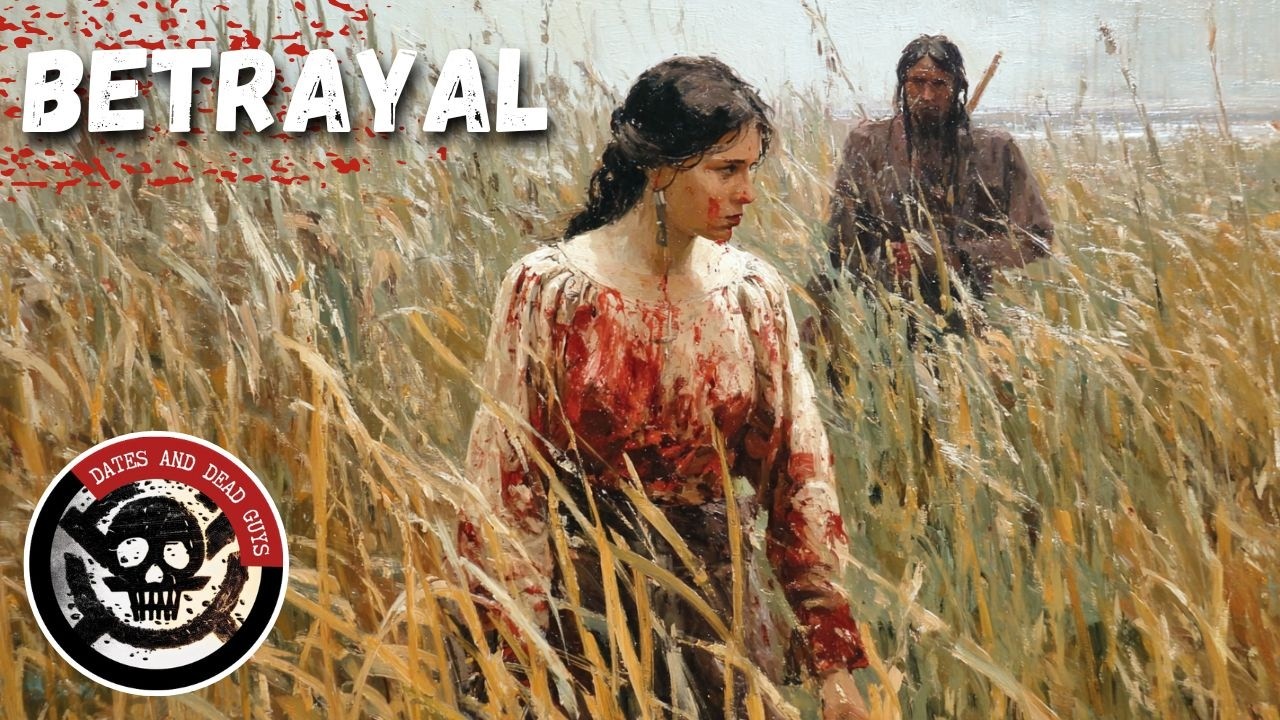 Lavina’s ordeal began as a morning of mundane domesticity. She was preparing breakfast for her five sons—Mertin, 11, Frank, Freddy, Giles, and 15-month-old Johnny—when their neighbor, Charlie Hatch, burst through the cabin door, gasping for air. “The Indians are upon us!”
he shouted. Hatch had discovered the body of a man named Voit, shot dead at the Herd cabin just moments earlier. The Eastlick family had only seconds to flee.
John grabbed two rifles and the baby, while Lavina, in a panic, tried to grab clothes. John knocked them out of her hands. There was no time.
She was pushed out the door barefoot, her feet already raw against the rough terrain.
The family ran south, joining a growing group of settlers who had gathered at the Wright cabin, where a band of Dakota men, including a man named Pawn, had promised to fight alongside them. Lavina was suspicious. She had seen Pawn days earlier, eyeing her horse with an unsettling intensity.
“I don’t trust them,” she told John. He tried to calm her, but his own doubts were evident. The group of 34 settlers, mostly women and children, decided to abandon the cabin and make a desperate run for Fort Ridgely, roughly 50 miles away.
They loaded the women and children into a wagon and set out, hoping the war party would let them pass.
They did not. Within a mile, the sound of thundering hooves and the high-pitched Dakota war cry filled the air. The settlers abandoned the wagon and fled into a dry slough, a swampy depression filled with tall grass that offered concealment but no real protection.
For two hours, the Dakota warriors took turns firing down from a nearby hilltop. Lavina later wrote, “Balls fell around us like hail.” She was shot in the heel, then in the side, and finally a bullet lodged between her skull and scalp.
 John, trying to defend his family, was discovered and killed instantly. His last sound was a faint groan.
As the firing slowed, a familiar voice called out from the hill. It was Pawn. He promised the women and children would be spared if they surrendered.
Tommy Ireland stood up to beg for mercy and was shot through the chest and arm. The settlers, exhausted and out of ammunition, began to rise. Lavina, her head bleeding profusely, stopped at her husband’s body.
She moved on, helped by her sons Frank and Giles. Then the betrayal became clear. Pawn’s promise was a lie.
As Lavina was held by a warrior, she watched an old Dakota woman beat her son Freddy with a club and stab him repeatedly. Frank was shot through the mouth, bowels, and thigh. Lavina was then forced to walk away, her body screaming in pain.
She was shot a fourth time, the ball passing through her back and right forearm. She fell, and a warrior bashed the back of her head with his rifle butt. Playing dead, she lay motionless in the pouring rain for three hours, waiting for the knife that never came.
When she finally rose, she found herself in a scene from hell. The slough was littered with the bodies of her neighbors, some tortured, others dying. She found her son Giles, dead from a chest wound.
She found Frank, still breathing, but clearly dying. “I wish to lie down and die beside my sweet boy,” she wrote, but she knew she had to find Mertin and baby Johnny, who were missing.
 Lavina searched through the night, hiding in the grass during the day to avoid detection. She heard the cries of captives in a nearby camp, followed by gunshots, and feared her remaining sons were dead. On the third day, she made her way to a friend’s house on Buffalo Lake, 16 miles away, where she found Tommy Ireland, miraculously alive.
He told her the news that would give her the strength to continue: Mertin and Johnny were alive. The 11-year-old boy had hidden in the slough during the surrender and, carrying his baby brother, had walked 50 miles to safety in two days without food.
Lavina, Tommy, and a mail carrier set out to find them. They traveled for over a day, following the trail toward New Ulm. When they finally found Mertin, he was silent, Johnny sleeping in his arms.
Lavina took the baby and hugged her sons. The reunion was short-lived. They were still in hostile territory, and the group—now including Mrs.
Herd and her children, survivors of the initial attack—found shelter in an abandoned cabin. They stayed there for nine days, recovering from their wounds. Lavina’s foot was so swollen she could not walk; she crawled or relied on Mertin.
Finally, a contingent of 14 soldiers arrived, alerted by Tommy Ireland, and escorted them to safety in New Ulm.
The Lake Shetek Massacre was a microcosm of the larger Dakota War, which erupted in August 1862 after the U. S. government failed to deliver promised annuities and rations to the Dakota people.
Starving and desperate, they had been told by a trader, Andrew Myrick, to “eat grass or their own dung.” The war that followed killed over 350 civilians and led to the largest mass execution in American history, when 38 Dakota men were hanged in Mankato, Minnesota. The rest were forcibly removed from the state, their lands seized.
 Lavina Eastlick survived, but her body and heart were forever scarred. She lost her husband, John, and three sons—Freddy, Giles, and Frank. Her injuries left her foot and arm permanently damaged.
Yet she lived, and she wrote her story, a harrowing account of survival against impossible odds. Mertin, the 11-year-old hero, became a local legend, celebrated by soldiers for carrying his baby brother to safety. The family’s photograph, taken shortly after the tragedy, shows a mother and her two surviving sons, their faces etched with a grief that words cannot capture.
The massacre at Lake Shetek was not an isolated incident of random violence. It was the result of decades of broken promises, forced removals, and systemic neglect by the U. S.
government. The Dakota people, pushed onto reservations with insufficient land and resources, were starving. When they asked for help, they were met with contempt.
The war that followed was a desperate, doomed uprising, and its consequences were catastrophic for both settlers and Dakota alike. For the settlers, it was a nightmare of terror and loss. For the Dakota, it was the final act of dispossession, leading to their exile from their ancestral homeland.
Lavina’s account, preserved in historical records, remains one of the most detailed and harrowing survivor narratives of the Dakota War. It is a testament to the resilience of the human spirit, but also a reminder of the brutal cost of westward expansion. The Slaughter Slough, where so many died, still bears its grim name.
The bodies of the victims were later recovered and reburied, but the scars on the land and in the memory of the survivors remain. Lavina Eastlick died in 1917, but her story lives on, a haunting echo of a day when the prairie ran red with blood and a mother’s love was tested beyond all reason.
