The heart of Tenochtitlan, the gleaming island capital of the Aztec Empire, was not merely a city of canals and towering pyramids; it was a stage for a terrifying theater of blood. In the second month of the Aztec calendar, a ceremony unfolded that defied the imagination of the Spanish conquistadors who would later chronicle its horrors. This was Tlacaxipehualiztli, the “Flaying of Men,” a brutal ritual of gladiatorial sacrifice designed to appease Xipe Totec, the god of renewal and spring.
Here, in the shadow of the great Templo Mayor, the line between honor, terror, and the divine was erased in a spectacle of violence that would echo through history.
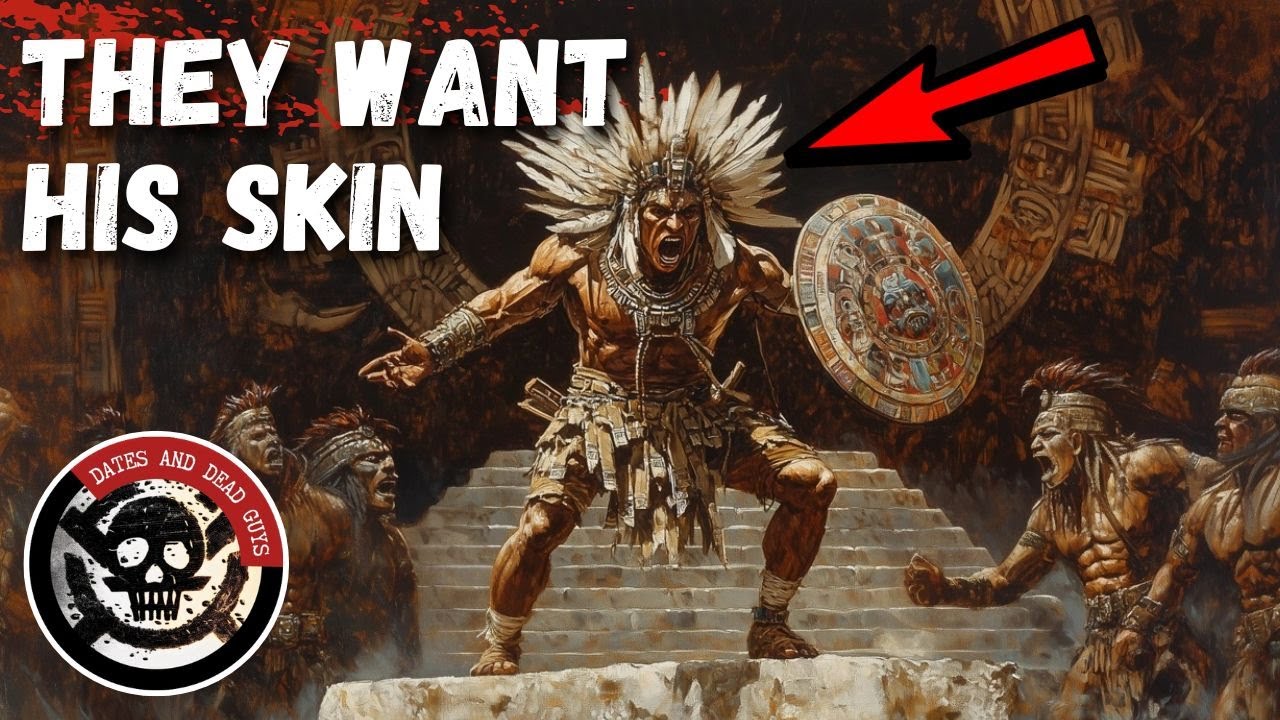 The prisoners, captured in the ritualized “Flower Wars” fought specifically to secure victims for the gods, were not simply led to the slaughter. They were prepared for a performance. Bathed and purified, they were transformed into living embodiments of Xipe Totec, their bodies smeared with plaster and adorned with feathers, their eyelids painted black and lips stained red.
They were the centerpiece of a grand diplomatic event, with the Aztec ruler inviting kings from rival nations to witness the power of his empire and the favor of his gods. The city itself, a marvel of engineering home to a quarter-million people, became a coliseum for this deadly contest.
The stage was a massive stone wheel, carved with depictions of Aztec military glory, some measuring up to twelve feet across. A rope was tied to a hole in its center, and the other end was secured around the prisoner’s neck, waist, or ankle, allowing him just enough slack to circle the stone’s perimeter. His weapons were a cruel mockery of a warrior’s arsenal: a shield and a macuahuitl, but instead of the razor-sharp obsidian blades that could slice through flesh with surgical precision, this club was edged only with feathers.
He was a gladiator armed for a fight he was never meant to win, a man sent to die for the entertainment of the masses and the sustenance of the gods.
As the drums began to beat and the crowd chanted, the first of four elite Aztec warriors ascended the stone. Dressed in the fearsome regalia of jaguars and eagles, these were the most skilled and decorated fighters of the empire, men who had proven their prowess by capturing enemies in battle. Their macuahuitls, in stark contrast to the prisoner’s, were lined with obsidian blades sharper than any European steel.
The fight was not a duel of equals but a trial of endurance, a slow and brutal execution designed to showcase the courage of the victim and the martial supremacy of his captors.
The prisoner was given wooden balls to throw at his attackers, a desperate and futile gesture of defense. The warriors would advance, their obsidian-edged clubs slashing at the victim’s legs, hacking at his flesh to weaken him and draw blood. The goal was not a quick kill but a prolonged spectacle of suffering.
 The victim, bleeding and exhausted, would parry with his feathered club, but the blows were ineffective. Some prisoners, like the legendary Tlaxcalan warrior Tlahuicole, fought with such ferocity that they killed eight warriors and wounded many more before finally succumbing, but such defiance was a rare and celebrated anomaly.
The end was inevitable. The prisoner, weakened by blood loss and exhaustion, would eventually collapse, his feathered macuahuitl falling from his grasp. The elite warriors would then disarm him, and the high priest, adorned in golden armbands and a feathered headband, would ascend the stone.
With a single, practiced stroke of his black obsidian knife, he would cut open the victim’s chest and tear out his still-beating heart. The heart was placed in a painted gourd, an offering to the gods, while the body was rolled down the steep temple steps, leaving a trail of crimson on the stone. At the bottom, warriors waited to hack off the limbs and head.
The ritual did not end with the death of the gladiator. The body of the sacrificed warrior was butchered and consumed in a form of ritual cannibalism. The captor and his family would eat parts of the flesh, believing that by ingesting the brave warrior, they would inherit his courage and strength.
This was not an act of savagery in the Aztec mind, but a sacred communion, a way to honor the fallen and absorb their martial spirit. The skull was added to the massive tzompantli, the skull rack that stood in the city center, a grim monument to the empire’s power and its insatiable debt to the gods.
But the most haunting part of the ceremony was yet to come. After the heart was torn from the body, the skin of the victim was meticulously flayed, removed in one piece. This fresh, bloody skin was then worn by a priest or a warrior, who became known as a Xipime, or “Skinned One.”
 For twenty days, these individuals would parade through the city, wearing the rotting flesh of the dead as a suit. They would engage in mock battles and solicit gifts and donations from the citizenry, their bodies reeking of decay. The skin was a symbol of Xipe Totec, representing the shedding of the old to make way for the new, the husk of a seed that gives life to the sprout.
The Xipime were not allowed to bathe for the entire twenty-day period. The skin, denied any preservation, would begin to rot and decompose on their bodies. The stench, described by chroniclers as the smell of dead dogs, would cling to them as they moved through the city.
This was not an unintended consequence but an integral part of the ritual. The decay was a physical manifestation of the cycle of death and rebirth, a visceral reminder that life emerges from death. The skin was a costume of mortality, worn to honor a god who embodied the eternal renewal of the earth.
At the end of the twenty days, the captors of the sacrificed victims would host a great feast, funded by the donations collected by the Xipime. Only then were the Skinned Ones allowed to remove their gruesome garments. The rotting skins were buried in a cave beneath a temple, returned to the earth from which new life would spring.
The bones of the victims, however, were kept by their captors, to be used in future ceremonies as powerful relics. The cycle was complete, but the memory of the bloodshed would linger, a testament to a civilization that saw death not as an end, but as a necessary fuel for the sun and the harvest.
The scale of this violence is difficult to comprehend. Historians estimate that the Aztecs sacrificed up to 20,000 people a year, a figure that some believe to be conservative. This was a civilization that had built magnificent aqueducts, floating gardens, and a city that astounded the Spanish, who wondered if they were dreaming.
 Yet, this same civilization was driven by a profound and terrifying belief that the gods demanded a constant tribute of human blood to keep the world from ending. The ritual of the Flaying of Men was not an act of random cruelty but a deeply ingrained, religiously mandated duty, a desperate attempt to sustain the cosmos.
The Spanish conquistadors, men hardened by war and conquest, were horrified by what they witnessed. Bernal Díaz del Castillo, a soldier who chronicled the conquest, wrote of his awe at the city’s beauty and his revulsion at its sacrificial rites. The images of men being dragged up the pyramid steps, of hearts being torn from chests, and of warriors wearing the flayed skin of their victims were burned into their minds.
This horror would be used to justify the brutal conquest of the Aztec Empire, framing the Spanish invasion as a holy war against a satanic civilization, a narrative that would have devastating consequences for the indigenous peoples of the Americas.
The story of the Aztec gladiatorial sacrifice is a stark reminder of the vast gulf between cultures, a chasm where one civilization’s sacred duty is another’s unspeakable atrocity. The Aztecs were not a simple, primitive people; they were a sophisticated, complex society with a rich culture, advanced engineering, and a profound philosophical understanding of the world. But their worldview was one where the sun itself was a hungry god, and the only food it would accept was the blood of human hearts.
The stone wheel, the feathered club, and the rotting skins are artifacts of a belief system that demanded the ultimate price for the continuation of life.
In the end, the ritual of the Flaying of Men stands as one of the most brutal and unique practices in human history. It was a ceremony that blended sport, religion, and statecraft into a single, bloody spectacle. It was a demonstration of power, a payment of a cosmic debt, and a terrifyingly logical extension of a worldview where death was the engine of life.
The prisoners, dressed as gods and armed with feathers, were not just victims; they were actors in a sacred drama, their deaths a necessary part of the eternal cycle of renewal. The skin they wore in death would be worn by the living, a macabre bridge between the world of the dead and the world of the living, until the earth itself reclaimed the rotting flesh and the cycle began anew.
