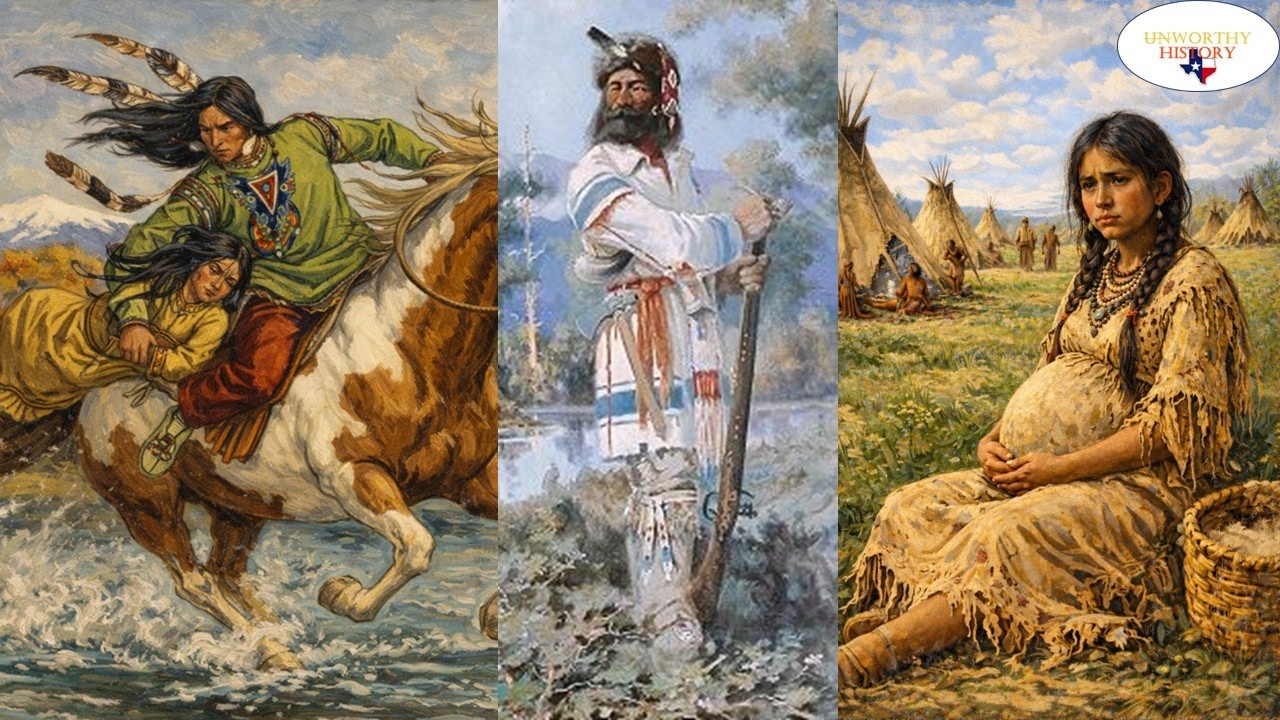
The brutal abduction of a 10-year-old Shoshone girl from her family’s hunting camp in the Rocky Mountains set in motion a chain of violence, enslavement, and exploitation that would ultimately place a pregnant teenager in a Mandan village in North Dakota in November 1804, where she would encounter the Corps of Discovery. The story of Sacagawea, the iconic guide of the Lewis and Clark expedition, is inextricably linked to a harrowing prelude of terror that has been largely sanitized from the national narrative. Newly surfaced accounts, drawn from the 1918 book Bird Woman: Sacagawea’s Own Story by James Willard Schultz, reveal the dark and tragic circumstances that led to her presence at that pivotal historical meeting, detailing a life of captivity, fear, and subjugation that began years before she ever saw a white man.
The account, which Sacagawea herself told in a Mandan council hall in the early 1800s, was later relayed to Schultz by Earth Woman, also known as Mrs. James Kipp. It paints a starkly different picture from the romanticized version of a noble guide.
 Sacagawea’s own words, as recorded in the book, begin not with the expedition, but with a desperate plea for context. “I must first tell you something about my Snake people,” she began. “It is not because they are cowards that they are poor, that they hide in hunger in the mountain forests.
It is because they cannot possibly hold their own against the plains tribes, especially bands of the Blackfeet.” Her people, the Snakes, were constantly driven back from the buffalo plains by numerically superior enemies, living in a state of perpetual starvation and terror.
The narrative describes a pivotal moment before Sacagawea’s birth, when the Snake, Flathead, and Pend d’Oreille tribes attempted to unite, numbering over 600 warriors, to hunt buffalo near the Great Falls of the Missouri. Their confidence was shattered when a war party of about 200 enemies approached. “Our chiefs said to one another, ‘They are crazy, crazily brave,’” Sacagawea recounted.
The enemy, however, possessed a terrifying new technology. As the united warriors charged, the enemy raised what appeared to be “shining sticks” that burst with “fire and smoke and booms of thunder,” killing riders and horses instantly. The 600 warriors fled in terror, believing their enemies had been given weapons of the sky gods.
This event condemned the mountain tribes to generations of hiding and hunger, forever ceding the plains to their enemies.
Sacagawea’s own life of fear began in her childhood. “From the going of the snow until it came again, the moons were moons of terror for us all,” she said. By the spring of her 10th summer, starvation forced her people to cross the mountains to hunt buffalo near the forks of the Missouri River.
The camp was a place of constant dread, with families scattering into the brush at night to sleep. One morning, the terror became a reality. Hunters rushed back with a warning: the enemy was coming.
In the ensuing chaos, Sacagawea became separated from her mother. “I called and called my mother, running first to our lodge, then to other places, but I cannot find her,” she recalled. She fled into the timber, running until she was exhausted, only to be captured by four enemy riders while trying to cross a river.
 “Then a rider suddenly seized my arm and yanked me up on his horse in front of him,” she said. “I whirled about and looked at him and tried to bite and scratch his face, but he just laughed.”
The captors were Minnetarees, also known as Hidatsa. Sacagawea was taken along with eight other young prisoners, including her close friend, Otter Woman. They were marched across the vast, terrifying plains, a journey that crushed any immediate hope of escape.
“As far as we could see to the north and east, they ran to the edge of the world without a break,” Sacagawea described the plains. “We had not thought that they were of so great an extent.” The man who captured her, a man of about 50 with a kind face, promised her safety and food but warned, “Do not try to escape.
If you do, I shall have to kill you.” The prisoners made one desperate attempt to flee, using logs to float across a river, but the plan was foiled when Otter Woman awoke and shrieked, alerting the captors. The other children escaped, but Sacagawea, Otter Woman, and another girl were left behind, their fate sealed.
Upon arriving at the Hidatsa village, Sacagawea’s life became one of servitude. She was set to work tanning leather and tending corn fields. The initial kindness of her captor, Red Arrow, was a fragile shield against the brutal reality of her situation.
The narrative then takes a devastating turn, revealing how Sacagawea was treated not as a person, but as property. A white man, a French trader named Toussaint Charbonneau, was a frequent visitor to the village, gambling with the Hidatsa men. One morning, after a long night of play, Charbonneau challenged Red Arrow to a bet.
“I will bet my fast buffalo horse against your two Snake captives,” Charbonneau signed. Red Arrow, a heavy loser, reluctantly agreed. “No, no,” Sacagawea screamed, pleading with Red Arrow not to gamble them away.
 “We will work for you oh so hard,” she begged. But her pleas were ignored. The bones were juggled, the song was sung, and Charbonneau pointed to Red Arrow’s left hand, which held the losing black bone.
In a single moment, Sacagawea and Otter Woman were won like chips in a game, their fate sealed by a roll of chance.
Charbonneau, a man old enough to be her father, took them to his lodge. His Minnetaree wife was kind, but she was sickly, and the two young captives soon took over all the work. The story reveals a brief glimmer of hope for Sacagawea when a young Mandan man named White Grass fell in love with her.
“He told me that he loved me,” she said. “I was not ashamed. I told him that I had long been hoping that he would say that to me.”
White Grass offered Charbonneau ten horses for her, a fortune by any measure. Charbonneau’s reaction was one of unbridled rage. “Dog Mandan,” he howled.
“Go away from here. Go, go, go. Never enter this lodge again.”
White Grass was banished, but he promised to return with more horses. He left with a war party against the Pawnees but was killed in an ambush by the Arikaras. “That was the last I ever saw of my Mandan sweetheart,” Sacagawea recounted, her heartbreak palpable even in the translated text.
 With the death of her love and the subsequent death of Charbonneau’s Minnetaree wife, Sacagawea’s fate was fully sealed. Charbonneau, showing no grief for his deceased wife, immediately claimed the two young women as his own. “Now that the old woman is gone, you two shall be my wives,” he declared.
“You shall be my head wife.” Sacagawea was terrified. “I was more scared than when I had been seized in the river by the Minnetaree warrior,” she said.
When she hesitated, Charbonneau resorted to violence. “He seized me and lifted me and threw me over upon his couch, crying out, ‘I’ll teach you to mind me. Now, stay there, right there where you belong.’”
This was the final act of subjugation. The young Shoshone girl, who had been torn from her family, marched across the plains, and gambled away like property, was now the forced wife of a brutal French trader.
The account ends with Sacagawea’s own words: “So it was that I became the head wife of Charbonneau.” The story does not detail the immediate aftermath, but historical record confirms that she was pregnant with Charbonneau’s child when Lewis and Clark arrived in November 1804. She was no more than 16 years old.
She gave birth to her son, Jean Baptiste, on February 11, 1805, just months before the expedition departed. This tragic prelude, hidden for so long in the pages of an obscure book, casts a profound shadow over her celebrated role as a guide. It reveals a young woman who was a victim of intertribal warfare, a slave, and a pawn in a gambling game, long before she became a symbol of American exploration.
Her story is not one of simple heroism, but of survival against overwhelming odds, a story that mainstream historians have often left untold.
