The first blood hit the sawdust floor of the Bear Exchange saloon before the card game’s stakes were even settled. In the flickering candlelight of San Antonio, 1846, a young ranger’s life ended with a single, savage slash of a Bowie knife—his neck cut half through—and the man who wielded the blade simply stepped over the twitching corpse, placed a boot on the body, and asked the stunned onlookers if anyone wanted to continue the fight. No one did.
They all went to the bar and drank with him instead. That man was John Joel Glanton, and the murder that night was not an anomaly but a prelude—the opening note of a bloody symphony that would echo from the Texas frontier to the deserts of the Southwest, culminating in one of the most notorious scalp-hunting rampages in American history.
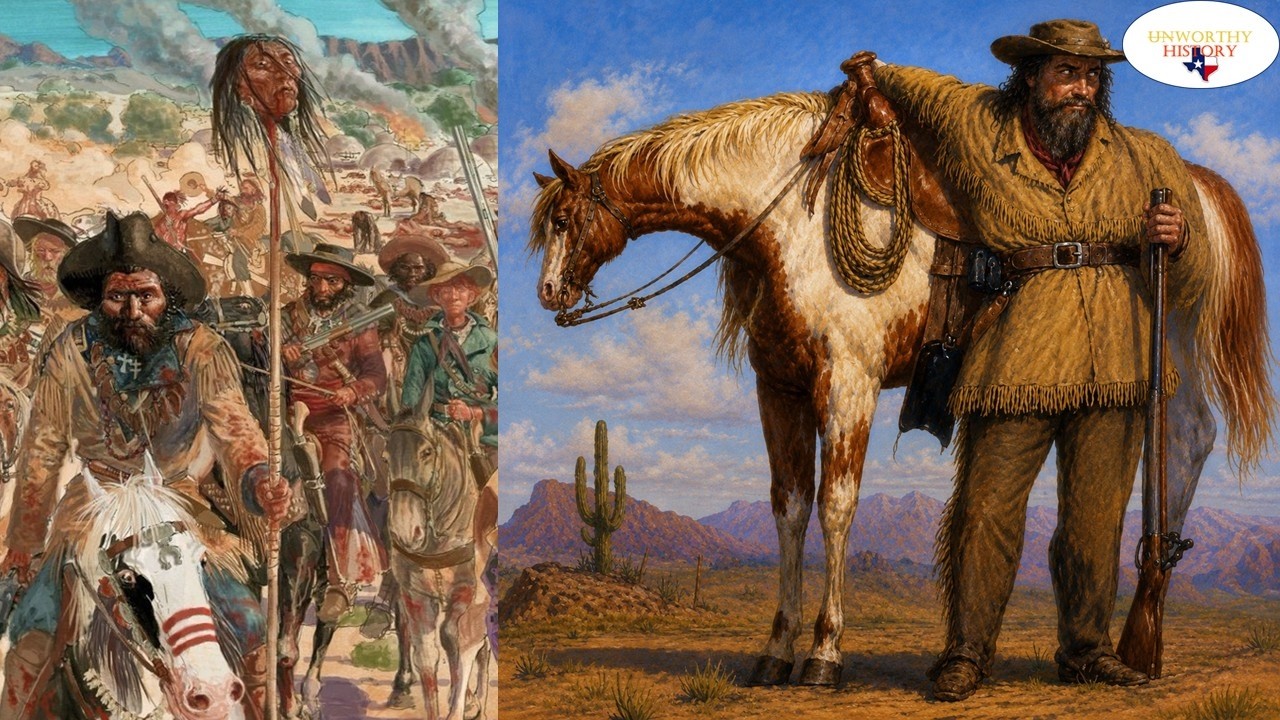 The witness to this brutal introduction was a 16-year-old runaway from Boston named Samuel Chamberlain, a rogue and future memoirist whose account of this era, My Confession, would later serve as the foundational text for Cormac McCarthy’s literary masterpiece Blood Meridian. But on that night in 1846, Chamberlain was merely a greenhorn volunteer, fresh off a harrowing journey from Illinois, thrust into a lawless world where human life was cheaper than whiskey. His story, preserved in his unpublished manuscript for nearly a century, provides a chilling, firsthand glimpse into the birth of a monster—a man whose wife had been scalped by Apache raiders, and who responded by declaring a genocidal war against all Indigenous peoples, a war that would mutate into a mercenary slaughter-for-profit enterprise.
Chamberlain’s path to that bloody saloon floor was as chaotic as the era itself. Expelled from his Christian school in Boston for repeatedly brawling with teachers and classmates, the defiant teenager had drifted westward, landing in Alton, Illinois, in May 1846. The town was ablaze with war fever.
General Zachary Taylor was reportedly surrounded by Mexican troops on the Rio Grande, and General Gaines had issued a call for 50,000 volunteers. Within two hours of his arrival, Chamberlain enlisted in the Alton Guards, a motley crew of river-town roughnecks whose election of officers was a farce of whiskey-bribes and bombastic speeches. A local butcher named Peter Goff, who bragged about shooting abolitionist Elijah Lovejoy, won the captaincy by promising to spend fifty dollars on drink for the men.
Chamberlain, despite his ambition and skill at drilling troops, was reduced to the rank of drill sergeant.
The camp at Upper Alton was a cesspool of debauchery. Officers were incompetent and drunk, and the men were a volatile mob. Chamberlain’s attempt to maintain discipline led to a full-scale mutiny when Captain Goff, in a drunken rage, assaulted his own lieutenants.
The men seized the captain, tied him up, and offered Chamberlain the command of one hundred half-drunken desperadoes. He accepted, building barricades and preparing for a firefight until Generals John E. Wool and Shields, along with Governor Ford, arrived to negotiate a peace.
General Wool, impressed by the teenager’s engineering of the barricades, remarked prophetically, “My man, if you don’t get shot for insubordination, you will, if you live and see service, rise in the profession.” Despite the pardon, Chamberlain was broken to the ranks, a scapegoat for the chaos.
The journey south was a descent into hell. Embarking for New Orleans, the volunteers turned the passage into a floating bacchanal. In New Orleans, Chamberlain was attacked by a fellow soldier named Brown, who attempted to rob and drown him in the Mississippi.
In a desperate struggle, Chamberlain nearly killed his assailant, pinning him to the ground with a bayonet through the neck, but sparing his life. The incident left Chamberlain with a severe head injury that plagued him for weeks. From New Orleans, they sailed to Port Lavaca, Texas, where disease—mumps, measles, and scarlet fever—ravaged the ranks.
 Chamberlain, weak and emaciated, survived the brutal 160-mile march to San Antonio only by the charity of Lieutenant Colonel Don Morrison, who placed the sick teenager on his own horse.
In San Antonio, Chamberlain was discharged as unfit for duty, but he remained in the town, boarding with a gambler named Jim Scott who taught him the tricks of faro, monte, and poker. It was in this environment—a volatile mix of regulars, volunteers, Texas Rangers, Delaware Indians, and Mexicans—that Chamberlain first laid eyes on John Glanton. The Rangers, Chamberlain wrote, were “a more reckless, devil-may-care-looking set it would be impossible to find this side of the infernal regions,” armed with revolvers and Bowie knives, their clothes black with grease and blood.
Glanton, however, was different. He was short and thick-set, his face bronzed like an Indian’s, with deep-set, bloodshot eyes and coarse black hair hanging in snake-like locks. He wore the leather costume of a Mexican herdsman, a stark contrast to the red-shirted rangers around him.
The confrontation was trivial—a dispute over a card game. Glanton threw a glass of liquor in his opponent’s face. The tall, handsome ranger drew his revolver and pressed it to Glanton’s chest, vowing to blow a hole through him.
Glanton didn’t flinch. “Shoot and be damned,” he said, “but if you miss, John Glanton won’t miss you.” The ranger pulled the trigger, but only the cap exploded.
In that instant, Glanton sprang up, his Bowie knife flashing. The ranger fell with a sickening thud, his neck sliced nearly in half. Glanton wiped his blade on his leather sleeve, and the bar resumed its business as if nothing had happened.
Chamberlain, horrified yet oddly admiring, inquired about the killer and learned he was a famous Indian fighter and desperado, a man who had already carved a legend of blood across the frontier.
The story of John Joel Glanton’s rage began years earlier, in 1835, when he was a young man in his teens fighting in the Texas Revolution. He was at Gonzales for the first official battle, where the “Come and Take It” flag was raised. But the defining trauma of his life occurred around that time: his fiancée was abducted by Lipan Apaches.
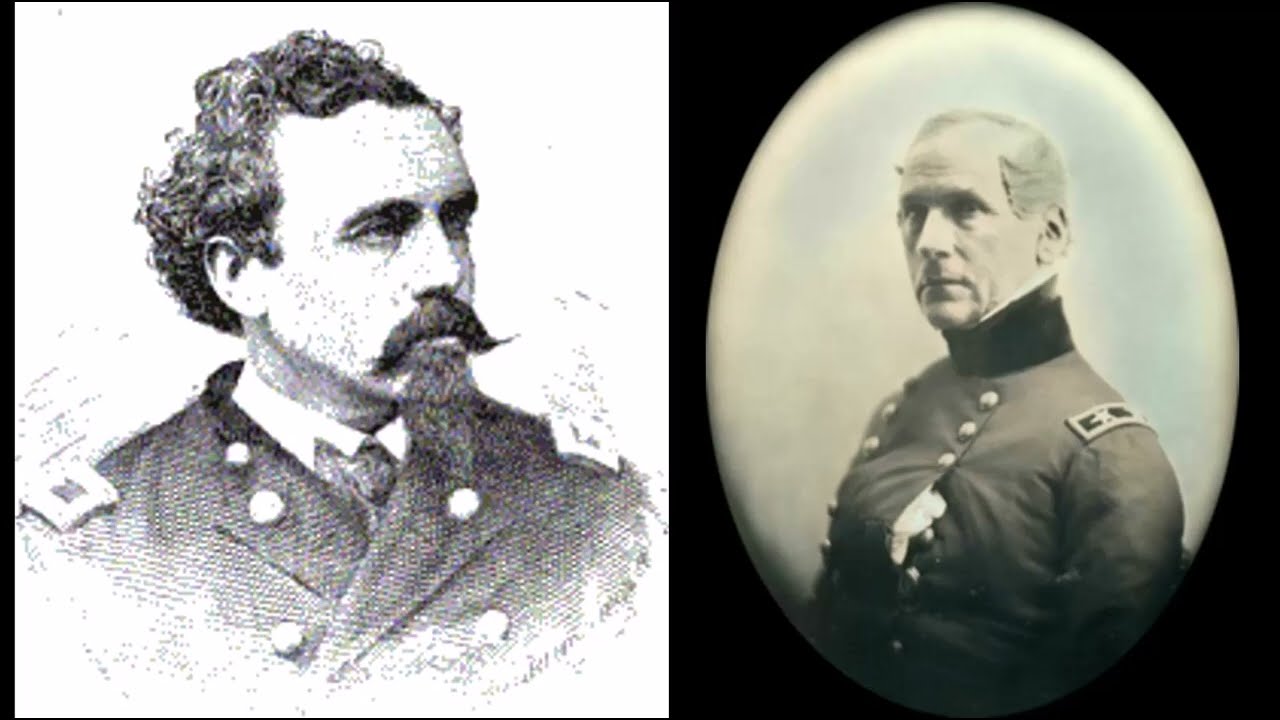 She was scalped and killed, subjected to unspeakable outrages. The loss broke something inside Glanton. Like other infamous “Indian haters” of the era—Bigfoot Wallace’s Jeff Turner, Tom Quick, Lewis Wetzel—Glanton made a solemn vow to kill every Indian he could find.
He became a lawless predator, so violent that Sam Houston himself reportedly banished him from Texas. He fled to Arkansas and Louisiana, where he remained for a decade until the outbreak of the Mexican-American War called him back to the killing fields.
Chamberlain’s own descent into San Antonio’s underworld continued after the saloon murder. He bought a Bowie knife and soon found himself in a dispute with his gambling partner, Scott, over a rigged poker game. In the Texas fashion of 1846, they settled it with knives.
Chamberlain badly cut Scott, who ran onto the point of his blade. For this, Chamberlain was thrown into the old Spanish calaboose—a 20-foot-square hellhole filled with horse thieves, murderers, and the wildest characters of the frontier. He was covered in vermin, his ankles chafed raw by rusty irons, his mind shattered by the blasphemy and bestial orgies of his fellow prisoners.
He went insane, and when Scott declined to press charges, Chamberlain was released naked and wild-eyed into the streets.
He was found three weeks later by a farmer, lying nude and insensible near the road, thirty miles from San Antonio. He was taken to Castroville, where a German doctor named Carl Ritter nursed him back to health. The doctor’s 16-year-old sister, Catherine, fell deeply in love with the delirious young soldier, offering him her first pure affection.
In a scene of almost unbearable tension, Chamberlain resisted her advances, preserving the honor of the Ritter household, though he left the girl heartbroken. He returned to San Antonio and enlisted in the regular army, joining Company E of the First U. S.
Dragoons under Captain Enoch Steen. He was now a soldier in the true sense, ready for the war that would take him to Mexico—and, eventually, back into the orbit of the man he had watched murder a man over a card game.
 The Glanton Gang’s reign of terror, which would reach its zenith in 1849 and 1850, was a direct outgrowth of the Mexican-American War’s aftermath. With the war over, the U. S.
military no longer needed scalp hunters to clear the frontier. But the Mexican state of Chihuahua, desperate to protect its northern settlements from Apache and Comanche raids, offered bounties for scalps—$100 per warrior, $50 per woman, $25 per child. Glanton, along with a fellow former Ranger named James Kirker, seized this bloody opportunity.
They formed a gang of mercenaries, a mix of Americans, Mexicans, and Delaware Indians, who hunted humans for profit. But the bounties were too tempting, and the distinctions too blurry. The gang soon began killing peaceful Indigenous peoples, and even Mexicans, selling their scalps as proof of Apache kills.
They became outlaws, wanted in multiple states and territories.
Chamberlain, who would later join the gang for a time, documented their atrocities in My Confession. The book, written between 1855 and 1861 but unpublished until 1956, is a harrowing account of a lawless land. It is the source material for McCarthy’s Blood Meridian, which fictionalized Glanton as the Judge Holden’s companion in a brutal, philosophical exploration of violence.
But the real Glanton was no literary symbol; he was a flesh-and-blood killer whose personal tragedy—the scalping of his wife—fueled a murderous rampage that spanned thousands of miles. He died in 1850, at the hands of Yuma Indians near the Colorado River, his gang wiped out in a bloody reprisal for their own atrocities. His body was thrown into the river, and his legend, such as it is, was left to men like Chamberlain to record.
For Chamberlain, the encounter in the Bear Exchange was a brutal education. He had left Boston as a boy, expelled for fighting. He arrived in San Antonio as a man, hardened by disease, betrayal, and violence.
He had seen a man murdered in cold blood and had nearly killed another himself. He had been jailed, driven insane, and nursed back to health by strangers. His memoir, written decades later, is a testament to the savagery of the American frontier—a place where a 16-year-old could witness the birth of a serial killer and then, years later, ride alongside him.
The story of John Glanton is not just a tale of one man’s revenge; it is a story of how the American West was won, not with righteous courage, but with blood, scalps, and the cold calculus of survival. And it all began, for Samuel Chamberlain, with a game of euchre and a Bowie knife in a smoky San Antonio saloon.
