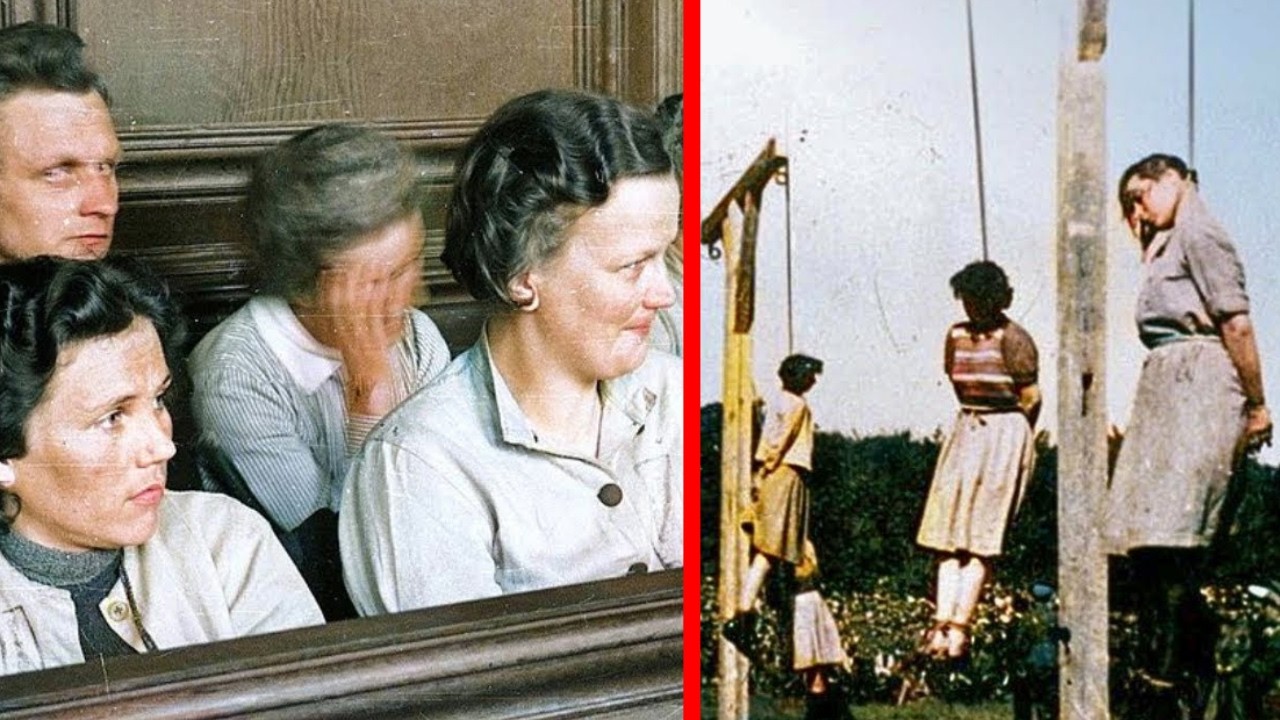
GDANSK, Poland — The gallows stood silhouetted against a gray Baltic sky on the morning of July 4, 1946, as tens of thousands of Poles pressed against wooden barricades, their faces a mixture of grief, fury, and grim satisfaction. Before them, five young women who had once wielded absolute power over the starving inmates of Stutthof concentration camp were led to their deaths, their final moments witnessed by the very nation they had helped terrorize. The public executions of Jenny-Wanda Barkmann, Gerda Steinhoff, Ewa Paradies, Elisabeth Becker, and Wanda Klaff marked the brutal culmination of a war crimes trial that laid bare the savagery of female camp guards, and the last hours of these women were consumed by a terror they had so casually inflicted on others.
The journey to that Gdansk scaffold began years earlier, in the autumn of 1939, when Stutthof was established just days after the Nazi invasion of Poland. Initially a detention site for Polish intellectuals, priests, and resistance members, the camp near the Baltic coast east of Gdansk metastasized into a sprawling complex of subcamps holding prisoners from over 25 nations. By the final years of the war, as the Third Reich’s eastern front collapsed, Stutthof became a dumping ground for tens of thousands of evacuated inmates from camps like Auschwitz, many already dying of starvation and disease.
 The exploding prisoner population created an urgent demand for more guards, and the SS turned to recruiting women, many of whom were ordinary working-class Germans seeking stable employment in a wartime economy shattered by labor shortages and Allied bombing raids. They entered the system through Ravensbrück, the primary training center for female concentration camp guards, where any lingering humanity was systematically stripped away and replaced with a doctrine of absolute brutality.
Once inside Stutthof, these women became architects of suffering. Survivor testimony from the 1946 trial painted a harrowing portrait of daily sadism. Jenny-Wanda Barkmann, a former tram conductor who had once aspired to modeling, was described by witnesses as a volatile predator who beat female prisoners savagely and participated in selections that sent inmates to their deaths.
Gerda Steinhoff, who arrived with prior camp experience, was accused of relentless abuse, particularly targeting sick prisoners too weak to work. Ewa Paradies gained infamy for whipping inmates and kicking women during roll calls, using violence with casual indifference. Elisabeth Becker, who had worked civilian jobs before joining in 1944, was accused of physically attacking prisoners and taking part in lethal selections.
These women carried whips, sticks, and pistols, and used dogs to terrorize inmates who moved too slowly, spoke without permission, or simply collapsed from exhaustion. The camp’s final months were even more hellish, as typhus epidemics raged and SS leadership ordered death marches beginning in late January 1945, forcing around 25,000 prisoners westward through freezing snowstorms. Guards shot those who faltered, leaving bodies scattered across the forests and roads of northern Poland.
As the Soviet Red Army closed in during April 1945, the Nazi system began to disintegrate. Communication broke down, orders became contradictory, and fear gripped the SS personnel. Many female guards, realizing the war was lost, shed their uniforms and SS insignia, attempting to blend into the massive refugee crowds fleeing westward.
Some reportedly softened their behavior in a desperate gambit to curry favor with potential witnesses, while others grew more violent as panic consumed them. But their efforts to vanish were largely futile. After liberation, Polish investigators, aided by recovered SS records and the searing memories of survivors, hunted down the former guards.
Many were recognized in refugee centers and train stations by prisoners who had endured their cruelty for months or years. By mid-1945, most of the key female guards were in custody, and the first Stutthof trial convened in Gdansk in April 1946, less than a year after the war’s end.
 The courtroom was a cauldron of raw emotion. Survivors sat just feet away from the women who had once controlled their every breath, while journalists and government officials packed the benches. Outside, crowds gathered daily to catch a glimpse of the accused.
The female defendants reacted to the mounting evidence in starkly different ways. Some wept openly as witnesses described the beatings, starvation, and selections. Others sat stoic, denying nearly every accusation.
Barkmann, whose striking appearance drew heavy media attention, became a focal point of public outrage. The prosecution rejected the defense that the women were merely following orders, arguing instead that they had acted with individual cruelty and malice. The trial lasted weeks, but the verdict was never truly in doubt.
On May 31, 1946, the court sentenced all five female guards to death, along with several male kapos and SS personnel. The executions were ordered to be carried out publicly in Gdansk, a decision reflecting the overwhelming public demand for visible justice in a nation where an estimated six million citizens, including three million Polish Jews, had perished.
The condemned women were returned to prison cells to await their fate, a period of psychological torment that many historians believe was a form of delayed justice. Unlike the countless victims they had sent to death, these women knew exactly when they would die. The gallows were being prepared just outside the prison walls, and every morning they woke to the knowledge that their final day was drawing nearer.
Reports from prison officials later described varied reactions. Some of the women prayed frequently and requested religious visits. Others became withdrawn and silent, their minds fractured by the constant anticipation of the noose.
 A few continued to protest their innocence, insisting they were scapegoats for a system that had used them as tools. Barkmann, however, reportedly maintained an unusual composure, a demeanor that would later fuel sensationalized stories about her final hours. The psychological weight of the wait was immense, a stark reversal of the power dynamics that had defined their time at Stutthof, where they had held life and death authority over prisoners who never knew when their last moment would come.
On the morning of July 4, 1946, the condemned were led from their cells for the final time. The execution site was already surrounded by a massive crowd, with estimates ranging from tens of thousands to over one hundred thousand people. Men, women, and children climbed trees, rooftops, and walls to secure a view of the gallows.
The atmosphere was charged with a volatile mix of anger and vindication. Poland was still a landscape of ruins, its families shattered by occupation, executions, and deportations. Many in the crowd had lost relatives to the camps, and others were survivors themselves, their bodies bearing the scars of starvation and abuse.
The prisoners were transported under heavy guard, their final journey a stark contrast to the power they had once wielded. The executions proceeded one by one. Barkmann was among the first led to the gallows, followed by Steinhoff, Becker, Klaff, and Paradies, alongside the male defendants.
As the trapdoors opened, some spectators shouted curses, while others watched in stunned silence. Survivors later described a complex emotional response, a mixture of satisfaction that justice had been served and a profound sorrow that no execution could ever undo the suffering inflicted.
In the immediate aftermath, the scene descended into a disturbing spectacle. Reports described crowds surging toward the gallows as authorities loosened control, with some spectators cutting pieces of the rope to keep as souvenirs. The grisly memento-taking underscored the depth of public rage that still simmered in post-war Poland.
 Photographs of the hangings spread widely, becoming some of the most iconic images of post-war justice against Nazi personnel. But the story did not end on that scaffold. The 1946 trial was merely the first chapter in a broader reckoning.
Polish courts conducted additional Stutthof trials over the following years, prosecuting dozens of guards, kapos, and SS members as investigators continued to gather survivor testimony from across Europe. Many perpetrators had escaped into the chaos of post-war Germany, hiding among refugees or assuming false identities. Some managed to live out their lives in obscurity, marrying, raising families, and burying their pasts.
The pursuit of justice, however, proved relentless. In the late 20th and early 21st centuries, German prosecutors shifted their legal strategy, arguing that mere service at a concentration camp was sufficient to establish complicity in mass murder, even without proof of a specific killing. This legal evolution reopened decades-old cases and brought elderly former camp workers back into the spotlight.
One of the most prominent was Irmgard Furchner, a former secretary at Stutthof who was charged in her 90s with aiding and abetting the murders of thousands of prisoners. Her trial, which began in 2021, drew international attention, serving as a stark reminder that the shadow of the Holocaust extended far beyond the war years. Furchner’s case, like the 1946 executions, underscored a fundamental principle: that the machinery of death required the participation of ordinary people, and that accountability could not be extinguished by the passage of time.
Today, the site of Stutthof operates as a museum and memorial in Poland, where visitors walk through preserved barracks, the crematorium, and the remains of the gas chamber. The memory of the female guards who terrorized the camp remains permanently etched into its history, a chilling testament to how ordinary women could become instruments of extraordinary cruelty. The brutal last hours of those five guards, spent in a cold prison cell awaiting a public hanging, were a final, ironic echo of the power they had once held.
They had controlled the fates of thousands, deciding who lived and who died with a flick of a whip or a pointed finger. In the end, they faced a certainty they had never granted their victims, a reckoning that was swift, public, and absolute. The gallows in Gdansk did not balance the scales of justice, but they did serve as a warning to a shattered world that the architects of atrocity, regardless of gender or rank, would not be allowed to disappear into the rubble of history.
