The noose tightened around Adolf Eichmann’s neck at one minute past midnight on June 1st, 1962, inside Ramla prison, but the legacy of the man who orchestrated the logistics of the Final Solution did not die with him. It was inherited by four sons scattered across two continents, each forced to confront a surname that had become synonymous with industrial genocide. Their divergent paths—ranging from militant defense of their father’s ideology to a complete repudiation of his crimes—offer a chilling study in how the children of history’s monsters navigate the wreckage of their inheritance.
The youngest of the four, Ricardo Francisco Eichmann, born in Buenos Aires in 1955, was just five years old when Mossad agents snatched his father from a bus stop on Garibaldi Street. His memories of Adolf are not of a war criminal but of a father who walked him to that same bus stop by the hand and bought him chocolate at a nearby sweet shop. The arrest tore the family’s fragile world apart, and the subsequent trial in Jerusalem became a global spectacle that the Eichmann children could not escape.
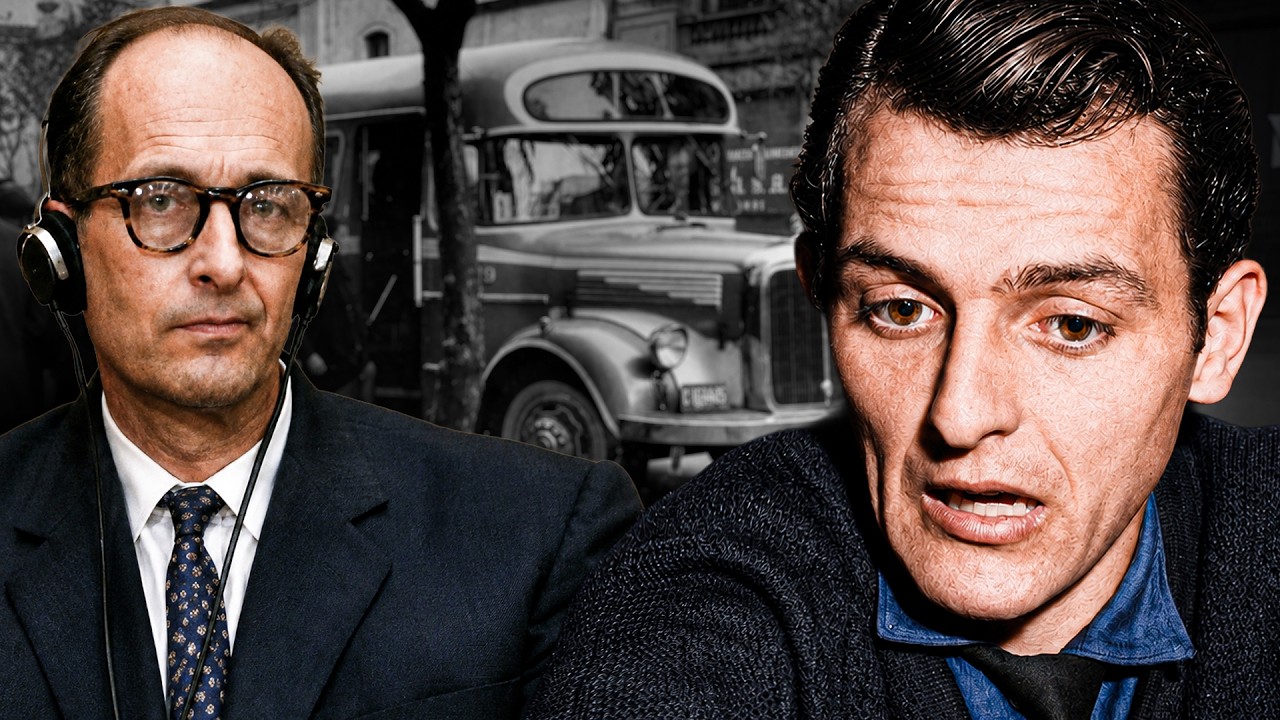 While his mother hid newspaper clippings about the proceedings under a sofa, young Ricardo would later piece together the horrifying truth of his father’s role in the murder of six million Jews, a revelation that would fundamentally alter the course of his life.
Ricardo’s response to his inheritance was not one of denial but of deliberate, academic flight. As a teenager, he immersed himself in books about his father’s crimes, seeking understanding outside the fraught silence of his family. He enrolled at Heidelberg University in 1977, choosing to study prehistory, classical archaeology, and Egyptology—subjects as far removed from the 20th century’s horrors as he could possibly find.
His choice proved to be a form of salvation. He completed his doctorate in 1984 and went on to become a distinguished archaeologist, serving as director of the Orient Department of the German Archaeological Institute in Berlin from 1996 to 2020, leading excavations in Saudi Arabia, Jordan, and Qatar.
In a moment of profound symbolic reckoning, Ricardo met Zvi Aharoni in 1995, the very Mossad agent who had identified his father in Buenos Aires. Ricardo described the encounter as deeply emotional but insisted he held no resentment toward the man who helped bring his father to justice. He has publicly stated that his father deserved his fate, arguing that the defense of “following orders” excused nothing.
When asked if he ever considered changing his surname to escape the stigma, Ricardo’s response was starkly pragmatic: there would have been no point, he reasoned, because nobody truly escapes their own past. He chose instead to confront it head-on, building a life of scholarly integrity that stands in direct opposition to his father’s legacy.
 The eldest son, Klaus Eichmann, born in Berlin in 1936, took the opposite approach, embracing his father’s ideology with a fervor that shocked the world. In 1956, while living in Buenos Aires under his real name, Klaus began dating Sylvia Hermann, unaware that her father, Lothar, was a half-Jewish German lawyer who had survived the Dachau concentration camp. Klaus boasted openly about his father’s role in the Nazi regime, making comments so inflammatory that Lothar Hermann became convinced he was dating the son of a wanted war criminal.
Hermann’s subsequent letter to Fritz Bauer, a Jewish attorney general in West Germany, set in motion the chain of events that would lead to Adolf Eichmann’s capture.
Klaus’s reaction to his father’s trial and execution was one of unrepentant defiance. In 1961, while Adolf sat in an Israeli prison, Klaus traveled to the United States and gave an interview to Parade magazine, defending his father and dismissing the charges as propaganda. He even suggested that prominent Jewish figures had engineered the wartime deaths themselves, a grotesque distortion of history that led to his swift deportation back to Argentina.
His public outbursts did not end there; he organized a press conference in Buenos Aires within hours of his father’s death sentence, protesting what he called the injustice of the verdict. Klaus never publicly renounced his views, and according to family testimony, he supported his father’s ideology to the very end of his life. He died in Germany in 2015 at the age of 79, having outlived his father by 53 years.
 The most committed of the four sons, however, was Horst Adolf Eichmann, born in Vienna in 1940 and named in part for the dictator his father served. Horst absorbed the family ideology more completely than any of his brothers, treating the Holocaust as an invention and believing his father had done nothing wrong. His long-time partner, Carmen Bretton Lindemann, later revealed that Horst took their father’s cover story—that Hitler had targeted Jews because of a plot to sterilize Germans—as absolute fact.
To believe otherwise, she said, would have collapsed his entire world. This fanaticism translated into action in the volatile atmosphere of 1960s Argentina, where the Tacuara Nationalist Movement was launching a wave of anti-Semitic attacks.
Horst and Klaus did not limit themselves to ideological posturing. According to Lindemann’s account, corroborated by police records, the brothers formed a small Nazi cell in Argentina with plans to attack Jewish businesses and synagogues, allegedly including a Jewish school bus. The cell was dismantled in 1962 when Argentine police raided their headquarters after a reported shootout, recovering Nazi propaganda, firearms, and Molotov cocktails.
Horst was jailed for possession of weapons and extremist material, and his public profile remained toxic. In 1964, he appeared at a press conference wearing a Nazi armband with a swastika, and in August 1965, he was arrested again in a massive sweep of extremists, though he was released for lack of substantial evidence. Horst died in Buenos Aires in December 2015 from bowel cancer, just months after his older brother, having spent his life in quiet, unrepentant obscurity.
 The third son, Dieter Helmut Eichmann, born in Prague in 1942, chose a path of silence, avoiding both the public defiance of his older brothers and the academic repudiation of his younger one. He gave no interviews, kept his distance from politics, and built a quiet career as a construction foreman, eventually managing rental properties in Argentina and Germany. According to Carmen Bretton Lindemann, Dieter privately believed his father was innocent but simply never said so in public.
Photographed in Buenos Aires in 2018 at the age of 76, he was living in an apartment a short drive from the spot where his father had been captured by the Mossad 58 years earlier. He declined to comment, embodying a generation of Germans who chose to bury the past rather than confront it.
The Eichmann sons’ divergent fates—Klaus’s defiant anger, Horst’s violent extremism, Dieter’s private denial, and Ricardo’s public rejection—paint a complex portrait of inherited guilt. The name they all carried meant something different to each of them: a banner to wave, a burden to bear, a private inheritance to hide, or a question that never went away. The decisions they made about their father’s legacy played out across six decades, proving that the consequences of genocide do not end with the executioner’s rope but echo through generations.
The story of Adolf Eichmann’s children is not merely a footnote to history; it is a stark reminder that the sins of the fathers are often visited upon the sons, and that the reckoning with evil can take many forms, from the most abject denial to the most courageous acceptance.
