The final surrender came on May 8, 1945, but for the men who had ruled the skies over Europe, the reckoning was only beginning. Erich Hartmann, the most lethal fighter pilot in the history of aerial combat, with 352 confirmed kills, did not walk into a prisoner-of-war camp that day; he vanished into a Soviet gulag that would consume a decade of his life. His story, along with those of Adolf Galland, Johannes Steinhoff, and Günther Rall, reveals a generation of warriors who were forced to navigate a world that had been burned to the ground, only to rise again as the architects of the very alliance they had once sought to destroy.
Hartmann’s surrender near the Czech town of Písek was a calculated gamble that failed catastrophically. He had deliberately steered his unit toward American lines, hoping that the Western Allies would treat him as a professional adversary rather than a war criminal. Instead, the Americans, eager to appease their Soviet partners and bound by the Yalta agreements, handed the entire group over to the Red Army within days.
 For the man the Soviets called the “Black Devil,” the terror of the Eastern Front, this was a death sentence in slow motion. He was not shot, but he was subjected to a brutal psychological campaign designed to break him, accused of atrocities he vehemently denied, and offered a path to freedom in exchange for cooperation with the nascent East German regime. He refused every time, a stubbornness that cost him years of solitary confinement and a 25-year hard labor sentence imposed by a Soviet court in 1949.
The decade behind wire was a crucible of despair and defiance. Hartmann, who had never been shot down by an enemy fighter in over a thousand missions, found himself fighting a different kind of war, one of starvation, disease, and psychological torment. He was held in camps where the distinction between prisoner and slave was meaningless, and where the hope of repatriation faded with each passing year.
The Western Allies had long since sent their prisoners home, but the Soviets held onto the German remnants as political leverage, a grim reminder of the millions of Soviet citizens who had perished. It was only the diplomatic breakthrough of September 1955, when West German Chancellor Konrad Adenauer negotiated the release of the last 10,000 prisoners in Moscow, that Hartmann finally saw a way out. He returned to a country split in two, a nation that was already rearming and choosing its side in the Cold War.
His return was not a quiet retirement. In 1956, Hartmann did the unthinkable for many of his contemporaries: he put on a uniform again, this time for the Bundesluftwaffe, the air force of West Germany. He became the first commander of Jagdgeschwader 71 Mölders, the country’s first all-jet fighter wing, tasked with training a new generation of pilots to fly American Sabres against the very Soviet Union that had held him captive.
It was a profound irony, a man who had once been the embodiment of the Luftwaffe’s Eastern Front dominance now standing as a bulwark against the Red Army. His second career, however, was marked by the same stubbornness that had defined his captivity. He clashed with his superiors over the procurement of the American F-104 Starfighter, a jet he publicly condemned as dangerous and unfit for German service.
His outspokenness cost him his command and he retired early in 1970, a prophet ignored in his own land, dying in 1993 as a legend but a controversial one.
 Adolf Galland’s path diverged sharply from Hartmann’s, yet it was equally defined by the war’s long shadow. As the General der Jagdflieger, the supreme commander of the Luftwaffe’s fighter force, Galland had been at the center of the air war’s most desperate battles. He had clashed with Hermann Göring over the catastrophic defense of the Reich, and in early 1945, he was stripped of his command for his honesty.
Rather than accept a desk job, he formed a small, elite squadron of Me 262 jet fighters, flying combat missions himself until he was wounded in April 1945. Captured by the Americans, he was interrogated extensively for his knowledge of German jet development, a valuable asset to the Allies who were eager to understand the technology that had nearly turned the tide. Released in 1947, he found a defeated Germany with no air force, no aircraft industry, and no place for a man of his reputation.
Galland’s solution was to leave the ruins of Europe entirely. In 1948, he accepted an invitation from Juan Perón to travel to Argentina, where the president was building a modern air force and a domestic aircraft industry, and where German expertise was welcomed with open arms. For seven years, Galland helped shape the Argentine Air Force, testing aircraft and developing training programs, a strange second act for a man who had once led the fight against the Allies.
He returned to Germany in 1955, the same year West Germany joined NATO, but he never rejoined the military. Instead, he became a successful aviation consultant and an elder statesman of German flying, writing his memoir, The First and the Last, which became a definitive account of the air war. In his later years, he forged remarkable friendships with the British and American pilots he had once fought, treating the conflict as a professional contest rather than a moral crusade.
He died in 1996, having lived long enough to see the Cold War end and the reunification of his nation.
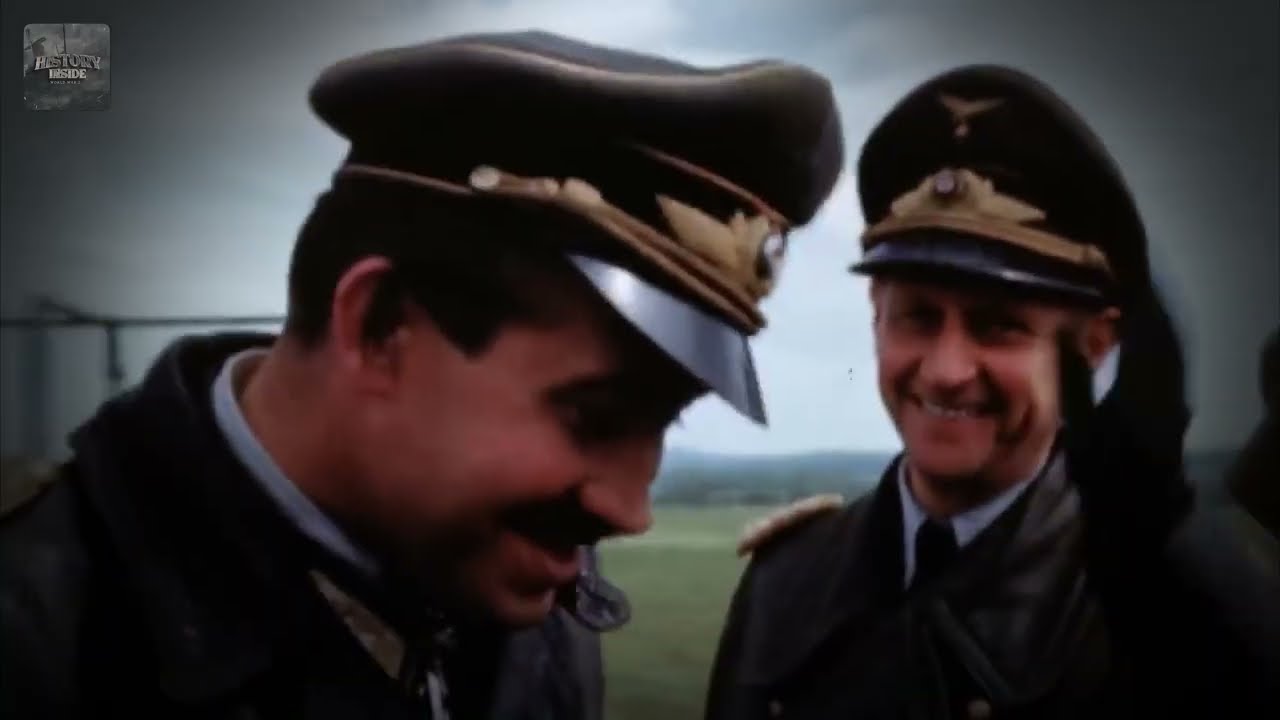 The most dramatic transformation, however, belonged to Johannes Steinhoff. A highly respected fighter leader with over 170 victories, Steinhoff’s war ended in a fiery crash on April 18, 1945, when his Me 262 blew a tire on takeoff and burst into flames. He was pulled from the wreckage alive, but the fire had destroyed his eyelids and left his face permanently disfigured.
He spent two years in hospital undergoing a series of reconstructive surgeries, a painful ordeal that would have broken a lesser man. Yet, when he returned to service in the 1950s, he did so with a determination that saw him rise to the very top of the Western military hierarchy. He became chief of staff of the West German Air Force from 1966 to 1970, and then, in a stunning culmination, he was appointed chairman of NATO’s Military Committee from 1971 to 1974, the highest post any German officer would ever achieve in the alliance.
He was the man who grounded the infamous F-104 Starfighter fleet in 1966 after a series of deadly crashes, a decision that saved countless lives and cemented his reputation as a leader of integrity.
Alongside Steinhoff served Günther Rall, the third-highest scoring ace in history with 275 victories. Rall, who had fought Soviet aircraft over the Eastern Front, rose to become the inspector of the West German Air Force, the senior officer of the entire air arm, and then the German representative to NATO’s Military Committee. His career was a testament to the rehabilitation of the German military, a man who had once been the enemy now helping to plan the defense of Western Europe against the Soviet Union.
He lived until 2009, the last of the great German aces to die, a living link to a past that Germany had spent decades trying to reconcile. Gerhard Barkhorn, the second-highest scorer with 301 victories, also joined the new air force in 1956, commanding a fighter-bomber wing and rising to major general before retiring in 1975. He was killed in a car accident in 1983, a mundane end for a man who had survived hundreds of aerial duels.
 The careers of these men were not without controversy, and the ghosts of the Third Reich never fully faded. In the spring of 1976, a West German Air Force wing held a reunion and invited Hans-Ulrich Rudel, the most decorated German serviceman of the war and an unrepentant Nazi supporter, as its guest of honor. The Defense Ministry was furious, but Rudel came anyway, signing autographs for young airmen.
Two serving generals, Walter Krupinski and Karl-Heinz Franke, publicly defended him, comparing his Nazi past to the communist past of a leading social democrat politician. The comparison caused a national uproar, and the Defense Minister forced both men into early retirement. Krupinski, a veteran of the Eastern Front with 197 victories who had once trained Hartmann, ended his career in disgrace, a stark reminder that the old wounds had never fully healed.
His dismissal became a landmark in the long and painful argument over how much of the Wehrmacht’s traditions the new German military should carry.
These men were not simply survivors; they were architects of a new world order, albeit one built on the ashes of the old. They had fought with fanatical devotion for a regime that had committed unspeakable crimes, and yet they were entrusted with the defense of the very democracy that had defeated them. Their lives were a paradox, a study in how a generation of warriors could adapt to a world that had rejected everything they once believed in.
Hartmann’s decade in a Soviet cell and his subsequent NATO command, Galland’s exile in Argentina and his later friendships with former enemies, Steinhoff’s rise to the top of NATO, and Rall’s quiet service all speak to a profound resilience, but also to a troubling ambiguity. They were men who had served evil, and their post-war careers were an attempt to atone, to rebuild, or simply to survive. The war may have ended in 1945, but for these aces, the battle for their own legacy, and for the soul of their nation, had just begun.
