The silence above the jungle floor was a lie. For months, American soldiers stationed near the quiet, heavily guarded bases in South Vietnam had been dying in inexplicable ways—ambushes that materialized from nowhere, sabotage within supposedly impenetrable perimeters, and sentries found dead at their posts with no sign of an enemy approach. The men searched the treeline, scanned the rice paddies, and watched the skies.
The answer, however, was not above them. It was beneath their boots, carved into the earth itself.
 The Vietcong had built an underworld. What began in the late 1940s as a crude network of hiding spots for Vietnamese fighters resisting French colonial rule had, by the mid-1960s, evolved into a vast, multi-level military complex. The tunnels were never originally conceived as a weapon against Americans.
They were a necessity born of guerrilla warfare—a way to move troops, store supplies, and launch surprise attacks while remaining invisible to a technologically superior enemy. The first tunnels were dug by hand, using simple tools like shovels and woven baskets to haul away the dirt. It was slow, agonizing work, expanding section by section over decades.
By the time American ground forces began arriving in significant numbers in the early 1960s, the Vietcong had transformed this network into a strategic asset of staggering proportions. The main system lay beneath the Cu Chi district, a swath of farmland and forest roughly 20 miles northwest of Saigon. At its peak, the network stretched an estimated 250 kilometers, linking Vietcong bases from the outskirts of the capital to the Cambodian border.
This meant fighters could traverse vast stretches of the region without ever stepping into the open air. They could sleep, eat, plan, and stage attacks directly beneath the feet of American patrols who had no idea the ground was hollow.
The tunnels were not simple burrows. Some sections descended three or four meters below the surface, built on multiple levels stacked one atop another. Deep underground, the Vietcong maintained sleeping quarters, kitchens, small hospitals, weapons caches, meeting halls, and command centers where officers orchestrated operations.
Even the act of cooking was engineered for concealment. Smoke from underground stoves was channeled through narrow pipes and vented through openings placed far from the actual kitchen, making it nearly impossible for aerial reconnaissance to pinpoint human activity. For years, this entire network existed directly beneath areas occupied or controlled by American forces, undetected.
That changed in January 1966. On the seventh, soldiers from the U. S.
Army’s 1st Infantry Division, known as the “Big Red One” for the massive red numeral on their shoulder patches, alongside troops from the 173rd Airborne Brigade, stumbled upon entrances to the tunnel system in the Cu Chi area. The discovery finally provided an explanation for the mysterious attacks that had plagued American commanders. Helicopters had been sabotaged inside supposedly secure bases.
Soldiers had been killed in their sleep. Yet there had been no clear sign of how the Vietcong entered or exited. The tunnels offered the first coherent answer to how the enemy could appear and vanish so quickly.
The discovery triggered an immediate military response. On January 8, the U. S.
Army launched Operation Crimp, a major search-and-destroy mission targeting the Ho Bo Woods, a dense forested area near Cu Chi that intelligence believed housed a significant Vietcong headquarters. The operation lasted until January 14 and involved approximately 8,000 American and Australian troops. At the time, it was the largest allied operation of the Vietnam War.
The overall command was assigned to Major General Jonathan O. Seaman, commander of the 1st Infantry Division. Before ground forces moved into the area, B-52 bombers were dispatched.
These massive, long-range aircraft, originally designed to carry nuclear weapons, were used extensively to drop conventional bombs during the war. The bombardment was devastating. A single bombing run could obliterate a swath of jungle nearly a mile long, leaving the earth pockmarked with deep craters.
American commanders expected this level of firepower to destroy the hidden Vietcong positions. But when ground troops moved in afterward, they discovered more than 200 tunnel entrances. The Vietcong fighters who used the tunnels had already gone.
Many had simply moved deeper into the network and survived the bombing, even as some bombs detonated only a few meters above their heads. The Americans then tried other methods to flush them out. Soldiers pumped tear gas into some tunnels, hoping the fumes would drive those inside to the surface.
They experimented with acetylene gas, a highly flammable substance, and attempted to place explosives directly at tunnel mouths. But the underground system was too large, too deep, and too complex. Some tunnels featured multiple levels, hidden entrances, narrow passages, and sections that could be sealed off from the rest of the network.
The methods used above ground simply could not clear the system.
 By the end of Operation Crimp, American commanders faced a problem they had not anticipated. Bombing the jungle had not destroyed the tunnels. Gas had not cleared them.
Explosives had not solved the issue either. If the U. S.
Army wanted to know what was inside these tunnels and destroy the network from within, there was only one option left. Someone had to go underground and search for the enemy by hand, tunnel by tunnel. The men who volunteered for this task became known as “Tunnel Rats.”
The name was not intended as an insult. These soldiers required a very specific physical and mental constitution. Size mattered more than rank or experience because many passages were less than half a meter wide.
A man with broad shoulders simply could not fit through. Claustrophobia would disqualify a volunteer immediately. Panic inside such a confined space could trap a soldier and lead to his death within seconds.
There was no formal training program for Tunnel Rats when the mission first began in January 1966. The initial volunteers had to learn by entering the tunnels themselves, often discovering things through trial and error. In this environment, mistakes could be fatal.
Their equipment was as minimal as possible because there was not enough room to carry anything else. Typically, a Tunnel Rat carried a pistol, a knife or bayonet, and a flashlight. Some carried a spool of string and used it to mark their path through the darkness, giving them a way to find the entrance again if they lost their bearings in the depths.
Even the pistol most carried initially created problems. The standard sidearm was often the M1911, a . 45 caliber pistol widely issued in the U.
S. Army. Above ground, it was a reliable weapon.
Inside a narrow tunnel, it could become a serious liability. When fired in an enclosed space, the sound of the gunshot was painfully loud, and the muzzle flash could temporarily blind the shooter. A Tunnel Rat could lose his hearing and vision for crucial seconds, a dangerous situation in a fight that could be decided instantly.
Because of this, many men switched to revolvers, which some found easier to use in tight spaces. Others used silenced pistols when they could obtain them. Some Tunnel Rats preferred to use a knife or bayonet whenever possible, because a blade makes no sound.
Inside the tunnel, remaining silent was one of the few advantages a soldier had. At any given time, the U. S.
Army had only about 100 specialized Tunnel Rats operating in Vietnam. That was a very small force compared to the hundreds of thousands of American troops serving in the country. These men had a specialized job that no one else wanted to do.
They eventually developed their own name for the experience of going underground. They called it “Black Echo.” The name described the two things that dominated the tunnels: the pitch-black darkness and the strange way sound traveled through the narrow passages.
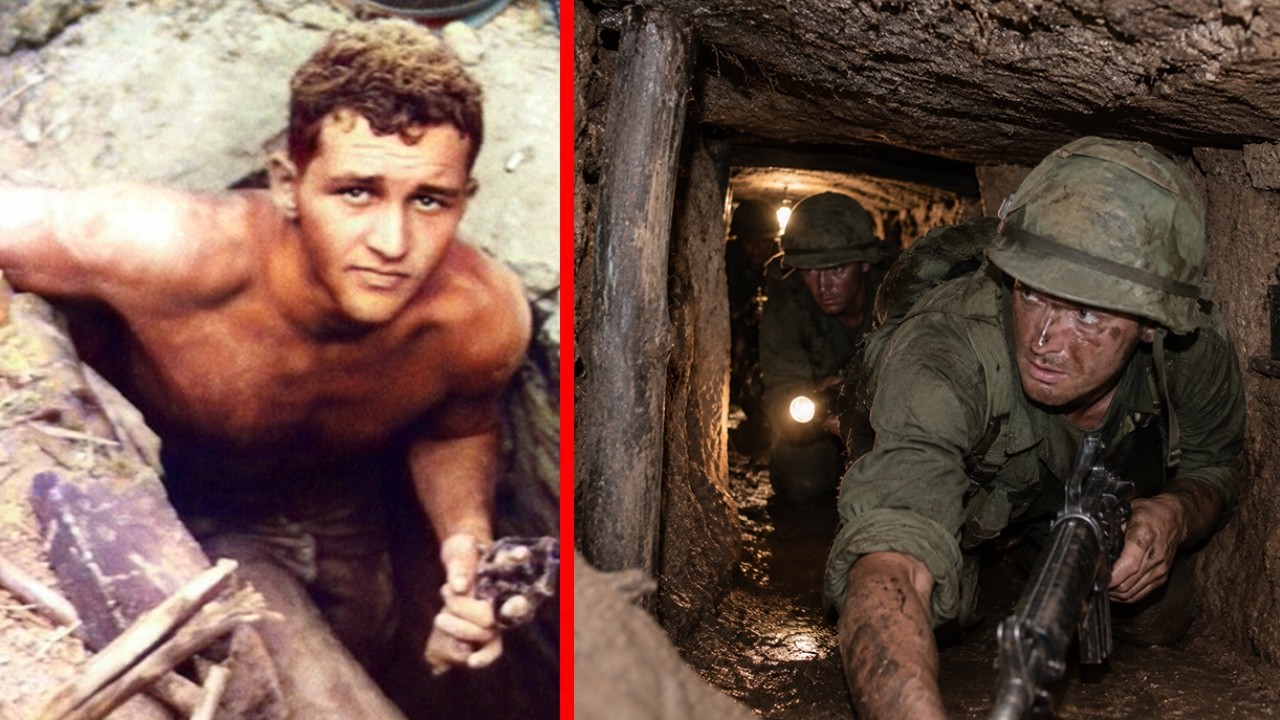
With walls only inches away on both sides, every movement, step, breath, and noise could reverberate through the tunnel. Entering one meant lowering yourself into an opening barely wider than your shoulders. After crawling just a few meters, the daylight from the entrance disappeared, leaving only a small flashlight as the sole source of light.
Movement through these passages was slow and painful. A Tunnel Rat could not simply walk through them. He had to crawl forward inch by inch, often using one hand to move and the other to carry his weapon or light.
 A bayonet could also be used to carefully probe the ground and walls, searching for tripwires, hidden openings, or areas where the soil looked different. One careless move could trigger a grenade attached to a tripwire. Another could send the soldier falling through a concealed trapdoor into a pit filled with sharpened stakes.
These were jagged bamboo spikes, sometimes coated with human feces to increase the likelihood of a serious infection if they pierced a soldier’s body. The Vietcong also built false passages and dead ends within parts of the network. These were not accidental.
They were deliberately designed to confuse anyone entering and force them to waste time, air, and energy trying to find the correct path. Some sections featured U-shaped turns that could be flooded when defenders opened a water source, potentially trapping an intruder between tunnel sections. The deeper a soldier went, the harder it became to breathe, especially in areas lacking proper ventilation shafts.
The tunnels were also intensely hot and humid, and even when the weather changed above ground, some sections retained a layer of additional danger: animals.
Vietcong defenders sometimes placed boxes containing scorpions or venomous snakes along likely paths, rigged with simple mechanisms that could release the animals onto an approaching soldier. American troops nicknamed one type of snake the “three-step snake,” a reference to the belief that a person bitten might only be able to take a few steps before the venom took effect. There were other creatures that lived underground without needing to be placed there.
Bats, rats, and fire ants were common in the tunnels, making an already terrifying environment worse. Every part of the tunnel system posed an additional problem for the man crawling inside it. The statistics show just how dangerous this mission was.
Tunnel Rats suffered a total casualty rate—killed and wounded—of approximately 33% during the war. Simply put, nearly one in three men who served as Tunnel Rats was injured. Among the early Tunnel Rats who worked in 1966 before the army developed better methods and equipment, some estimates suggest the chance of surviving a single mission could be as low as 3%.
Jim Merritt, a combat engineer who served as a Tunnel Rat, later wrote about the losses within his unit. He stated that 36 men were killed and approximately 200 others were wounded during his time in the war. Those numbers were largely consistent with the high casualty rate recorded for Tunnel Rats.
But Merritt also noted that most of the injuries in his unit actually occurred above ground. Many were caused by mines and booby traps while soldiers searched for explosives or tried to defuse them on the surface. The danger followed Tunnel Rats everywhere.
Going underground was only part of the mission. If a soldier was trapped underground, his chances of survival depended on several factors. The most important was how much breathable air he could access.
The Vietcong relied on ventilation shafts to bring air to their underground positions. So, finding one could mean the difference between life and death. A soldier’s survival also depended on how quickly his unit realized he was missing and began searching for him.
If enough air was available, a trapped soldier could survive for hours. Without adequate oxygen, the heat, panic, and dwindling oxygen levels could become a deadly combination much faster. This was the price of trying to destroy a tunnel network that had taken about 20 years to build.
In 1967, the U. S. Army launched another major attempt to destroy the tunnel system.
Operation Cedar Falls began on January 8 and lasted until January 26 of that year. This time, the Americans were not simply targeting the tunnels around Cu Chi. They were also attacking the wider region known as the “Iron Triangle,” a major Vietcong stronghold northeast of Saigon.
Approximately 30,000 American and South Vietnamese troops participated in the operation. They came from several major units, including the 1st Infantry Division, the 25th Infantry Division nicknamed “Tropic Lightning,” the 196th Light Infantry Brigade, the 173rd Airborne Brigade, and the 11th Armored Cavalry Regiment. On paper, the results looked more impressive than those of Operation Crimp.
American forces reported destroying more than 400 tunnels and bunkers during the operation. Reported enemy casualties reached approximately 3,000, including about 720 killed and 280 captured. Meanwhile, 72 American soldiers were killed.
 During the operation, a photograph was taken of Ronald Payne, a platoon leader in the 1st Battalion of the 25th Infantry Division, crawling inside a tunnel near the Ho Bo Woods on January 24, 1967.
But the damage did not last long. Within weeks, much of the tunnel network that had been destroyed was being rebuilt by hand. The Vietcong simply returned to the same basic method they had used when creating the tunnels nearly two decades earlier.
Mai Chi Tho, a prominent communist political figure linked to the leadership in Hanoi and brother of Politburo member Le Duc Tho, later credited these repaired tunnels with helping Vietcong fighters enter and exit Saigon without being detected for the rest of the war. The Americans could destroy parts of the network, but the Vietcong repeatedly proved their ability to rebuild it. That vicious cycle continued for another two years, and in early 1968, the tunnels played a role in the largest offensive of the war up to that point.
In January 1968, Vietcong and North Vietnamese forces launched the Tet Offensive, a massive, coordinated series of attacks across dozens of cities and towns in South Vietnam. One of the primary targets was Saigon, where communist forces managed to launch attacks at astonishingly close range to major American and South Vietnamese military positions. In the weeks leading up to the offensive, fighters, weapons, and supplies were able to move through the underground passages without being seen by the American forces operating above them.
By 1968, the Tunnel Rats were also far more experienced than they had been during Operation Crimp two years earlier. They understood more about how the tunnels were built and how the Vietcong used them. They had developed better methods for searching the passages and had weapons more suited for fighting in such tight spaces.
Within the army, Tunnel Rats had also gained a reputation as the bravest soldiers in Vietnam.
But experience could only reduce the danger to a certain extent. Every time a Tunnel Rat went underground, he was still entering pitch-black darkness and crawling into a space where the enemy knew every turn, trap, and hidden passage far better than he did. What made the Tet Offensive particularly alarming for American commanders was not just the number of attacks.
It was what those attacks revealed. For months, Vietcong fighters and their supplies had been moving through areas that American forces believed they were monitoring and controlling. Much of that movement had occurred literally beneath the feet of American soldiers, hidden underground just a few meters away.
Over the course of the Vietnam War, historians estimate that approximately 45,000 Vietnamese fighters died defending the Cu Chi tunnel system. This figure illustrates just how important the network had become to the Vietcong’s overall war effort. The tunnels were not just hiding places.
They continued to function even when American forces controlled the ground above them. Given that importance, they were defended fiercely throughout the war.
However, the American Tunnel Rat program never significantly exceeded its original size. At any given time, the U. S.
Army had approximately 100 volunteers working as full-time Tunnel Rats. Australian forces also had combat engineers trained separately for underground operations at the Australian Army’s School of Military Engineering near Sydney. The numbers were small, but the psychological impact of the work could last for decades.
Many former Tunnel Rats returned home carrying the memories of the tunnels with them. Some suffered for years from the constant fear and stress they faced underground, where every sound, movement, or shadow could mean the enemy was about to attack. Jack Flowers, who served as a Tunnel Rat leader under the call sign “Rat Six,” spent decades after the war helping to preserve the memories of other surviving Tunnel Rats.
He collected and recorded their first-hand accounts so that their experiences would not disappear with the men who lived them. Another veteran, Carl Currie, who served with the 25th Infantry Division during tunnel operations, described the hardest part of the mission as the moment before entering. While standing at a tunnel entrance, the soldier would see the darkness ahead, but he had no idea what awaited him underground.
By the time American forces withdrew from Vietnam in the early 1970s, the Cu Chi tunnel systems had survived years of bombing, chemical attacks, and major attempts to destroy the network. Thousands on both sides had been killed or wounded in the fighting around them. Yet the tunnels continued to exist.
What began in the 1940s as a hand-dug hiding system used by Vietnamese revolutionaries to fight French colonialism had evolved into one of the most difficult military problems the Americans faced in Vietnam. The Tunnel Rats who descended into that darkness faced odds that were almost insurmountable. They crawled into the unknown with nothing but a flashlight, a knife, and a pistol, knowing that the enemy had built the maze and knew every inch of it.
The survival of a trapped soldier depended on air, on the speed of his comrades, and on a measure of luck that was often in short supply. In the end, the tunnels outlasted the war itself, a testament to the ingenuity and determination of those who built them, and a grim reminder of the cost paid by those sent to destroy them.
