The execution chamber was silent, save for the muffled sobs of witnesses, as the trapdoor swung open and the condemned man plummeted into the void. For over a millennium, hanging has been promoted by states and empires as a swift, clean, and almost merciful end to a life. But the stark reality, as revealed by medical examiners and historical records, is a complex and often horrifying physiological process that has repeatedly defied the calculations of those who sought to perfect it.
From the agonizing minutes of death by slow asphyxiation to the rare but catastrophic failure of a severed head, the human body’s response to the noose has forced a centuries-long reckoning with the true nature of this form of capital punishment.
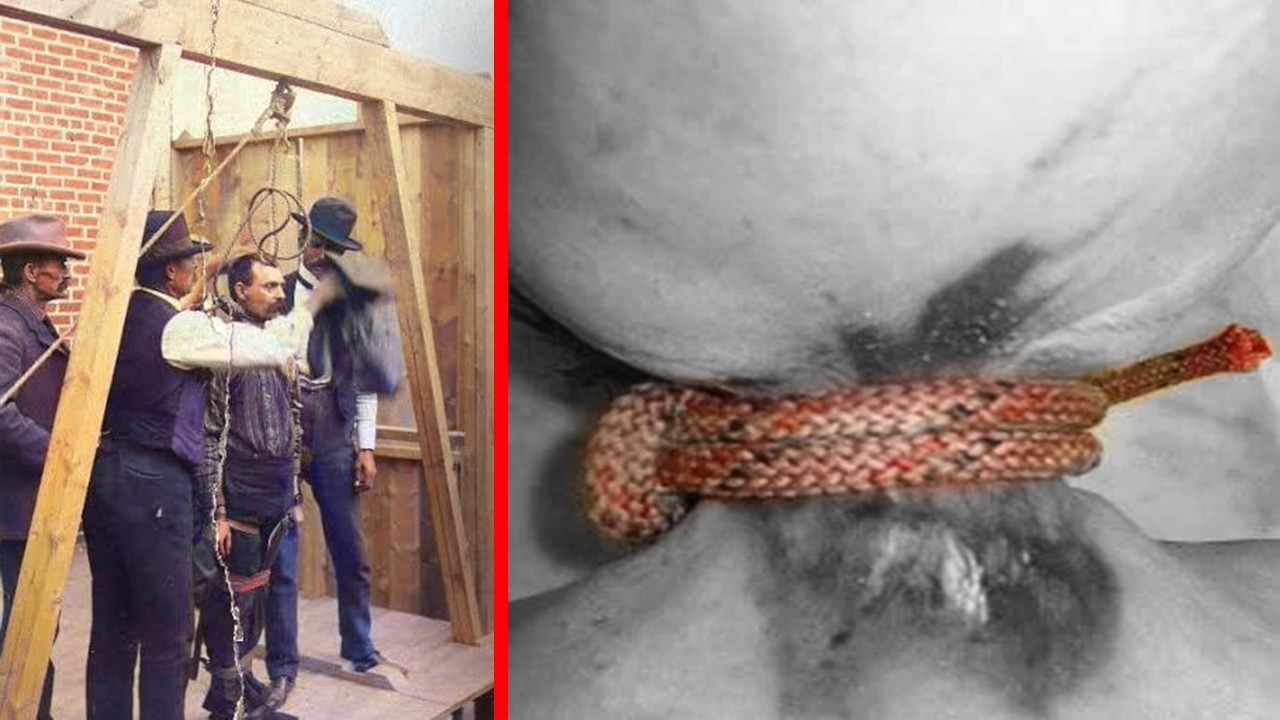 Before the 1870s, the primary method of execution in Britain, Europe, and colonial America was the “short drop.” This technique involved placing the condemned on a cart, stool, or platform with a rope around their neck. The support was then removed, allowing the body to fall only a foot or two before the rope snapped taut.
Contrary to popular belief, this method was not designed to break the neck. Instead, the sudden jerk was intended to cause death via strangulation. The pressure of the rope would constrict the carotid arteries, the main blood vessels in the neck responsible for delivering oxygen-rich blood to the brain.
When the brain is deprived of oxygen, unconsciousness typically occurs within 10 to 20 seconds, but this is far from the moment of death.
The heart, possessing its own electrical conduction system, can continue to beat for several minutes, and complete death could take anywhere from four to over fifteen minutes. During this time, witnesses were often horrified to see the body convulsing violently. Legs would kick, muscles would twitch, and the chest would heave as the body’s automatic reflexes fought against the extreme stress and lack of oxygen.
In 18th and 19th century England, this grim spectacle was known as the “Tyburn jig,” named after the infamous London execution site where public hangings drew massive crowds. For a spectator, these violent movements appeared as a conscious struggle for life, but in reality, the person was usually already unconscious, their body merely a puppet of involuntary spinal reflexes.
The inherent unpredictability of the short drop, which often left the condemned to die slowly, prompted a radical reform in the 1870s. William Marwood, a Lincolnshire shoemaker with no prior connection to the penal system, became obsessed with the mechanics of hanging. He believed that the process could be made faster and more predictable by using a “long drop.”
 His method involved calculating the precise distance of the fall based on the condemned person’s weight, aiming to generate enough force to fracture the cervical vertebrae near the top of the spine. The intended result was a severe injury to the spinal cord, leading to near-instantaneous unconsciousness. Marwood created detailed drop tables, mathematical charts that correlated body weight with rope length and fall distance, and between 1874 and his death in 1883, he personally executed 176 people using his system.
His reputation became so strong that “to be hanged by Marwood” briefly became a colloquial English term for hanging, and his method spread throughout the British Empire and influenced procedures in the United States.
However, the long drop was far from a perfect science. The human body refused to conform to the neat calculations of the tables. If the drop was too long for the person’s weight, the force could be so great that it caused decapitation, completely severing the head from the body.
This occurred in a well-documented case in the American West on April 26, 1901, when train robber Thomas Edward Ketchum, known as Black Jack, was executed in Clayton, New Mexico. The rope used was too long for his weight, and when the trapdoor opened, the force instantly ripped his head from his body in front of the assembled witnesses. Conversely, if the drop was too short, the neck would not break properly, and the person would suffer the slow, agonizing death by strangulation of the old short drop method, compounded by the physical trauma of the fall.
Reports from various American executions in the late 19th and early 20th centuries describe prisoners taking ten minutes or more to die, their bodies writhing against the rope while officials waited.
 Even when the procedure went as planned and the neck broke cleanly, death was not necessarily immediate. Forensic pathologists who studied executions in the 20th century, including renowned British expert Keith Simpson, documented cases where the heart continued to beat for 10 to 20 minutes after the drop, despite the person showing no external signs of consciousness. This created a disturbing grey area for forensic medicine.
Prison doctors would stand beside the body with a stethoscope, listening to the heart as it continued its rhythm long after the brain had ceased to function. This raised unanswerable questions about whether the person felt any pain in the brief moment between the fall and the spinal cord injury, and whether the involuntary muscle spasms observed after the drop were evidence of suffering or merely automatic reflexes.
This medical uncertainty fueled a growing debate about the continued use of hanging as a method of execution. In the United States, states began to shift towards what they considered more modern methods, such as the electric chair and later the lethal injection. However, a few states retained hanging for much longer than most people realize.
On May 27, 1994, Charles Rodman Campbell was hanged at the Washington State Penitentiary in Walla Walla, a highly publicized event that drew national media attention. Delaware kept hanging as an option for inmates sentenced before a certain date, and on January 25, 1996, Billy Bailey was hanged at the Delaware Correctional Center near Smyrna. Bailey, convicted of murdering an elderly couple in 1979, chose hanging over lethal injection, and his execution became the last judicially sanctioned hanging in the United States.
The United Kingdom, the very nation that had spent decades perfecting the long drop system, eventually abolished the death penalty for murder in 1965. The last hangings in Britain took place on August 13, 1964, when Peter Anthony Allen and Gwynne Owen Evans were executed simultaneously in separate prisons in Liverpool and Manchester. Canada followed suit in 1976, abolishing hanging and removing the death penalty from its criminal code for most offenses.
 Many other nations cited the same fundamental problems that had plagued the method since Marwood’s time: the inconsistency of results, the risk of severe injury or decapitation, and the inability of medical science to definitively confirm that unconsciousness was truly instantaneous.
Despite its decline in the West, hanging has not disappeared from the world. As of the mid-2020s, several countries, including Iran, Iraq, Japan, Singapore, and Egypt, still use hanging as an active method of execution. Japan’s system is particularly similar to the long drop method developed in 19th-century Britain, with executions carried out in detention centers under a shroud of extreme secrecy.
Inmates are often given only a few hours’ notice, and families are informed only after the execution has occurred. The Japanese system also employs a unique mechanism designed to diffuse psychological responsibility among the executioners: multiple officers press buttons simultaneously, but only one button actually opens the trapdoor, so no single officer can ever be certain that they were the one who caused the death.
Iran carries out a significant number of hangings each year, more than almost any other country, according to monitoring by international human rights organizations like Amnesty International. The exact numbers are difficult to verify independently, but reports have documented hundreds of hangings in recent years. The continued use of hanging in these nations means that the questions that troubled reformers for over a century remain unresolved today.
Modern equipment and standardized procedures can make the process more disciplined, but they cannot eliminate the fundamental uncertainties about consciousness, pain, and the intricate physiological events that occur within the body. The history of hanging is a testament to the persistent human desire to control and rationalize death, and the repeated failure to do so in the face of the body’s complex and unpredictable reality.
