For decades, the image was flawless: a face that launched a thousand magazine covers, eyes that captivated the silver screen, and a name synonymous with the golden age of Hollywood glamour. Hedy Lamarr was the woman the world believed it knew completely—a beautiful star whose life seemed to be an open book written in the language of fame and allure. Yet, beneath the surface of that carefully constructed public persona, a different life was unfolding, one of scientific curiosity, personal struggle, and a relentless fight against the very identity that made her famous.
Now, the full scope of that hidden existence has come into focus, revealing a story far more complex and remarkable than the legend ever suggested.
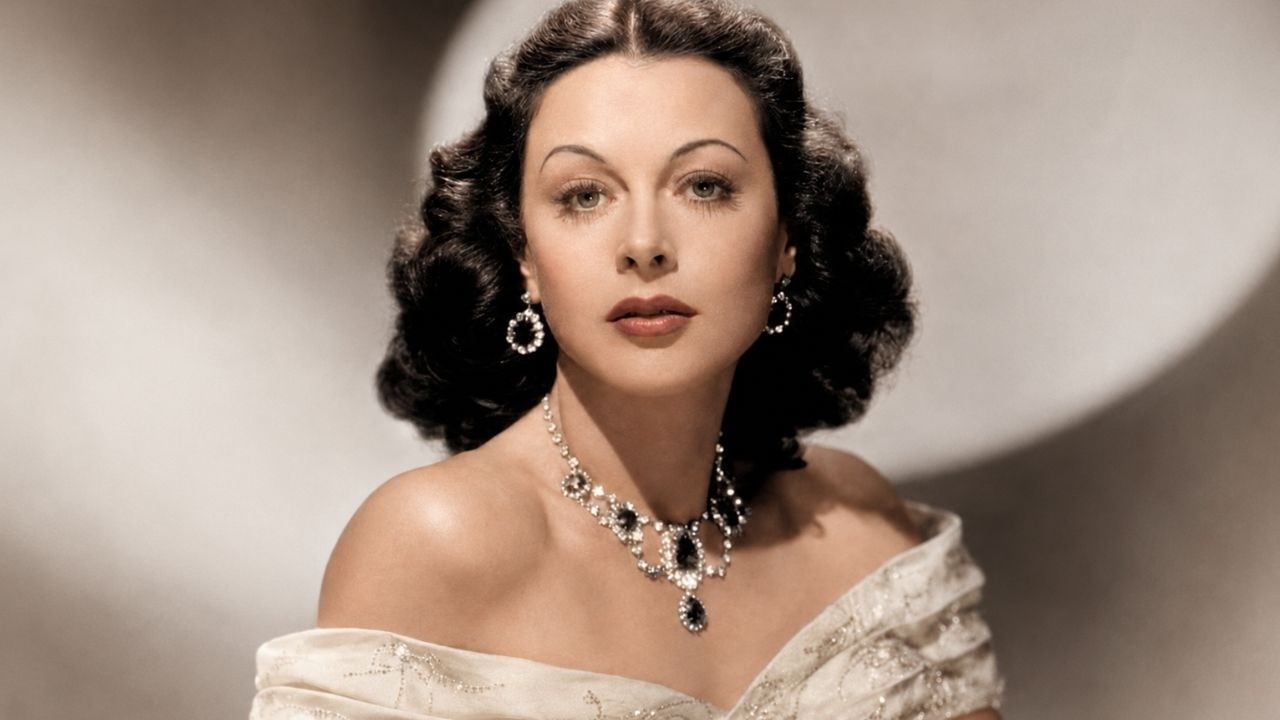 The public’s understanding of Hedy Lamarr has been fundamentally incomplete. While the world saw a glamorous icon, the reality was that she was a woman trapped in a gilded cage, an inventor dismissed by the military, and a mother who experienced profound heartbreak. The revelation of her double life is not a single scandal but the slow, posthumous uncovering of a truth that was always there, hidden in plain sight.
It is the story of a woman who spent her entire life fighting against the definitions others placed upon her, and the world is only now beginning to understand the depth of that battle.
Born Hedwig Eva Maria Kiesler on November 9, 1914, in Vienna, her early life was a blend of two distinct worlds that would later define her internal conflict. Her father, Emil Kiesler, a bank director, nurtured her curiosity about the mechanical world, taking her on walks and explaining the workings of streetcars and machinery. From him, she learned to ask why and how.
Her mother, Gertrude, a concert pianist, immersed her in the world of art and music, encouraging her love for performance and drama. These two passions—for science and for the stage—grew side by side, creating a unique duality that would shape her entire existence.
This duality was present from her earliest years. She excelled in chemistry at school, drawn to the logic of the physical world, while simultaneously loving to dress up and perform imaginary roles in front of a mirror. Her striking beauty began to attract attention in her teenage years, winning a small beauty contest, but it was her passion for acting that led her to leave school and study under the legendary theater director Max Reinhardt.
This decision set her on a path toward cinema, but it was a path that would soon be complicated by the very attributes that made her stand out.
Her entry into the film industry was swift, but it was her role in the 1933 Czech film Ecstasy that catapulted her to international notoriety. The film, which featured nude scenes and a bold portrayal of female desire, was a scandal. Hedy later claimed she was deceived about the nature of the scenes, and the controversy branded her with an image she never wanted.
The film made her famous, but it was a fame built on a foundation of scandal and objectification, a pattern that would repeat throughout her career. She had become a name known across Europe, but for reasons that had little to do with her talent as an actress.
The scandal of Ecstasy was soon followed by a personal imprisonment. Her marriage to Fritz Mandl, a powerful Austrian arms manufacturer, was a turning point. To the outside world, it was a fairy tale union with a wealthy industrialist.
For Hedy, it was a prison. Mandl was controlling and possessive, isolating her from her career and her friends. She was a beautiful ornament at his parties, but she was also a silent observer.
It was during these years that she absorbed the dinner-table conversations about weaponry, control systems, and military technology—knowledge that would prove invaluable decades later but was useless to her at the time.
In 1937, she made the daring decision to escape this life. Fleeing Mandl, she traveled to London and eventually secured a meeting with Louis B. Mayer, the head of MGM.
Mayer was initially unimpressed, seeing just another pretty face. But during an Atlantic crossing on the ocean liner Normandy, Hedy used her intelligence and charm to convince him otherwise. By the time the ship docked in New York, she had a contract and a new name: Hedy Lamarr.
 She had left behind Hedwig Kiesler and her troubled past, but she was stepping into a new kind of trap.
Hollywood immediately seized upon her beauty. Her first American film, Algiers (1938), made her an instant sensation. The press dubbed her “the most beautiful woman in the world,” a title that became both her greatest asset and her heaviest burden.
MGM cast her in a series of films like Boom Town and Ziegfeld Girl, where she played exotic, mysterious, and seductive characters. She worked with the biggest stars of the era, but the roles were often one-dimensional. The studio had decided who Hedy Lamarr should be, and it was a role that left little room for the intelligent, ambitious woman underneath.
This professional frustration was a constant theme. She yearned for complex, dramatic roles, but was continually typecast. She famously turned down the lead in Casablanca, a decision she later regretted, and missed out on Gaslight, which won Ingrid Bergman an Oscar.
The opportunities for serious acting were rare, and the ones that did come were often given to other actresses. Hollywood saw a beauty icon, not a serious performer. This disconnect between her public image and her private ambitions became the central conflict of her life, a conflict that extended far beyond the film set.
While the world saw a movie star, Hedy was secretly pursuing a very different passion. In her private time, she was an inventor. She set up a small workshop in her home where she would sketch ideas and work on technical problems.
Her friendship with the eccentric billionaire Howard Hughes was based on this shared love of innovation. When Hughes was struggling with aircraft design, Hedy studied the shapes of the fastest birds and fish, applying their aerodynamic principles to her sketches. Hughes was reportedly impressed, calling her a genius, a stark contrast to the way the rest of the world perceived her.
Her inventive mind was not limited to aviation. She once developed a bouillon-like tablet that could dissolve in water to create a soda, an idea born from wartime shortages. But her most significant contribution came from her wartime experiences.
Concerned about the war in Europe and remembering the technical discussions she had overheard with Mandl, she began to think about a problem plaguing the Allied forces: radio-controlled torpedoes were easily jammed by the enemy. She believed she could find a solution.
She shared her idea with George Antheil, a composer and fellow inventor. Together, they developed a “frequency-hopping” system that would allow a signal to jump across multiple radio frequencies in a synchronized pattern, making it nearly impossible for the enemy to intercept or jam. On August 11, 1942, they were granted a patent for their “Secret Communication System.”
It was a brilliant, ahead-of-its-time invention. However, when Hedy presented it to the U. S.
Navy, they dismissed it. The technology was deemed too complex, and the military brass could not take a movie star seriously. The patent was filed away and forgotten.
 The rejection was a profound disappointment. While her films were breaking box office records, her intellectual work was being ignored. The world saw the glamorous star of Samson and Delilah, but knew nothing of the woman who had co-authored a patent that would later become a foundational technology for Wi-Fi, GPS, and Bluetooth.
This was the true double life of Hedy Lamarr: the public beauty and the private inventor, the celebrated actress and the dismissed scientist. The irony was staggering, and it would define her sense of self for the rest of her life.
Her career continued into the 1950s, but the peak had passed. The studio system was crumbling, and a new generation of stars was emerging. Hedy’s attempts to take control of her career, such as producing The Strange Woman and starring in the ambitious Loves of Three Queens, did not achieve the success she hoped for.
After her final film, The Female Animal (1958), she quietly stepped away from the big screen. The career that had made her a legend was over, but the personal struggles that had been simmering beneath the surface were about to boil over.
Her personal life was a series of six marriages, each one a search for the simple, stable love that had always eluded her. Her first marriage to Mandl was a prison. Her subsequent marriages to Gene Markey, John Loder, Teddy Stauffer, W.
Howard Lee, and Lewis B. Mayer all ended in divorce. With John Loder, she had two children, Denise and Anthony, and experienced moments of domestic peace, but the pressures of her career and her own mental health struggles took their toll.
She also adopted a son, James, with Gene Markey, but that relationship would later become a source of deep regret and distance.
The loneliness that plagued her was a stark contrast to the public’s perception. She was surrounded by admirers, but felt profoundly misunderstood. The press chronicled her marriages and divorces, but missed the woman desperately trying to build a home.
Her relationship with her adopted son, James, deteriorated over the years, a wound that never fully healed. The woman who had everything—beauty, fame, and wealth—was often desperately unhappy, a fact that the public would only glimpse in the decades to come.
The years following her retirement were difficult. In 1966, a memoir titled Ecstasy and Me was published under her name, but she vehemently disowned it, claiming it was full of lies and distortions. She spent years fighting legal battles to protect her image, suing Mel Brooks over the character Hedley Lamarr in Blazing Saddles and a software company for using her likeness.
These were not just frivolous lawsuits; they were attempts to control a narrative that had been written by others for her entire life.
As she aged, the world that had once worshipped her beauty became a source of pain. She struggled to accept her changing appearance and underwent multiple cosmetic surgeries, with results that were often disappointing. She was arrested for shoplifting, an incident that made headlines and painted a picture of a troubled, reclusive woman.
 Her fortune, once considerable, dwindled due to poor investments. By the late 1970s, she had almost completely withdrawn from public life, living as a recluse in Florida, communicating with the outside world primarily by telephone.
For years, she seemed to have vanished, a forgotten relic of a bygone era. But then, something remarkable happened. The world began to rediscover her.
Researchers and technology historians started to examine the 1942 patent and realized its profound significance. They uncovered the story of the movie star who had invented a technology that would one day underpin the modern wireless world. The narrative began to shift, and the public started to see Hedy Lamarr not just as a beauty icon, but as a brilliant mind.
In 1997, at the age of 82, she and George Antheil were honored with the Electronic Frontier Foundation Pioneer Award. When she was told about the recognition, she famously replied, “It’s about time.” Those four words encapsulated a lifetime of frustration and vindication.
She had waited decades for the world to acknowledge the part of her that was not just a face, but a mind. The recognition was a small but powerful validation of the identity she had always fought to be seen.
Hedy Lamarr died on January 19, 2000, at the age of 85. In accordance with her wishes, her ashes were scattered in the Vienna Woods, returning her to the city of her birth, far from the Hollywood she had both conquered and been confined by. Her death marked the end of a life that was far more complex than any of her film roles.
It was the end of a story about the cost of beauty and the resilience of the human spirit.
Her legacy is a powerful and paradoxical one. She is remembered as one of the most beautiful women of the 20th century, but her most enduring contribution was her intellect. The frequency-hopping technology she co-invented is a cornerstone of modern communication, a fact that has only been widely recognized in the years since her death.
She was a woman who was underestimated precisely because she was so famous for her beauty, a cruel irony that defined her life.
The true story of Hedy Lamarr is not about the beauty that captivated the world, but about the brilliant, struggling, and determined woman who lived behind that image. It is a story about the fight to be seen for who you truly are, not just what you appear to be. The world took a long time to see the rest of her, but the truth is finally out.
The legend of the beautiful movie star has been replaced by the far more compelling story of a remarkable woman who lived a double life, and whose genius was finally recognized, even if it was tragically late.
