The photograph surfaced on a Tuesday afternoon, a seemingly innocuous image of artist Alexandra Grant stepping out in Los Angeles, her signature silver curls cropped into a sharper, shorter cut. Within hours, the internet had done what the internet does, transforming a personal choice into a global conversation, a trending topic, and a flurry of speculative headlines. The frenzy was not about art, nor about her latest exhibition, but about the length of her hair and what it might “mean” for her relationship with Keanu Reeves.
It is a moment that encapsulates a deeply uncomfortable truth about modern celebrity, one that echoes a similar, far more painful episode from over a decade ago involving the very same man now standing beside her.
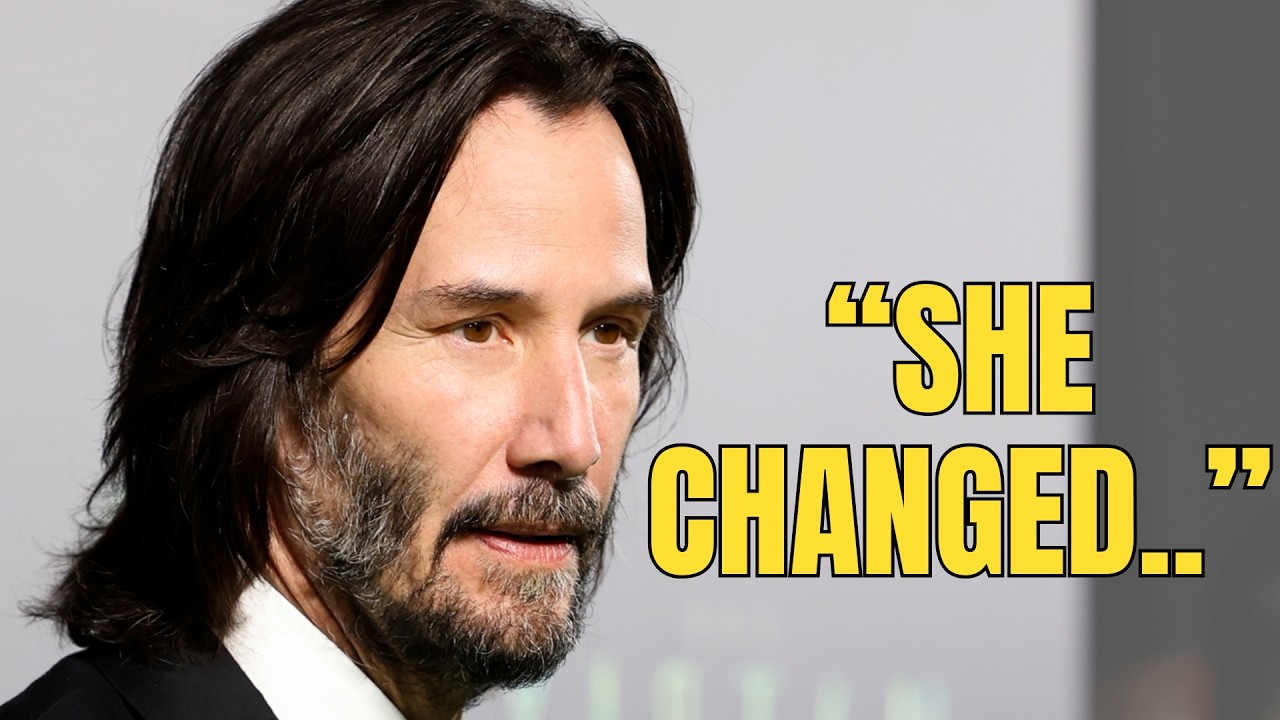 To understand the current noise, one must first revisit the silence of January 2010. A paparazzo captured Reeves sitting alone on a park bench in Los Angeles, eating a sandwich, his gaze fixed somewhere beyond the lens. The image, stripped of all context, was instantly dubbed “Sad Keanu” and became a viral phenomenon.
It was remixed into movie posters, greeting cards, and memes, a global punchline built on the assumption that a man eating lunch alone was a man in profound despair. The internet did not pause to consider the life behind the image, a life that had already been marked by a series of catastrophic losses that would have broken most people. The joke required no answer, only a surface-level image ready for consumption.
The real story, the one the memes ignored, is a testament to a resilience that is almost incomprehensible. In 1993, Reeves lost his close friend and My Own Private Idaho co-star River Phoenix, who died of a drug overdose at the age of 23. Devastated, Reeves channeled his grief into the relentless physicality of the action film Speed, which became a massive hit.
The performance masked a sorrow that audiences in theaters had no idea they were witnessing. It was the first in a long line of private battles fought in the public eye, a pattern that would define his life and career.
The next blow came at the peak of his professional success. In late 1999, just months after The Matrix made him a global superstar, Reeves and his girlfriend, Jennifer Syme, lost their daughter, Ava, who was stillborn. The relationship, strained by a grief too immense to process, did not survive.
Then, in April 2001, Syme was killed in a car accident. Reeves, who was preparing for the massive productions of The Matrix Reloaded and The Matrix Revolutions, reportedly flew back to be with her family and served as one of her pallbearers. Within 18 months, he had buried a daughter and the mother of his child, all while two of the most anticipated sequels in film history waited for him to return to set and perform under immense technical pressure.
 He showed up, carrying the weight silently, without complaint.
Running beneath these tragedies was a quieter, decade-long battle. Reeves’s younger sister, Kim, was diagnosed with leukemia in 1991. For roughly ten years, he became her primary caregiver, selling his home to live closer to her, cooking her meals, and managing her care, all while his career was exploding.
He later established a private charitable foundation supporting children’s hospitals and cancer research, deliberately keeping his name off of it. When asked about his sister’s fight, he offered only a modest sentence about being there for her, because, as he put it, “that’s what you do for someone you love.” This is the man behind the park bench meme, not a punchline, but a person who had already buried a friend, a daughter, and a partner, while fighting to keep his sister alive, all without a single public plea for sympathy.
This history is the emotional architecture of his most iconic roles. The quiet, lived-in devastation he brought to John Wick, a character defined by the loss of his wife, was not a performance of grief; it was testimony. In a 2006 interview, Reeves spoke with startling clarity about his experiences, stating that “grief changes shape, but it never actually ends.”
He admitted that people who believe you can simply process it and move on are wrong, and that all you can hope for is that it transforms into something closer to memory and solace. This is the philosophy of a man who has learned to live with profound loss, not by erasing it, but by integrating it into his being.
 It is into this life that Alexandra Grant entered. A visual artist working far outside the Hollywood machinery, Grant met Reeves in the late 2000s, and their connection was built on friendship and creative collaboration long before it was ever romantic. They co-published two books together, Ode to Happiness and Shadows, projects rooted in shared ideas rather than red carpets.
This period of pure friendship gave Grant years to understand the man behind the fame, a man who had survived unimaginable loss without ever turning it into a public performance. Their relationship, when it finally became romantic, was described by those close to them not as a Hollywood fairy tale, but as something closer to relief. Reeves, who has always been more comfortable listening than performing, found in Grant a partner who never needed him to fill a silence.
The couple did not formally step into the public eye until November 2019, when they walked their first red carpet together, ending nearly a decade of privacy. The reaction was instantaneous and overwhelming, with Grant recalling that everyone she knew called her within the first week. It was a strange thing, watching two people who had spent over a decade deliberately keeping something private suddenly become one of the most discussed couples on the internet overnight.
They did not chase the attention. They continued their lives, taking motorcycle trips and working on their own projects, occasionally correcting the record when the rumor mill went too far.
That instinct was tested again in the fall of 2025 when a single photograph of the couple kissing at Roden Crater in Arizona sent the internet into a wedding frenzy. Congratulations poured in before either of them had said a word. Grant addressed it directly, thanking everyone for the kindness but clarifying plainly that no wedding had happened.
 “Except we didn’t get married,” she wrote, adding with dry humor that people should “be careful out there.” Reeves, asked about it at a film premiere, handled it with the same easy warmth, noting the kind messages were lovely even if the premise was untrue. Neither of them seemed remotely bothered by the mistake, a testament to a relationship that has never been engineered for an audience.
Now, the haircut. The cycle is identical: a photograph, a headline, a manufactured controversy. The world, having spent years ignoring them, now invents entire narratives out of a single frame.
But the actual story, the one that never makes the headlines, is the one about a man who lost a close friend in his 20s, a daughter, and the mother of that daughter within 18 months of each other at the height of his fame, and who spent a decade quietly keeping his sister alive. It is the story of a woman who never needed his fame, who gave him years of ordinary friendship before either of them called it anything else. Their relationship was not tested by public scrutiny; it was tested decades before it began, by death and by a grief that changes shape but never leaves.
So why does the world keep circling back to something as small as a haircut or a kiss photo? Perhaps it is because some people become so adept at protecting what actually matters that the rest of the world is only ever left with the surface to talk about. The headlines are a distraction, a way to avoid confronting the uncomfortable reality of a man who has endured more than most and still chooses to live his life with quiet grace.
The story of Keanu Reeves and Alexandra Grant is not about a hairstyle or a wedding rumor. It is about two people who found each other after surviving their own private storms, and who have built a life on a foundation of friendship, trust, and a shared understanding that true happiness is not a performance. It is a story about the difference between being a subject of content and being a person, and a quiet refusal to let the noise of the world dictate the terms of a real, lived life.
