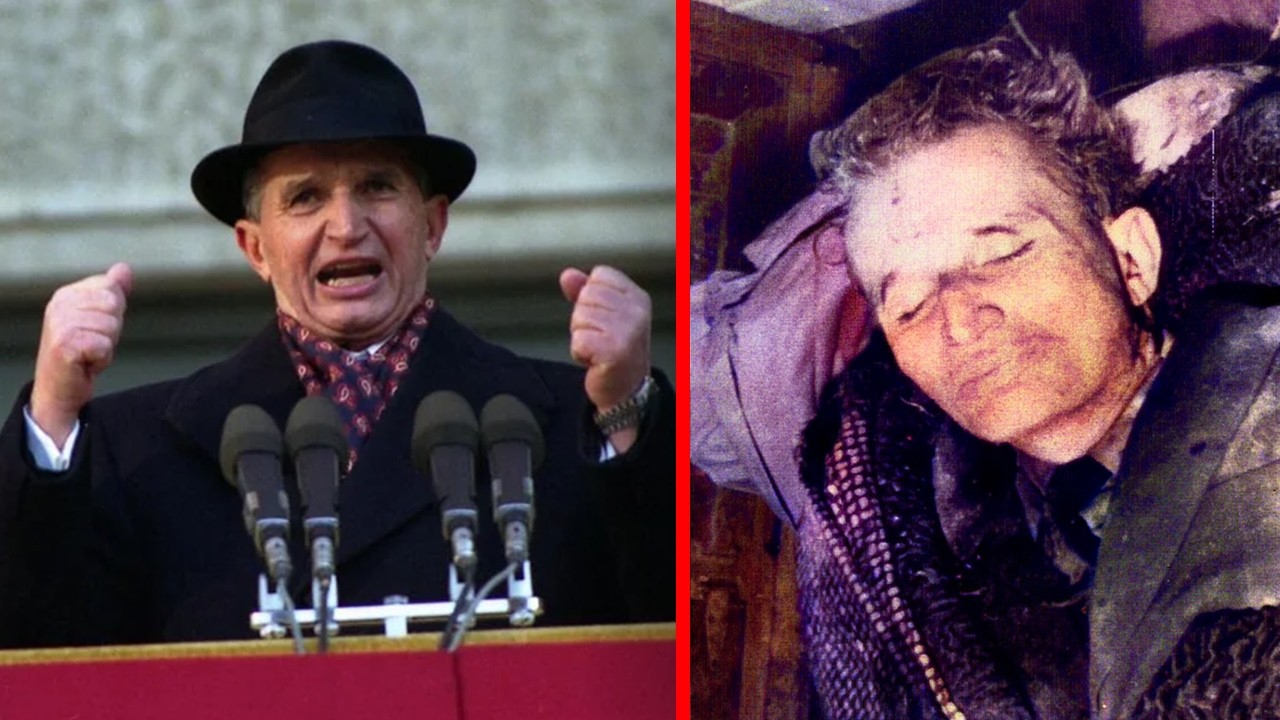
The desperate roar of a crowd, the bewildered face of a tyrant, and a revolution broadcast live into every home in Romania—the final act of Nicolae Ceausescu’s 24-year reign was not a quiet abdication, but a chaotic, bloody spectacle that culminated in a Christmas Day execution carried out against a bullet-riddled wall. The world watched in disbelief as the most powerful dictator in the Eastern Bloc was not only overthrown but tried, convicted, and shot within a matter of hours, ending his rule with a volley of gunfire that echoed across a nation shaking off decades of fear.
For a generation, Nicolae Ceausescu had been the absolute master of Romania, a man whose image was plastered on every wall and whose name was chanted in every factory. Born into profound poverty in the small farming village of Scornicesti on January 26, 1918, his early life was a struggle for survival. Leaving school at a young age, he drifted to Bucharest, where he was drawn into the illegal Communist Party.
 His political activities led to frequent arrests, and he spent much of his youth shuttling between prison and freedom. It was within these prison walls that he forged a crucial alliance with Gheorghe Gheorghiu-Dej, a senior communist figure who would later become Romania’s post-war leader. This relationship proved to be Ceausescu’s ladder to power, as Gheorghiu-Dej patiently groomed him, handing him increasingly influential positions over the next two decades.
When Gheorghiu-Dej died in 1965, Ceausescu ascended to the role of General Secretary of the Romanian Communist Party, the most powerful position in the single-party state. Nine years later, in 1974, he created a new, even more powerful role for himself—President of Romania—thereby consolidating absolute control over the government, the military, and the security apparatus. For a time, Western governments viewed him with a degree of favor, seeing him as a maverick who occasionally distanced himself from Moscow.
His public refusal to support the Soviet invasion of Czechoslovakia in 1968 won him accolades in the West, leading to visits to Britain, meetings with American presidents, and even an honorary knighthood from the British monarchy.
Inside Romania, however, the reality was starkly different. Ceausescu constructed one of the most oppressive and personality-driven regimes in the Eastern Bloc. The state-controlled media relentlessly praised him, bestowing upon him grand titles like “Genius of the Carpathians,” a reference to the mountain range that runs through the country.
His image was ubiquitous, and his wife, Elena, was promoted as a brilliant scientist despite her lack of formal education. The government granted her a doctorate and placed her in key scientific and political roles, eventually making her the First Deputy Prime Minister. By 1989, at least 27 members of the Ceausescu family held influential positions in the party or state, creating a dynastic rule at the heart of a communist system.
Behind this facade of propaganda stood the Securitate, Romania’s secret police, tasked with crushing dissent and protecting the regime. The Securitate built a vast network of informants that permeated every level of society, with neighbors reporting on neighbors and even family members under surveillance. Hundreds of thousands of informants were estimated to be on the payroll, and the government even required citizens to register their typewriters with the police, allowing them to trace any anti-government publication back to its source.
By the 1980s, the Romanian economy was in a state of severe collapse, largely due to Ceausescu’s own policies. Determined to pay off the country’s foreign debt, he diverted massive quantities of food and manufactured goods for export, leaving the population to endure crippling shortages. Imports were slashed, electricity and heating were rationed, and during the harsh winters, many Romanians lived in freezing apartments for hours on end.
While his people suffered, Ceausescu continued to pour billions into monumental construction projects designed to showcase his power, the most famous being the “House of the People” in Bucharest, a colossal government building that remains one of the largest administrative structures in the world. By late 1989, Romania was a nation of acute scarcity, poverty, cold, and fear. The communist governments of Eastern Europe were crumbling around it.
Poland had moved toward a non-communist government, the Berlin Wall had fallen in November, and Czechoslovakia’s communist regime was toppled in the peaceful Velvet Revolution. Ceausescu, however, remained convinced that Romania would be different, believing his system was strong enough to survive the wave of change sweeping the continent.
That belief shattered in December 1989, when a local dispute in the western city of Timisoara ignited a nationwide revolution. The local authorities had attempted to evict Laszlo Tokes, a Hungarian Reformed pastor who had publicly criticized the government. On December 16, a small group of his parishioners gathered outside his home to prevent the eviction.
The crowd swelled rapidly as others joined, their anger fueled by years of shortages, fear, and oppression. By December 17, large crowds were in the streets, openly demanding an end to Ceausescu’s rule. Ceausescu, who was on a state visit to Iran, dismissed the protests as a foreign conspiracy, blaming Hungary, the Soviet Union, and the United States.
He ordered the use of lethal force, and security forces opened fire on the protesters in Timisoara, killing and wounding dozens. The shootings did not end the protest; they only escalated it, and news of the violence spread across the country through foreign radio broadcasts.
When Ceausescu returned from Iran on December 20, the unrest was already spreading beyond Timisoara. Still believing he could regain control, he organized a massive rally in Bucharest on December 21, outside the Central Committee building, the headquarters of the Communist Party. Tens of thousands of workers were bused in to show their support.
As Ceausescu stepped onto the balcony to address the crowd, the speech initially followed the familiar pattern. But then, something shifted. Noise and shouting erupted from the crowd below.
 Ceausescu stopped speaking, visibly confused. For years, Romanian television had shown him as an undisputed leader surrounded by adoring crowds. Now, millions of Romanians watching from their homes saw something they had rarely witnessed before: their dictator losing control.
The state television eventually cut the broadcast, but the moment had already been seen.
By that evening, Bucharest was in turmoil. Crowds gathered in the city center and refused to leave. Security forces moved against them overnight, killing, wounding, and arresting many.
The violence only pushed more people to stand against the regime. The morning of December 22 began with a death that remains controversial. Vasile Milea, Ceausescu’s defense minister, was found dead at around 9:30 a.
m. It has never been definitively determined whether he was killed for refusing to order troops to fire on civilians, or whether he took his own life rather than carry out such an order. Ceausescu declared Milea a traitor, but the announcement did not restore control; it only increased the anger spreading through Bucharest.
General Victor Stanculescu was appointed as the new defense minister, arriving at the Central Committee building that morning with his leg still in a cast from a recent injury. He would soon become a key figure in the collapse of Ceausescu’s government.
Outside, the crowds were growing rapidly, with more than 100,000 people gathered around the Central Committee building. The army, which had been used to support the government, began to turn against the regime, with soldiers increasingly refusing to fire on protesters and, in some places, joining them. By the afternoon, protesters were surging into the Central Committee building itself.
Ceausescu made a final attempt to address the crowds from the balcony with a megaphone, but the noise below was too loud for his words to be heard. Inside the building, the situation was an emergency. Stanculescu organized a helicopter escape for Ceausescu and his inner circle.
As protesters stormed the building, Nicolae and Elena Ceausescu were rushed to the roof, accompanied by senior party officials Emil Bobu and Manea Manescu, and two personal guards. The helicopter was piloted by Vasile Malutan, Ceausescu’s personal pilot. It was so overcrowded that there was not enough room for everyone to sit properly, and reports indicate that the mechanic ended up sitting on Ceausescu’s lap during takeoff.
The helicopter lifted off just as the protesters reached the roof of the building. Below, the crowds flooded into the building the Ceausescus had just vacated, tearing down communist symbols and celebrating the apparent collapse of the regime.
But the revolution was not over. Romania still faced armed conflict, chaos, and competing forces in the streets. Although Ceausescu had fled Bucharest by helicopter, he had only escaped the capital.
The original plan was to fly to Snagov, a town by a lake north of Bucharest where the Ceausescus had a summer residence. From there, they were supposed to meet other helicopters to continue their escape, but that plan collapsed almost immediately. Malutan later explained what happened during the flight.
He told Ceausescu that their helicopter had been spotted on radar and might be shot down. This was not true, but the warning frightened Ceausescu enough to order the pilot to land immediately. Malutan’s ruse worked exactly as he intended.
 Once they landed, the situation became unbelievable for a man who had ruled Romania for 24 years. Ceausescu, Elena, and two security guards stopped a passing car, forced its four occupants out, and drove off in it themselves. Their escape did not last long.
They were spotted near Targoviste, a town about 45 miles northwest of Bucharest. Soldiers and local residents surrounded them and took them into custody.
By the evening of December 22, Nicolae and Elena Ceausescu were prisoners inside a military garrison in Targoviste. Meanwhile, Bucharest was descending into a new kind of chaos. A new political group called the National Salvation Front, led by former communist official Ion Iliescu, moved quickly to take control of the government.
But the street fighting did not stop. Gunfire broke out between various armed groups, and people were being killed by forces whose identity was often unclear. At the time, the new authorities blamed much of the violence on terrorists loyal to Ceausescu.
But the true identity of these people and how much of the fighting was real or misunderstood remains a matter of debate. The scale of the violence was immense. Of the 1,104 people who died during the entire uprising, 942 were killed after Ceausescu fled Bucharest on December 22.
In other words, most of the deaths occurred after his regime had already collapsed. This created immense pressure on the new leadership to end the confusion as quickly as possible. And there was one obvious person they could remove to show that the old regime was finally over: Ceausescu himself.
On December 24, leaders of the National Salvation Front held a secret meeting, reportedly inside a bathroom at the Ministry of Defense. There, they decided that Nicolae and Elena Ceausescu would be tried by a military court in Targoviste the following day, Christmas Day. The strange location and timing of the decision showed how rushed and improvised the entire process was.
General Victor Stanculescu, the same officer who had helped arrange Ceausescu’s escape from Bucharest two days earlier, was put in charge of what would happen to them. The military court consisted of several officers and was presided over by Judge Gica Popa. Two other officers participated in the proceedings, while defense lawyers, Nicolae Teodorescu and Constantin Lucescu, were assigned to represent the Ceausescus.
But the defense was extremely limited. As the hearing continued, the lawyers sometimes seemed more like prosecutors than people trying to save their clients. The charges against them were extremely serious.
They included genocide, based on claims of 60,000 deaths, armed sabotage against the state, destruction of public property, damage to the national economy, and attempting to flee the country while holding more than a billion dollars in foreign bank accounts. Many of these claims, especially the 60,000 death figure, were never properly investigated. The case was put together in a few hours rather than the type of investigation normally expected in a major criminal trial.
Ceausescu refused to recognize the authority of the court. He argued that the court had no constitutional basis and insisted that the new government itself was illegitimate. He also claimed that the entire revolution was actually a Soviet conspiracy against him.
He said he would only answer to the Grand National Assembly of Romania, the country’s official legislature, and denied the charges against him. Judge Popa rejected his argument. At one point, he told Ceausescu that the real fraud was what Ceausescu himself had done to Romania during his 25 years in power.
For decades, Ceausescu had controlled what the Romanian people could say about him. Now he was sitting in a room where a judge could confront him publicly without fear of the old regime. The entire trial lasted about 55 minutes.
 After the closing arguments, the court left the room to discuss its decision. After about 10 minutes, the judges returned. Judge Popa read the verdict.
Nicolae and Elena Ceausescu were found guilty on all charges and sentenced to death. Under the emergency military rules in effect during the revolution, the death sentence could be carried out immediately. According to accounts from the military base, the execution was carried out only about 5 minutes after the trial ended.
The firing squad had already been prepared that morning before the trial began. Eight paratroopers from a military unit stationed in Boteni were transported by helicopter. They were initially told only that they had been selected for a “degree zero” mission without being informed of what that mission entailed.
They were chosen from a larger group of soldiers, with the number first reduced from 50 officers to 20, then to the final eight who would carry out the sentence. The squad was led by Captain Ionel Boeru and included seven non-commissioned officers armed with rifles. Boeru later described seeing Ceausescu shortly before the trial.
The former president looked pale, unshaven, and agitated. However, he was still wearing aftershave, a small detail that Boeru remembered. Stanculescu had already chosen the execution site, next to a wall in the courtyard of the military barracks.
After the trial, Nicolae and Elena were taken outside with their hands tied behind their backs and placed in front of that wall. The firing squad opened fire almost immediately. A military cameraman was recording the event, but he did not capture the entire execution clearly.
The footage mainly showed the final bursts of gunfire, the smoke, and the bodies of the couple lying on the ground. Some accounts suggest that the soldiers fired before the official countdown had even finished. Elena Ceausescu became the only woman ever executed by the modern Romanian state.
Hours after the execution was first announced, official Romanian television aired silent footage of Nicolae and Elena being transported from an armored vehicle to the building where their trial took place. As the images were shown, a narrator read the verdict. For many Romanians, this was the first definitive proof that Ceausescu had actually been captured.
Since December 22, rumors had spread throughout the country because no one knew exactly what had happened to him. In part of the footage, Ceausescu raised both hands in what appeared to be a gesture of surrender. Near the end, he stood and tossed his fur hat onto the table.
It seemed as if he was saying he no longer needed it. The execution itself was not shown during that first broadcast. The full trial footage, along with images of the couple’s bodies, was delivered to Romanian television shortly afterward.
Excerpts were then broadcast around the world. For viewers who had spent decades watching communist leaders remain in power or retire quietly, these images were shocking. The bodies were transported to Bucharest under military guard because the streets were still highly unstable.
The authorities did not want large crowds gathering around the bodies or using them as a focal point for further violence.
On December 30, five days after the execution, Nicolae and Elena Ceausescu were quietly buried in the Ghencea Military Cemetery in Bucharest. They were placed in two separate unmarked graves, with Elena’s grave located in a highly secret area behind a marble mausoleum. The death of Ceausescu brought an end to 42 years of communist rule in Romania.
Ion Iliescu, who had led the National Salvation Front during the chaotic transition, became the country’s new president as the new political system began to take shape. Romania was also the only country in that wave of revolutions where a communist leader was executed. In Poland, Czechoslovakia, Hungary, and East Berlin, communist governments collapsed and their leaders stepped down, retired, or faced legal proceedings later.
Romania dealt with its former leader within days, ending with a military trial, a firing squad, and a wall in a courtyard.
