The blade falls in less than a second, traveling at speeds of up to seven meters per second, but the scientific and historical debate over what happens in the final moments of a guillotine execution has lasted for more than two centuries. The device, introduced in Paris in the spring of 1792, was designed as a great equalizer—a swift and uniform method of death for all citizens, regardless of class. Yet, the reality of what the human body endures, and the question of whether the severed head retains any flicker of consciousness, remains one of the most macabre and contested subjects in medical history.
Before 1792, the method of execution in France was a brutal reflection of the social hierarchy. Nobles faced decapitation by sword, a method considered honorable and relatively quick. Commoners, however, were subjected to hanging or far more savage punishments, such as breaking on the wheel, where a prisoner’s bones were shattered with a heavy iron bar, often leaving the victim alive for hours in agony.
 This system of unequal justice prompted Dr. Joseph-Ignace Guillotin to address the National Assembly on October 10, 1789, arguing that every person, rich or poor, noble or commoner, deserved the same swift method of death.
The task of designing the machine fell to Antoine Louis, secretary of the French Academy of Surgery, who collaborated with Tobias Schmidt, a German harpsichord maker. They tested prototypes on animal carcasses and human corpses to determine the optimal blade angle, height, and force required to sever the neck cleanly. By April 1792, the machine was ready for its first living subject, a highwayman named Nicolas-Jacques Pelletier, whose execution at the Place de Grève drew a large crowd expecting a prolonged spectacle.
Instead, the blade fell and it was over in seconds, leaving the audience disappointed and shouting for the return of the gallows, proving the machine had achieved its primary goal of speed over entertainment.
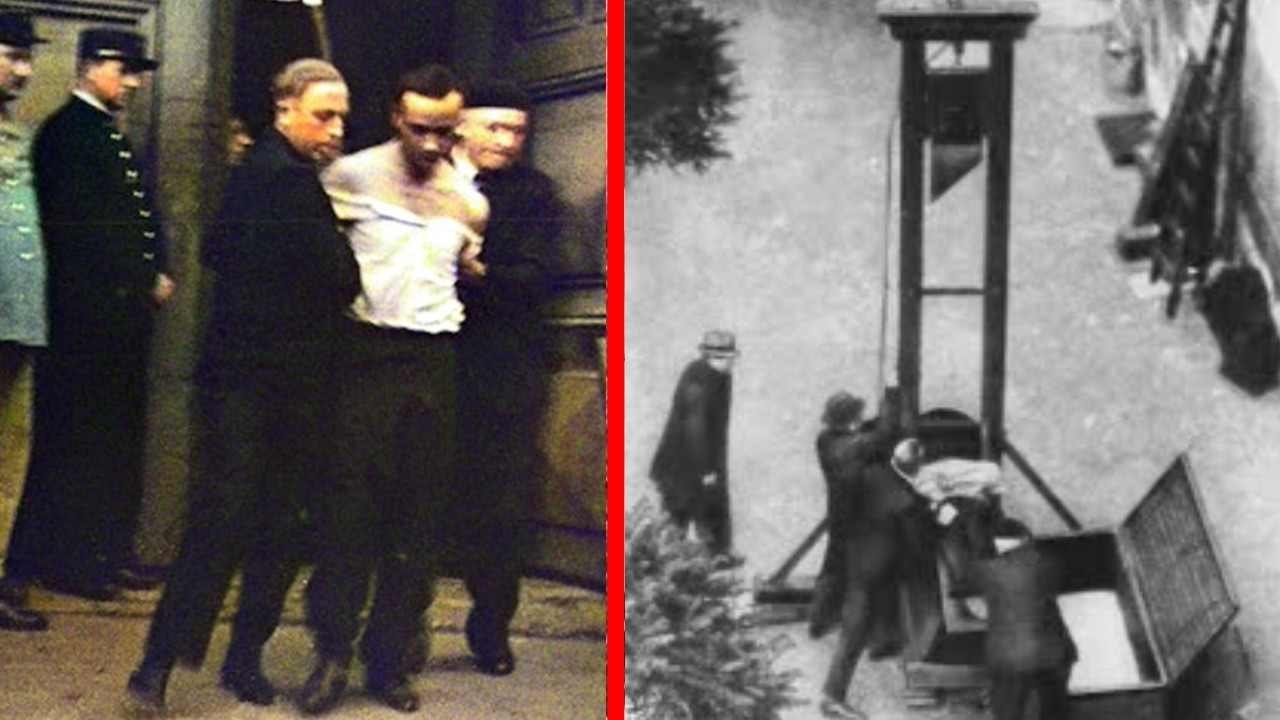
The guillotine’s design was deceptively simple but brutally efficient. Two upright wooden beams, approximately 4. 6 meters tall, formed the frame from which a 40-kilogram steel blade was suspended.
The blade was angled, not straight, a crucial detail that allowed it to cut through one side of the neck before the other, mimicking the action of slicing rather than chopping. This design required significantly less force and enabled the blade to sever skin, muscle, blood vessels, and the spinal column in a single, precise motion. The victim was secured on a tilting board called a bascule, with the neck held in place by two curved wooden pieces known as a lunette, ensuring no movement at the critical moment.
From the release of the blade to its complete passage through the neck, the entire process took less than one second. In that instant, the blade severed the spinal cord, the trachea, the esophagus, and the major blood vessels, including the carotid arteries and jugular veins. The head was completely separated from the body almost immediately.
 However, the heart does not stop beating at that exact moment. Like any muscle, it can continue to pulse for a few seconds if it still has sufficient oxygen, which means blood is forcefully pumped from the severed vessels in the neck rather than flowing out slowly. Witnesses frequently described a sudden, powerful gush of blood, a phenomenon fully consistent with what doctors expect while the heart is still pumping.
Inside the severed head, blood pressure drops to nearly zero instantly, as it is no longer connected to the body’s circulatory system. Without a fresh supply of oxygen-rich blood, the brain begins to lose oxygen within seconds. The body left on the guillotine board often continues to move for a short period after the execution, with witnesses reporting twitching arms or legs, muscle contractions, and unexpected jerks.
These movements are involuntary, caused by the nervous system and spinal reflexes continuing to function briefly after the brain is disconnected. They do not indicate that the person is still alive or conscious, similar to how a chicken’s body can move after its head has been cut off.
The most enduring controversy, however, concerns the severed head itself. For over two hundred years, doctors and witnesses have debated whether the brain can remain conscious for a few seconds after decapitation. During the French Revolution, numerous eyewitnesses claimed to have seen strange reactions from freshly severed heads, with some saying the eyes seemed to track movement and others believing facial expressions changed when a victim’s name was called.
These stories spread rapidly, but most were based on personal observation rather than controlled scientific study, making it impossible to verify their accuracy. One of the most famous tales involves the chemist Antoine Lavoisier, who was executed in 1794 and allegedly arranged to blink his eyes after the blade fell to measure how long consciousness persisted, with the story claiming he blinked up to fifteen times. Historians, however, have found no reliable documentation from the time to confirm this, and most now consider it a myth.
 A more serious attempt to answer the question came in June 1905, when French physician Gabriel Beaurieux had the rare opportunity to examine the head of an executed convict named Henri Languille immediately after his death. Beaurieux reported that when he called Languille’s name, the man’s eyelids opened slowly and his eyes seemed to focus directly on the doctor before closing again. The reaction reportedly repeated a second time before all movement ceased.
Beaurieux believed this indicated a brief period of consciousness, but other doctors disagreed, arguing that the eye movements could be automatic twitches of muscles as the nervous system shut down, not evidence of conscious perception. Without the ability to measure brain activity directly, the debate remained unresolved.
Modern technology has allowed researchers to study the question more carefully, though ethical constraints prevent experiments on humans. In 2011, researchers at Utrecht University in the Netherlands conducted a controlled study using decapitated rats, monitoring their brains with an electroencephalogram to measure how long brain activity persisted. They found that distinct brain wave patterns continued for about four seconds after decapitation, with activity gradually weakening rather than stopping abruptly.
After approximately seventeen seconds, electrical activity in the brain had almost completely disappeared. The researchers were cautious, however, noting that rat brains and human brains are not identical and that their study did not prove a human would remain conscious or aware during those final seconds.
Many scientists point to another critical factor: once the head is severed, blood pressure inside the skull collapses almost immediately because it is no longer connected to the heart. The brain depends on a continuous flow of oxygen-rich blood under pressure to function normally, and once that flow stops, the brain begins to shut down very quickly. For this reason, many researchers estimate that if any consciousness remains after decapitation, it likely lasts between two and ten seconds at most.
 They often compare this to what happens to fighter pilots during high-G maneuvers, where strong gravitational forces temporarily prevent enough blood from reaching the brain, causing pilots to lose consciousness suddenly within seconds. Decapitation causes a complete cessation of blood flow, making it highly unlikely that the brain continues to function normally for any extended period.
Even with modern science, no study has provided a definitive answer, as there is no direct way to measure a person’s conscious experience after decapitation. The most cautious scientific opinion today is that a very brief period of fading brain activity may be possible, but this does not necessarily mean the person remains fully aware, thinks clearly, or consciously experiences what is happening. Most researchers who have studied this topic believe that if any consciousness exists, it is likely extremely short, rapidly fading, and far from normal awareness.
While doctors and scientists continued to debate what happens during those final seconds, the guillotine remained in use in France for nearly two more centuries, carrying out executions long after the French Revolution ended. The machine itself was refined over the years, with spring-release mechanisms replacing the manual rope-cutting system to ensure the blade fell consistently every time.
The last person executed by guillotine in France was Hamida Djandoubi on September 10, 1977, in Marseille, after being convicted of torture and murder. Just four years later, in 1981, France officially abolished the death penalty, and the guillotine was permanently removed from the French judicial system. The machine that was created to provide a swift, equal, and humane death for all citizens ultimately became a symbol of terror during the Reign of Terror, when an estimated 17,000 people were officially sentenced to death across France, with approximately 2,600 executed in Paris alone.
Among them were King Louis XVI, Queen Marie Antoinette, revolutionary leader Georges Danton, and finally, Maximilien Robespierre himself, the man who had used the guillotine more than anyone else. The question of what the human body experiences in those final seconds after the blade falls remains unanswered, a grim mystery that continues to haunt the legacy of one of history’s most infamous machines.
