The faint scrape of a shovel, the whisper of a canvas bag against dirt, and the soft thud of displaced earth were the only sounds that marked the beginning of an underground war. For years, American soldiers patrolling the dense jungles and quiet perimeters of South Vietnam were haunted by a ghost they could not see. Men vanished from guarded bases, helicopters were sabotaged overnight, and sentries were found dead at their posts with no sign of an intruder.
The answers were not above ground, but buried deep beneath their boots, in a labyrinth that would come to define the conflict’s most terrifying and claustrophobic battles.
 The network, initially carved out in the late 1940s, was not conceived as a weapon against the United States. It was born from necessity during the Vietnamese struggle for independence from French colonial rule. Guerrilla fighters, vastly outnumbered and outgunned, needed a way to move, hide, and strike without being seen.
Using only hand tools like shovels and woven baskets to haul away the soil, they dug slowly, expanding their sanctuary section by section over many years. By the time American ground forces began arriving in significant numbers in the early 1960s, the Viet Cong had transformed this rudimentary system into a sprawling, highly organized underground complex.
The main artery of this subterranean world lay beneath the Cu Chi district, a patchwork of farmland and forest roughly 20 miles northwest of Saigon. At its peak, the network stretched an estimated 250 kilometers, linking Viet Cong bases from the outskirts of the capital to the Cambodian border. This allowed communist fighters to traverse vast swathes of territory without ever setting foot on the surface.
These were not simple trenches; some sections descended three or four meters, built on multiple levels with sleeping quarters, kitchens, small hospitals, weapons caches, and command centers where officers planned operations. Even cooking was a calculated act of concealment, with smoke vented through long, narrow pipes to emerge far from the actual kitchen, making it nearly impossible for American aircraft to pinpoint their location.
For years, this entire system existed directly beneath areas occupied or controlled by American forces, a secret kept in the dark. The discovery came in January 1966, when soldiers from the 1st Infantry Division, alongside the 173rd Airborne Brigade, stumbled upon entrances to the tunnel system in the Cu Chi area. This breakthrough finally explained the mysterious attacks that had plagued the Americans.
It was the key to understanding how the enemy could appear and vanish with such unnerving speed. The immediate response was Operation Crimp, a massive search-and-destroy mission launched on January 8th, targeting the Ho Bo Woods, a dense forest believed to house a major Viet Cong headquarters.
The operation involved around 8,000 American and Australian troops, making it the largest Allied operation of the war at that time. Before ground forces moved in, B-52 bombers were sent in to carpet the area, unleashing a torrent of explosives designed to obliterate anything beneath the surface. A single bombing run could devastate an area nearly a mile long, leaving the earth pockmarked with craters.
Yet, when the ground troops advanced, they discovered over 200 tunnel entrances. The Viet Cong had simply retreated deeper into their network, surviving the bombardment that had exploded just meters above their heads. Subsequent attempts to flush them out with tear gas and acetylene gas proved futile, as the system was too vast, too deep, and too complex.
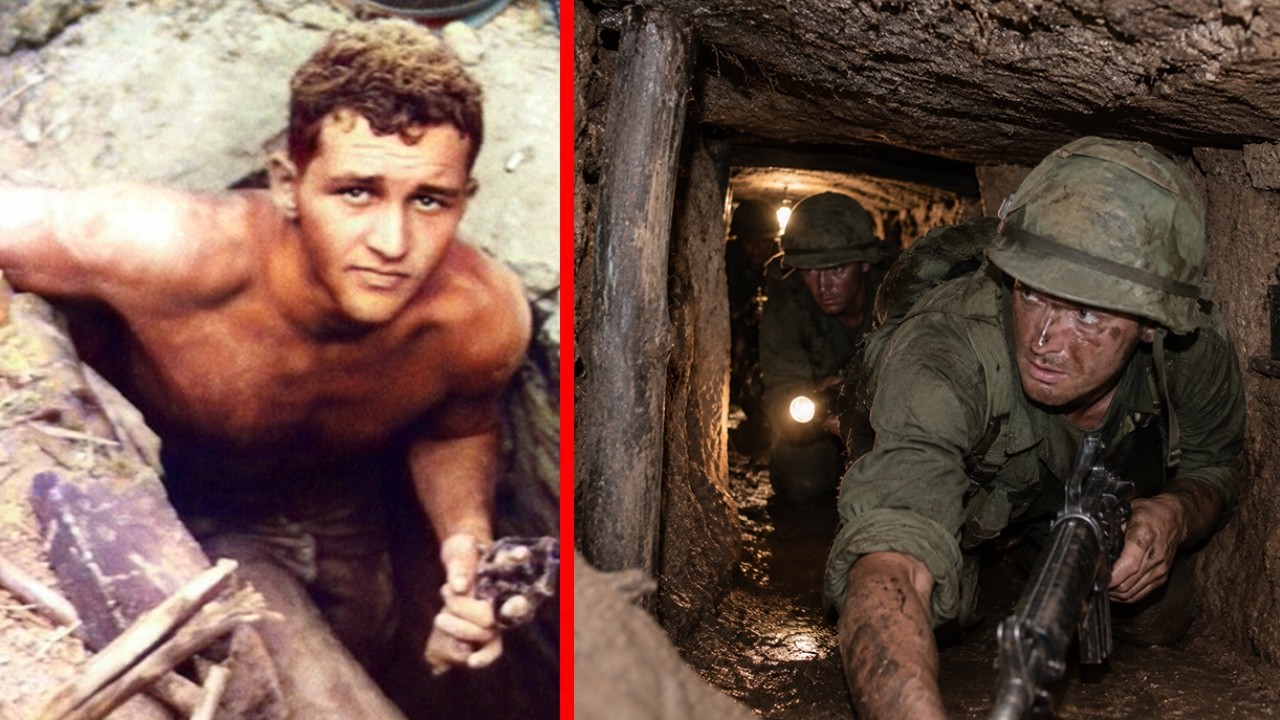
With conventional methods failing, there was only one option left: someone had to go down. The men who volunteered for this harrowing duty became known as “Tunnel Rats.” The name was not an insult but a badge of a unique and terrifying specialization.
 Size was the primary qualification; many passages were less than half a meter wide, making broad shoulders a fatal liability. Claustrophobia was an automatic disqualifier, as panic in such a confined space could lead to being trapped and killed in seconds. There was no formal training program when the mission began.
The first volunteers learned through trial and error, often with fatal consequences.
Their equipment was minimal: a pistol, a knife or bayonet, and a flashlight. Some carried a reel of string to trace their path back to the entrance. The standard-issue M1911 .
45 caliber pistol proved problematic; the deafening blast and blinding muzzle flash in a confined space could disorient the soldier for critical seconds. Many switched to revolvers or silenced pistols, while others preferred the silent lethality of a blade. At any given time, only about 100 dedicated Tunnel Rats were active in Vietnam, a small force compared to the hundreds of thousands of troops in the country.
They developed their own lexicon for the experience, calling it the “Black Echo,” a term that captured the absolute darkness and the strange, distorted way sound traveled through the narrow passages.
Descending into a tunnel meant lowering oneself into a hole barely wider than one’s shoulders. After crawling just a few meters, the daylight vanished, leaving only a small flashlight as the sole source of illumination. Movement was agonizingly slow, often requiring the soldier to inch forward on his belly, using one hand to move and the other to hold his weapon.
Bayonets were used to probe the ground and walls for tripwires, hidden compartments, or disturbed soil. A single careless movement could trigger a grenade rigged to a wire, or plunge the soldier into a pit filled with sharpened bamboo stakes, often smeared with human waste to cause infection. The Viet Cong also built false passages and dead ends to confuse and exhaust intruders, wasting their precious time, air, and energy.
The deeper a soldier went, the harder it became to breathe, especially in sections lacking proper ventilation. The tunnels were intensely hot and humid, and some sections contained another layer of danger: animals. The Viet Cong would place boxes containing scorpions or venomous snakes along likely paths, rigged to release the creatures on an approaching soldier.
 American troops nicknamed one species the “three-step snake,” referring to the belief that a bitten man could take only a few steps before the venom took hold. Bats, rats, and fire ants were common inhabitants, adding to the horror of the environment. The statistics show the peril of this task: Tunnel Rats suffered a casualty rate of about 33% during the war.
For the early rats operating in 1966, before better methods were developed, some estimates suggested the chance of surviving a single mission was as low as 3%.
If a soldier became trapped underground, his survival depended on several factors. The most critical was access to breathable air, which relied on finding one of the Viet Cong’s ventilation shafts. Survival also depended on how quickly his unit realized he was missing and began a rescue effort.
With enough air, a trapped soldier could survive for hours; without it, the combination of heat, panic, and dwindling oxygen could prove fatal much faster. This was the price of attempting to destroy a network that had taken two decades to build. In 1967, the military launched Operation Cedar Falls, an even larger effort targeting the “Iron Triangle,” a key Viet Cong stronghold.
Around 30,000 American and South Vietnamese troops participated, reporting the destruction of over 400 tunnels and bunkers.
While the official numbers seemed impressive, the damage was not lasting. Within weeks, much of the destroyed network was being rebuilt by hand. The Viet Cong simply returned to the same basic methods they had used two decades earlier.
This cycle of destruction and reconstruction continued for two more years, culminating in the tunnels playing a pivotal role in the largest offensive of the war. In January 1968, the Viet Cong and North Vietnamese launched the Tet Offensive, a massive, coordinated series of attacks across dozens of cities. In Saigon, communist forces were able to launch attacks from astonishingly close range to major American and South Vietnamese military installations, having moved troops, weapons, and supplies through the underground passages in the weeks prior without being detected.
By 1968, the Tunnel Rats were far more experienced than their predecessors. They understood the construction of the tunnels and how the Viet Cong used them. They had developed better search techniques and more suitable weapons for close-quarters combat.
 Within the army, they had earned a reputation as the bravest soldiers in Vietnam. But experience could only mitigate the danger so much. Every time a rat descended, he was entering a pitch-black space where the enemy knew every turn, trap, and hidden passage far better than he did.
What made the Tet Offensive particularly alarming for American leaders was not just the number of attacks, but what they revealed: for months, Viet Cong fighters and supplies had been moving through areas the Americans believed they controlled, often directly beneath their feet.
Over the course of the Vietnam War, historians estimate that around 45,000 Vietnamese fighters died defending the Cu Chi tunnel system. This figure underscores the immense importance the network held for the Viet Cong’s overall war effort. The tunnels were not just hiding places; they remained operational even when American forces controlled the ground above.
Because of that importance, they were defended fiercely throughout the war. The American Tunnel Rat program never significantly expanded beyond its original size, with roughly 100 full-time volunteers at any time. The Australian forces also had their own combat engineers trained separately for underground operations.
The psychological impact of the work lasted for decades. Many former Tunnel Rats returned home carrying the memories of the tunnels with them. Some suffered for years from the constant fear and stress they faced underground, where every sound, movement, or shadow could mean the enemy was about to strike.
Jack Flowers, who served as a Tunnel Rat leader under the call sign “Rat Six,” spent decades after the war helping to preserve the memories of other surviving rats, collecting their firsthand accounts so their experiences would not vanish with the men who lived them. Another veteran, Carl Currie, described the hardest part of the mission as the moment before entering, standing at the tunnel entrance, staring into the darkness with no idea what awaited below. By the time American forces withdrew from Vietnam in the early 1970s, the Cu Chi tunnel systems had survived years of bombing, chemical attacks, and major attempts to destroy the network.
Thousands on both sides had been killed or wounded in the fighting around them, yet the tunnels remained. What began in the 1940s as a hand-dug hiding system for Vietnamese revolutionaries fighting French colonialism had evolved into one of the most difficult military problems the Americans faced in Vietnam, a dark and silent adversary that proved, time and again, that the ground itself could be the most dangerous enemy of all.
