The final, desperate act of Nicolae Ceaușescu’s life unfolded not in a grand hall of power, but against a stark, rain-soaked wall in a military barracks courtyard in Târgoviște, a mere 55 minutes after a hastily convened tribunal condemned him. The man who had ruled Romania with an iron fist for 24 years, who had built one of the most formidable cults of personality in the Eastern Bloc, was executed by firing squad on Christmas Day 1989, alongside his wife, Elena. The world watched in stunned silence as grainy, silent footage of their corpses was broadcast on state television, a visceral and unprecedented end to a dictator’s reign that would forever change the landscape of post-Cold War Europe.
The execution was the culmination of a week of chaos that began not in the capital, but in the western city of Timișoara. On December 16, a protest erupted over the government’s attempt to evict László Tőkés, a Hungarian Reformed pastor who had dared to criticize the regime. What started as a small vigil for a dissident priest quickly metastasized into a full-blown uprising against the state.
 The crowd, swollen with citizens enraged by years of brutal austerity, food shortages, and secret police surveillance, began chanting anti-government slogans. Ceaușescu, who was on a state visit to Iran, ordered a violent crackdown. Security forces opened fire on the protesters, killing dozens, but the bloodshed only fueled the flames of rebellion, and the news of the massacre spread rapidly across the country.
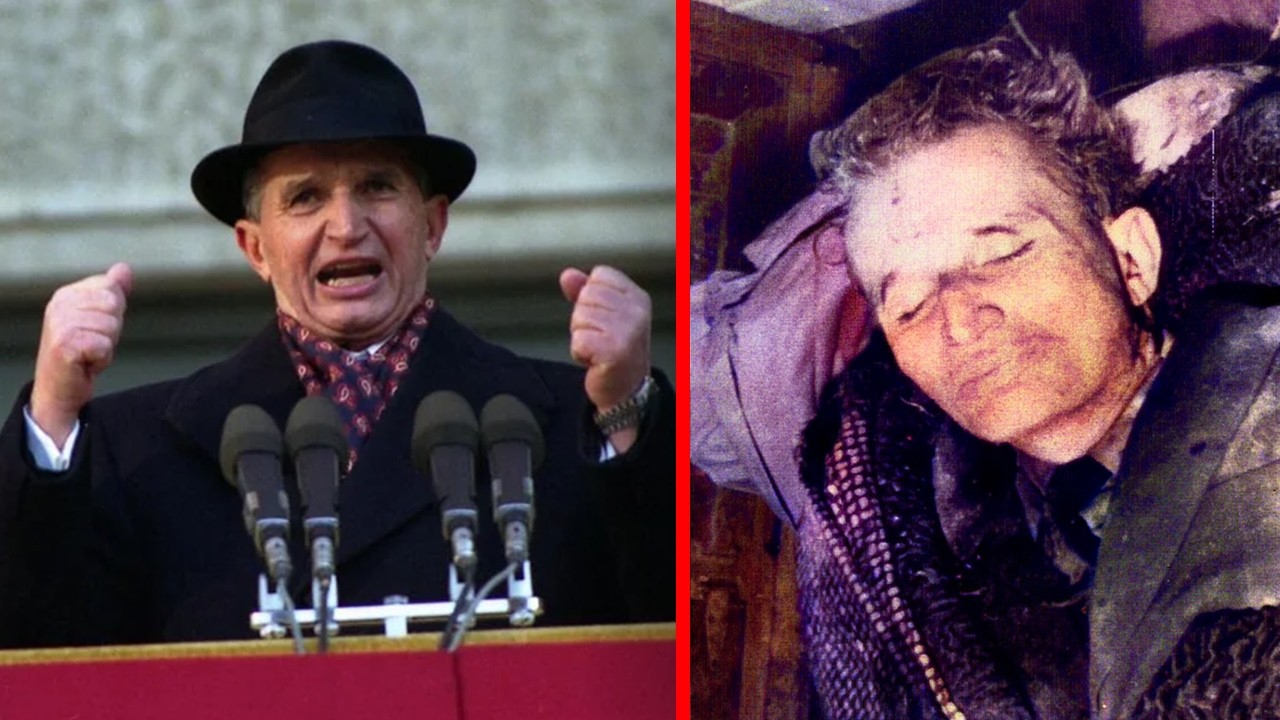
Returning to Bucharest on December 20, Ceaușescu remained defiantly out of touch, convinced he could quell the unrest. He convened a massive rally in the capital on December 21, expecting a show of loyalty. Standing on the balcony of the Central Committee building, he began to speak, but the crowd, which had been bused in, began to hiss and shout him down.
For the first time, the live television broadcast captured the dictator’s visible confusion and loss of control. The state television feed was abruptly cut, but the damage was done. The image of a bewildered Ceaușescu, unable to command a crowd, had been seared into the minds of millions of Romanians, shattering the carefully constructed myth of his infallibility.
By the following morning, December 22, the capital was in open revolt. Over 100,000 people surrounded the Central Committee building, and crucially, the army began to defect, refusing to fire on the crowds and in some cases joining them. Inside the building, the situation was dire.
General Victor Stănculescu, who had just been appointed defense minister, organized a desperate escape. As protesters stormed the building, Ceaușescu, his wife, and a few loyalists fled to the roof, where a helicopter was waiting. The pilot, Vasile Maluțan, was instructed to take off immediately, and the aircraft lifted off just as the mob reached the rooftop.
 The escape, however, was short-lived. Maluțan, who was loyal to the revolution, convinced the terrified dictator that the helicopter was in danger of being shot down by radar-guided missiles and landed in a field near Târgoviște. The couple commandeered a passing car, but were quickly apprehended by local residents and military personnel, and taken into custody at a military garrison.
While the Ceaușescus were being captured, Bucharest descended into a violent power vacuum. A new political group, the National Salvation Front, led by former Communist official Ion Iliescu, seized control of the government. But the streets were still dangerous, with intense gunfights erupting between various armed factions.
The new leadership blamed the violence on loyalist “terrorists,” though the true nature of the conflict remains a subject of historical debate. The death toll was staggering; of the 1,104 people killed during the entire uprising, 942 died after Ceaușescu had already fled Bucharest. The immense pressure to end the chaos and prove the old regime was truly dead fell on the captured dictator.
On December 24, in a secret meeting reportedly held in a bathroom at the Ministry of Defense, the leaders of the National Salvation Front made the decision to try Nicolae and Elena Ceaușescu. The trial was to be held the very next day, Christmas Day, at the military garrison in Târgoviște. The haste and improvisation of the entire process were evident in its location and timing.
 The tribunal, composed of military officers and presided over by Judge Gică Popa, was convened with a list of charges that included genocide, armed attack on the state, destruction of public property, undermining the national economy, and attempting to flee the country with over a billion dollars in foreign bank accounts. The proceedings, which lasted a mere 55 minutes, were a far cry from a standard legal process. The defense lawyers, appointed to represent the couple, often appeared to act more as prosecutors, and the charges, particularly the claim of 60,000 deaths, were never properly investigated.
Ceaușescu refused to recognize the court’s legitimacy, arguing that it had no constitutional basis and that the new government was itself illegal. He insisted the revolution was a Soviet conspiracy and demanded to answer only to the Grand National Assembly. Judge Popa rejected his arguments, telling the former dictator that the real fraud was what Ceaușescu had done to Romania during his 25 years in power.
The trial concluded with a guilty verdict on all charges and a sentence of death for both Nicolae and Elena. Under the emergency military rules in place, the sentence could be carried out immediately. The execution squad, a group of eight paratroopers from a unit in Boteni, had been assembled that morning, before the trial even began.
They were led by Captain Ionel Boeru, who later described seeing the former president looking pale, unshaven, and agitated, yet still wearing aftershave.
 The couple was taken outside to a wall in the barracks courtyard, their hands bound behind their backs. The firing squad opened fire almost immediately. A military cameraman recorded the event, but the footage was incomplete, showing mainly the final bursts of gunfire, smoke, and the two bodies lying on the ground.
Some accounts suggest the soldiers fired before the official countdown had even finished. Elena Ceaușescu became the only woman ever executed by the modern Romanian state. Hours later, Romanian state television broadcast silent footage of the couple being led from an armored vehicle into the building where they were tried.
For many Romanians, this was the first definitive proof that the dictator had been captured. The execution itself was not shown in that first broadcast, but the full trial footage, along with images of the bodies, was later released and aired around the world, shocking a global audience accustomed to seeing Communist leaders retire or be quietly removed from power.
The bodies were transported to Bucharest under military guard to prevent large crowds from gathering. On December 30, five days after the execution, Nicolae and Elena Ceaușescu were quietly buried in unmarked graves at the Ghencea Military Cemetery in Bucharest. Elena’s grave was placed in a highly secretive area behind a marble mausoleum.
The death of Ceaușescu brought an end to 42 years of Communist rule in Romania. Ion Iliescu, who had led the National Salvation Front through the chaotic transition, became the country’s new president. Romania was the only country in that wave of revolutions where a Communist leader was executed.
In Poland, Czechoslovakia, Hungary, and East Berlin, governments collapsed and leaders resigned, retired, or faced legal proceedings later. Romania dealt with its former leader in a matter of days, ending with a military trial, a firing squad, and a wall in a courtyard.
