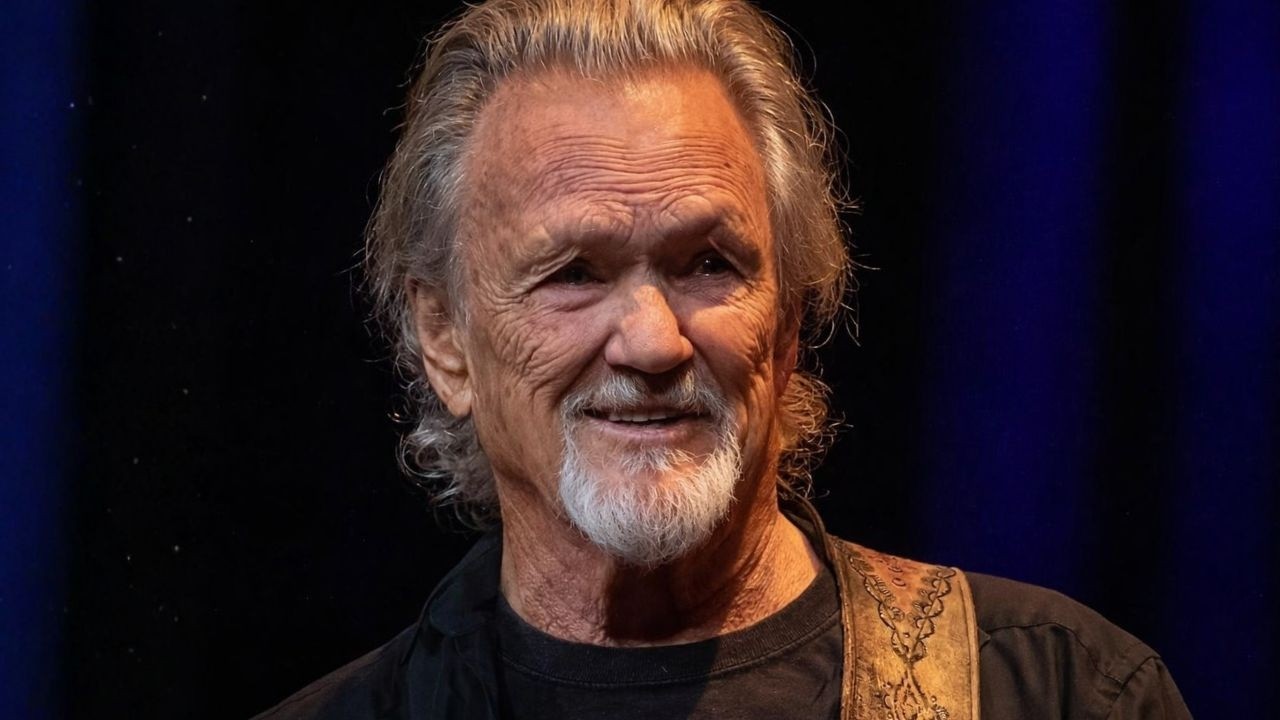
The silence that settled over Hana, Hawaii, in the final days of September 2024 was not the silence of an ending, but the quiet completion of a life that had been defined by its refusal to follow a single, predictable rhythm. Kris Kristofferson, the Rhodes Scholar who traded a general’s stars for a drifter’s guitar, died at his home at the age of 88, leaving behind a legacy that was as much about the fractures he endured as the anthems he created. His family confirmed the passing without a cause, a final act of privacy from a man whose public persona was a carefully constructed paradox of raw vulnerability and unyielding defiance.
The man who would come to redefine the very syntax of American songwriting was born into a world of rigid order on June 22, 1936, in Brownsville, Texas. His father, a U. S.
 Air Force officer who would rise to the rank of major general, ran the household with a military precision that left little room for deviation. Frequent relocations across bases in California and Oregon instilled in young Kris a chameleon-like adaptability, yet also a deep-seated sense of displacement. He was a star student and a standout athlete, a golden boy who seemed destined for a life of service and prestige, yet a quiet, unnamed current was already pulling him toward a different shore.
At the age of eleven, he received a guitar, a gift that would become the vessel for a parallel existence. He began writing songs not as a career ambition, but as a private language for the emotions that had no place in the disciplined environment of his upbringing. This dual life—the compliant cadet and the introspective poet—continued through his years at Pomona College, where he excelled in literature and sports, and culminated in 1958 when he was awarded a prestigious Rhodes Scholarship to study at Oxford University.
In the hallowed halls of Merton College, he immersed himself in the works of William Blake, a poet whose visionary intensity would forever shape his own lyrical approach, while simultaneously playing in local pubs, his songs a secret counterpoint to his academic pursuits.
Upon returning to the United States in 1960, Kristofferson re-entered the predetermined path, joining the U. S. Army and earning his commission as a second lieutenant.
He underwent rigorous Ranger training and qualified as a helicopter pilot, a skill that would later prove both a lifeline and a symbol of his restless nature. Promoted to captain, he was stationed in West Germany, where he commanded a helicopter unit and continued to write songs in his spare time. By 1965, he was offered a position teaching literature at the U.
S. Military Academy at West Point, a post that would have cemented his place within the military aristocracy. It was the logical, perfect culmination of his entire life’s trajectory, and he turned it down.
In a move that stunned his family and severed his relationship with his father for years, Kristofferson resigned his commission and moved to Nashville, Tennessee, with his wife, Fran Beer, and their young daughter. He arrived in the country music capital with a folder of handwritten songs and no clear plan. The city did not welcome him with open arms.
He took a job as a janitor at Columbia Records, sweeping floors and emptying ashtrays in the very studios where legends recorded, while he hawked his songs to publishers during the day. The descent from captain to janitor was steep, but it was a necessary purgatory for the artist he was becoming.
His first single, released in 1967, went nowhere. To support his family, he took a job flying helicopters for Petroleum Helicopters International, shuttling workers to oil rigs in the Gulf of Mexico. Between flights, he would scribble lyrics on the backs of flight plans, a man literally suspended between the sky and the earth, between his duty and his calling.
 It was during this period of grinding poverty and relentless creative output that he wrote the songs that would change the course of country music: “Me and Bobby McGee,” “Sunday Morning Comin’ Down,” “Help Me Make It Through the Night,” and “For the Good Times.”
The breakthrough came not through his own recordings, but through the interpretations of others. Roy Drusky recorded “Jody and the Kid,” and Jerry Lee Lewis took a crack at “Help Me Make It Through the Night.” But it was Roger Miller’s version of “Me and Bobby McGee” that put Kristofferson’s name on the map within the Nashville inner circle.
In early 1969, a live audition for producer Fred Foster at Monument Records led to a recording contract. The janitor was finally in the studio as an artist, his rough-hewn voice and conversational phrasing a stark departure from the polished sound of the era.
His self-titled debut album in 1970 was a revelation, a collection of songs that read like short stories, filled with flawed, complex characters and a weary, unflinching honesty. The lyrics were not about simple heartbreak or honky-tonk fun; they were about existential dread, moral ambiguity, and the high cost of freedom. His work resonated with a generation that was questioning authority, and his songs were quickly embraced by artists far beyond the country genre.
Johnny Cash’s stark rendition of “Sunday Morning Comin’ Down” on his television show brought the song to a national audience, and Sammi Smith’s sensual take on “Help Me Make It Through the Night” became a massive crossover hit, winning the Country Music Association’s Song of the Year award in 1970.
The most iconic moment came with Janis Joplin’s posthumous recording of “Me and Bobby McGee,” which shot to number one on the Billboard Hot 100 in 1971. The song, a bittersweet ode to freedom and loss, became an anthem for a generation, forever linking Kristofferson’s words to Joplin’s raw, desperate vocals. He had written the song with her in mind, and her death just days before she recorded it added a layer of tragic poignancy that would haunt the song forever.
He had achieved the success he craved, but it came with the weight of a personal loss that he would carry for the rest of his life.
The 1970s were a whirlwind of creativity and chaos for Kristofferson. He married singer Rita Coolidge in 1973, and the duo became one of music’s most celebrated couples, recording several albums together. His songwriting continued to be in high demand, and he began to forge a career in Hollywood, starring in films like “Pat Garrett and Billy the Kid” and “A Star Is Born,” a role that earned him a Golden Globe Award.
 Yet, the relentless pace of touring, recording, and filming took a devastating toll. His marriage to Coolidge dissolved in 1980, and his struggles with alcohol became increasingly public, impacting his performances and personal relationships.
By the mid-1980s, his solo career had lost its commercial momentum, but he found a new kind of sanctuary in collaboration. In 1985, he joined forces with Johnny Cash, Waylon Jennings, and Willie Nelson to form The Highwaymen, a country supergroup that was greater than the sum of its parts. The group’s first album, “Highwayman,” was a massive success, and their tours were legendary.
For Kristofferson, it was a chance to stand shoulder-to-shoulder with his peers, to be part of a collective that didn’t require him to carry the weight of a solo star. He was no longer the lone drifter; he was part of a brotherhood of outlaws.
The Highwaymen continued to record and tour for the next decade, providing a stable platform for Kristofferson’s later career. As the 1990s dawned, he began to pivot more seriously toward acting, taking on character roles that showcased his weathered gravitas. His performance in John Sayles’ 1996 film “Lone Star” was critically acclaimed, proving he was more than just a musician dabbling in movies.
Then came the role that introduced him to a new generation: Abraham Whistler, the grizzled vampire hunter in the “Blade” trilogy. The films were a commercial juggernaut, and Kristofferson’s presence added a touch of old-school cool to the action-horror franchise, keeping his name in the spotlight for a new millennium audience.
Throughout these later years, the honors began to accumulate. In 2004, he was inducted into the Country Music Hall of Fame, a recognition of his monumental impact on the genre. In 2014, he received the Grammy Lifetime Achievement Award, a testament to a career that had consistently prioritized artistic integrity over commercial trends.
Yet, even as he was being enshrined in the canon of American music, a new and insidious challenge was emerging. He began to experience memory loss and confusion, symptoms that were initially misdiagnosed as Alzheimer’s disease. For years, he and his family lived under the shadow of a neurodegenerative condition, adjusting his life around the treatment.
The diagnosis was later corrected to Lyme disease, a bacterial infection that can cause severe neurological symptoms. Once the proper treatment was administered, his condition improved dramatically. The fog began to lift, and his memory, while not fully restored, stabilized enough for him to reclaim a sense of normalcy.
 In 2016, he returned to the studio to record “The Cedar Creek Sessions,” a stark, intimate album of re-recordings of his classic songs. It was a powerful statement, a testament to his resilience and a final, definitive artistic statement. The album was nominated for a Grammy Award for Best Americana Album, a fitting coda to a recording career that had always defied easy categorization.
In 2021, he quietly announced his retirement from performing. There was no grand farewell tour, no final blowout concert. He simply stopped, retreating to his home in Hawaii to live out his remaining years surrounded by his family and the Pacific Ocean.
His personal life had been as complex and often turbulent as his music. He was married three times and had eight children, a family tree that reflected the different phases of his life. His early relationships suffered under the weight of his ambition and his drinking, but his third marriage to Lisa Meyers, which began in 1983, provided a lasting stability that allowed him to navigate the later challenges of his life.
Kris Kristofferson’s death marks the end of an era, but his influence is woven into the very fabric of American music. He was the poet laureate of the outsider, the chronicler of the weary and the lost. He took the simple country song and injected it with a literary complexity and a raw, confessional honesty that had never been seen before.
He didn’t just write songs; he wrote about the act of thinking, about the space between what we say and what we feel. His characters are not heroes; they are survivors, stumbling through life with a clear-eyed awareness of their own failings.
His legacy is not measured in gold records or chart positions, but in the way he changed the potential of a song. He proved that a country lyric could be as complex as a novel, as personal as a diary entry, and as profound as a philosophical treatise. He showed that vulnerability was a strength, and that the most honest art often comes from the deepest fractures.
He lived a double life for years, not as a spy or a fraud, but as a man caught between two worlds—the world he was born into and the world he had to create for himself. In the end, he chose the latter, and in doing so, he gave a voice to the dreams and disappointments of millions. He left the path that was laid out for him, and by doing so, he carved a new one for everyone who came after.
