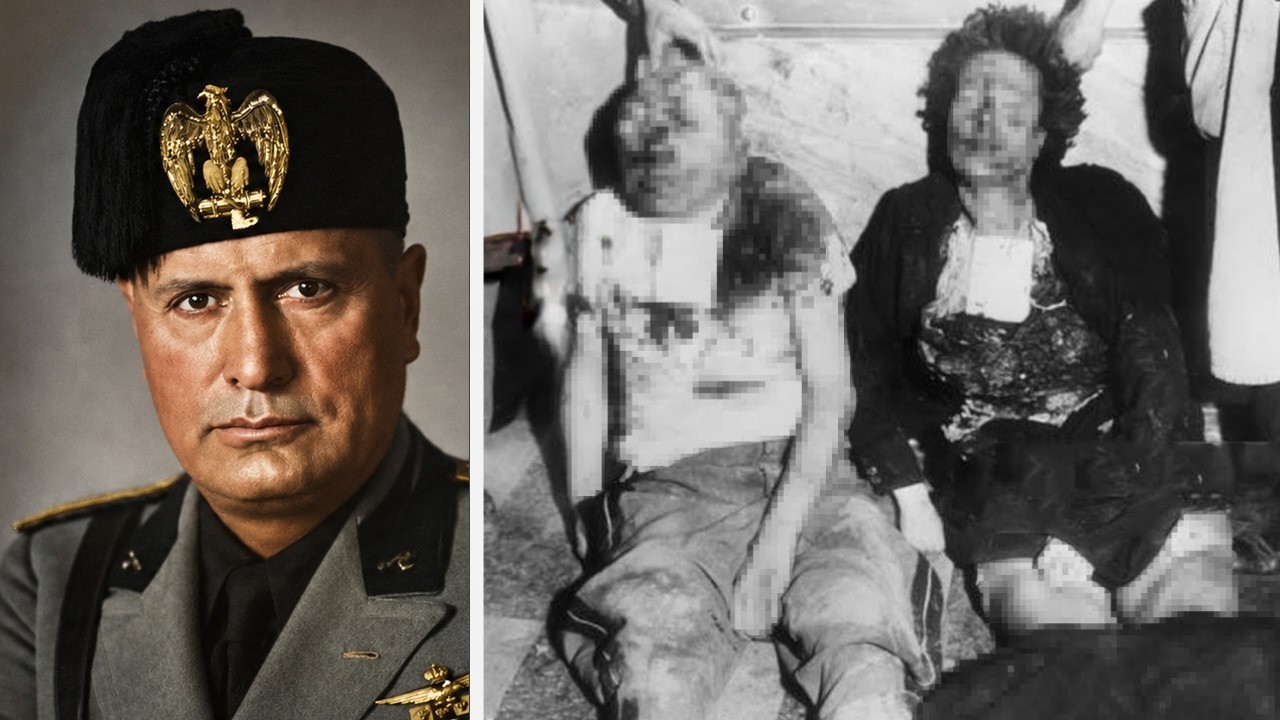
The final act of Benito Mussolini’s brutal reign unfolded not in a grand battle, but in a desperate, chaotic flight northward that ended in a hail of bullets and a spectacle of rage that shocked the world. As the Allied forces tightened their grip on a crumbling Italy in late April 1945, the dictator’s once-absolute power evaporated, leaving him a fugitive clinging to the last remnants of his shattered regime. The woman who chose to stay by his side, his mistress Claretta Petacci, paid for that loyalty with her life, and the world watched as their corpses were hung upside down in a Milan public square.
The collapse began with startling speed. On April 25, 1945, with the Axis powers in full retreat and partisan fighters seizing control of northern cities, Mussolini found himself isolated in Milan. His desperate attempt to negotiate a safe surrender with the Catholic Church failed, and he learned that his German allies were already conducting secret capitulation talks without him.
 With his government dissolving around him, he made a fateful decision to flee towards the Swiss border, hoping to escape the vengeance of the resistance fighters who now controlled the countryside.
His motorcade, a mix of German military vehicles and cars carrying loyal fascist officials, moved north along the shores of Lake Como, only to find every road increasingly blocked by partisan checkpoints. It was during this frantic journey that Claretta Petacci, who had been separated from him in the chaos, caught up with the convoy in the town of Menaggio. Witnesses reported that Mussolini urged her to leave while she still could, but she refused, choosing to climb into the convoy and remain at his side for whatever was to come.
The end came at dawn on April 27, 1945, in the small town of Dongo. A partisan brigade from the 52nd Garibaldi Brigade had set up a roadblock, and despite the German soldiers’ attempts to pass through, a thorough search of the vehicles revealed the former dictator hiding in the back of a truck, draped in a German military coat. He was pulled out and taken into custody, looking haggard and speaking little.
Petacci was also stopped and identified herself, stubbornly refusing every opportunity to slip away and save her own life.
For a day, they were held under guard in separate locations as urgent messages were sent to resistance leaders in Milan. The decision was made by the Communist-led Committee of National Liberation: Mussolini was to be executed. The man chosen for the task was Walter Audisio, a 28-year-old partisan commander using the alias “Colonel Valerio.”
On the morning of April 28, he arrived in Dongo with orders and a vehicle, taking both Mussolini and Petacci, who again refused to leave his side, to the gates of Villa Belmonte in the village of Giulino di Mezzegra.
There, with Lake Como stretching out below and the mountains rising behind them, the execution was carried out. Mussolini was shot multiple times in the chest, with a subsequent autopsy revealing at least five gunshot wounds. Petacci, just 33 years old, died beside him.
 Some witnesses claimed she threw herself in front of him in a final attempt to shield him; others believed she was simply killed because she would not abandon him. The exact details of the moment remain a matter of historical dispute, but the outcome was undeniable: the Duce and his mistress were dead.
Hours later, the bodies of Mussolini, Petacci, and about fifteen other captured fascist officials were loaded onto a truck and driven through the night to Milan. The destination was Piazzale Loreto, a large public square in the northeastern part of the city. The location was chosen deliberately, as it was the same square where, in August 1944, German forces had displayed the corpses of fifteen executed partisans as a warning to the citizens.
Bringing Mussolini’s body there was an act of symbolic revenge, a way to show the world that fascism had finally fallen.
By mid-morning on April 29, thousands of people had gathered in the square, and the scene quickly descended into pure, unadulterated chaos. After more than two decades of fascist rule, political violence, imprisonment, and a war that had cost countless Italian lives, the crowd’s pent-up fury exploded. They kicked the corpses, spat on them, and hurled insults.
Women who had lost husbands, sons, and fathers surged forward, desperate to get closer to the man they blamed for their suffering. The scene was uncontrollable and utterly devoid of dignity.
Later that morning, the bodies were strung up by their feet from the metal framework of a partially destroyed Esso gas station beside the square. Petacci’s body was hung next to Mussolini’s. In a rare moment of humanity, a resistance nurse named Maria Guidi noticed that Petacci’s skirt had slipped down due to the inverted position of her body.
 Using pins, she secured the skirt around the dead woman’s legs, a small gesture of respect in a day defined by its absence.
Photographers were present throughout the entire event, and the images they captured became some of the most iconic and disturbing photographs of World War II. The pictures of Mussolini and Petacci hanging upside down in Piazzale Loreto were printed in newspapers and shown in newsreels around the globe within days. No government orchestrated the display, but the raw, visceral power of the images could not be stopped.
They served as a brutal, undeniable testament to the fate of the dictator and the fury of the people he had oppressed.
By the afternoon, city officials, concerned about the growing crowd and the state of the bodies, ordered them to be taken down and transported to the city morgue. The spectacle was over, but its impact would reverberate for decades. For the world, it was a shocking visual confirmation of the war’s end in Italy.
For Italians, it was a cathartic, albeit horrific, release of years of pent-up anger and grief.
Rachele Mussolini, the dictator’s wife, was still near Lake Garda when the news broke. She was arrested by partisan forces and later handed over to Allied authorities, who interrogated her about her husband’s finances and documents. She was never charged with any crime.
 After the war, she lived in relative poverty, supporting herself by selling eggs and later running a small restaurant near Predappio. She never expressed any sympathy for Claretta Petacci, whom she blamed for exploiting her husband. Rachele Mussolini died on January 30, 1979, at the age of 88.
Mussolini’s body was buried in an unmarked grave in Milan in May 1945, but that was not the end of his story. In March 1946, a group of neo-fascist supporters stole his corpse. It was found months later at a monastery near Pavia, and the Italian government kept his remains hidden for over a decade before finally allowing them to be buried in the Mussolini family crypt in Predappio in August 1957.
The final resting place has since become a pilgrimage site for far-right sympathizers.
Claretta Petacci’s family claimed her body shortly after the war. Unlike Mussolini, her remains were never hidden or moved. She was buried in the Petacci family tomb at the Verano Cemetery in Rome, where she rests to this day.
Her story, once a footnote to the dictator’s demise, has become a tragic symbol of blind devotion and the ultimate cost of loyalty in a time of total war. The footage and photographs of that day in Milan remain a stark, unflinching reminder of the brutal consequences of fascism and the raw, unforgiving nature of justice at the end of a world war.
