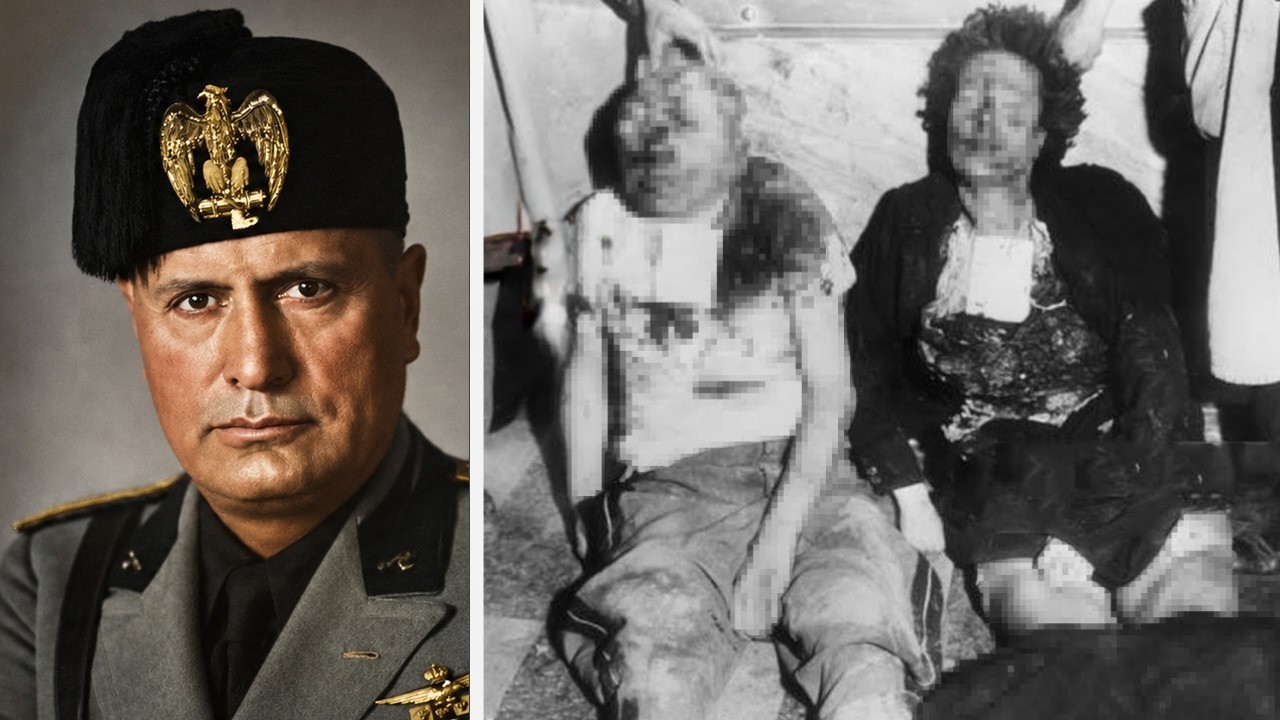
The final, desperate gamble of Benito Mussolini ended not in a dramatic last stand, but in a hail of gunfire against a villa gate on the shores of Lake Como, a death captured in gruesome detail by the cameras that would immortalize his fall and that of his devoted mistress, Clara Petacci.
The execution on April 28, 1945, brought a violent end to the dictator’s twenty-three-year grip on Italy. But it was the macabre spectacle that followed in a Milan square, where the corpses of Mussolini, Petacci, and other fascist leaders were hung by their heels from a steel girder, that seared the image into the global consciousness. The leaked footage and photographs, taken by journalists and onlookers, became a visceral symbol of the collapse of fascism and the raw, unvarnished vengeance of a liberated people.
 The story of that bloody finale begins not in the final hours, but in the chaotic twilight of the regime. As the Allied forces pushed north through Italy in the spring of 1945, the German-backed Italian Social Republic, a puppet state led by Mussolini from the town of Salò, was disintegrating. The partisan resistance, a coalition of anti-fascist fighters, was rising up across the north, seizing control of cities and hunting down collaborators.
On April 25, with the resistance declaring a general insurrection, Mussolini realized his time was up. He fled Milan, heading north toward the Swiss border, hoping to escape or negotiate a safe passage. His convoy, a mix of Italian fascists and German soldiers, was a target waiting to be hit.
Traveling with him was his mistress, Clara Petacci, the 33-year-old woman who had refused to abandon him despite the imminent danger. She had been his constant companion for nearly a decade, a figure of immense public scorn who had chosen to share his fate.
The convoy was stopped on the morning of April 27 by a partisan brigade near the town of Dongo, on the western shore of Lake Como. The Germans were allowed to proceed after a tense negotiation, but the Italians were not. Mussolini, disguised in a German greatcoat and helmet, was discovered slumped in the back of a truck.
He was captured without a fight. Petacci, who had been in another vehicle, refused to be separated from him and was also taken into custody.
The partisans held them overnight in Dongo, awaiting orders from the National Liberation Committee in Milan. The decision was made: the dictator and his mistress were to be executed. The man chosen to carry out the sentence was Walter Audisio, a communist partisan leader using the nom de guerre “Colonel Valerio.”
On the morning of April 28, Audisio took Mussolini and Petacci to a secluded spot near the village of Giulino di Mezzegra. He stopped the car at the gates of a villa known as Belmonte.
 Accounts of the final moments vary. Some say Petacci threw herself in front of Mussolini to shield him from the bullets. Others claim she was simply shot down beside him.
What is known is that Audisio fired a burst from a submachine gun, killing both instantly. The official autopsy later revealed at least five bullet wounds on Mussolini’s body, while Petacci had two. The execution was swift, brutal, and without ceremony.
The bodies were loaded onto a truck and driven to Milan. The destination was Piazzale Loreto, a square in the city’s northeast. The choice was deliberate.
In August 1944, the Nazis had displayed the bodies of fifteen executed partisans in that very square as a warning to the population. Now, the partisans were turning the tables, bringing the corpse of the man who had allied with Hitler to the site of that earlier atrocity.
When the truck arrived on the morning of April 29, the news spread like wildfire. A crowd, swollen with grief, rage, and a thirst for justice, quickly gathered. What followed was a scene of chaotic, visceral fury.
The bodies of Mussolini, Petacci, and several other executed fascist leaders were dumped onto the ground. The mob surged forward, kicking, spitting, and hurling insults at the corpses. Some women, many of whom had lost husbands or sons to the war, pushed through the throng to strike the bodies themselves.
 The scene was one of utter pandemonium. To make the bodies visible to the swelling crowd, partisans strung them up by their feet from the steel canopy of a partially destroyed Esso gas station. The image of Mussolini and Petacci hanging upside down, their bodies limp and lifeless, was captured by photographers who were already on the scene.
The photographs, and the film footage shot by newsreel cameramen, were transmitted around the world within days. They became the definitive, horrifying image of the dictator’s end.
The footage was not leaked in the modern sense of a clandestine release. It was a public spectacle, documented openly by professionals who were present. The sheer brutality of the imagery, however, had a profound impact.
For the Italian people, it was a cathartic, if gruesome, release of two decades of oppression. For the world, it was a stark reminder of the brutal nature of the conflict and the fate that awaited the architects of fascism.
The bodies were eventually cut down and taken to the city morgue. The crowd, however, had already seen what it needed to see. The message was clear: the fascist era was over.
The body of Clara Petacci, the woman who had chosen to die beside her lover, was claimed by her family and buried in the Verano Cemetery in Rome. She was not subjected to the same post-mortem odyssey as Mussolini.
 Mussolini’s remains had a more troubled journey. He was first buried in an unmarked grave in Milan, but in March 1946, his body was stolen by fascist sympathizers. It was recovered months later and then hidden by the Italian government for over a decade to prevent it from becoming a shrine for neo-fascists.
Finally, in 1957, his remains were interred in the family crypt in his hometown of Predappio, where they remain to this day, a site of pilgrimage for a small but persistent far-right fringe.
The story of the execution and the leaked footage is also the story of the two women at its center. Rachele Mussolini, the dictator’s wife, was captured by partisans but never charged with a crime. She spent her post-war years in relative poverty, running a restaurant, and never forgave Clara Petacci, whom she blamed for exploiting her husband.
She lived until 1979, a bitter survivor of a regime that had destroyed her country.
Clara Petacci’s fate, however, was sealed by her loyalty. She was not a political figure, but she became a symbol of the regime’s excess and its final, desperate attachment to power. Her decision to stay with Mussolini, despite his repeated offers for her to escape, cost her her life.
The footage of her body, hanging beside her lover’s, is a testament to a devotion that defied reason and ultimately proved fatal.
The events of April 28-29, 1945, were a turning point in European history. The violent end of Mussolini and the public display of his corpse served as a brutal bookend to the war in Italy. The leaked images, which have been reproduced countless times in documentaries, books, and articles, remain some of the most powerful and disturbing photographs of the twentieth century.
They are a stark reminder of the consequences of totalitarianism, the fury of liberation, and the thin line between justice and vengeance.
