The calculated precision of a hanging, refined over centuries into a science of weights and drop distances, has never been able to overcome the stubborn unpredictability of the human body, a reality that continues to haunt death chambers from Tokyo to Tehran. For over a millennium, execution by hanging was promoted as a swift and clean method of death, a narrative that a catastrophic failure in 1901 would violently shatter, forcing physicians and authorities to confront a grim truth about what truly transpires within the condemned. Even when the procedure unfolded exactly as intended, doctors discovered internal events that raised more questions than they answered, questions that remain unresolved in the modern era.
Before the 1870s, hanging almost always relied on the “short drop,” a method that served as the primary means of execution across Britain, Europe, and colonial America for centuries. The condemned would stand on a cart, stool, or elevated platform with a rope secured around their neck, and the support would be removed, allowing them to fall only a foot or two before the rope abruptly halted their descent. This short drop was not designed to break the neck but rather to cause death through strangulation, as the sudden constriction of the rope around the throat would impede blood flow through the carotid arteries, the main vessels carrying oxygen-rich blood to the brain.
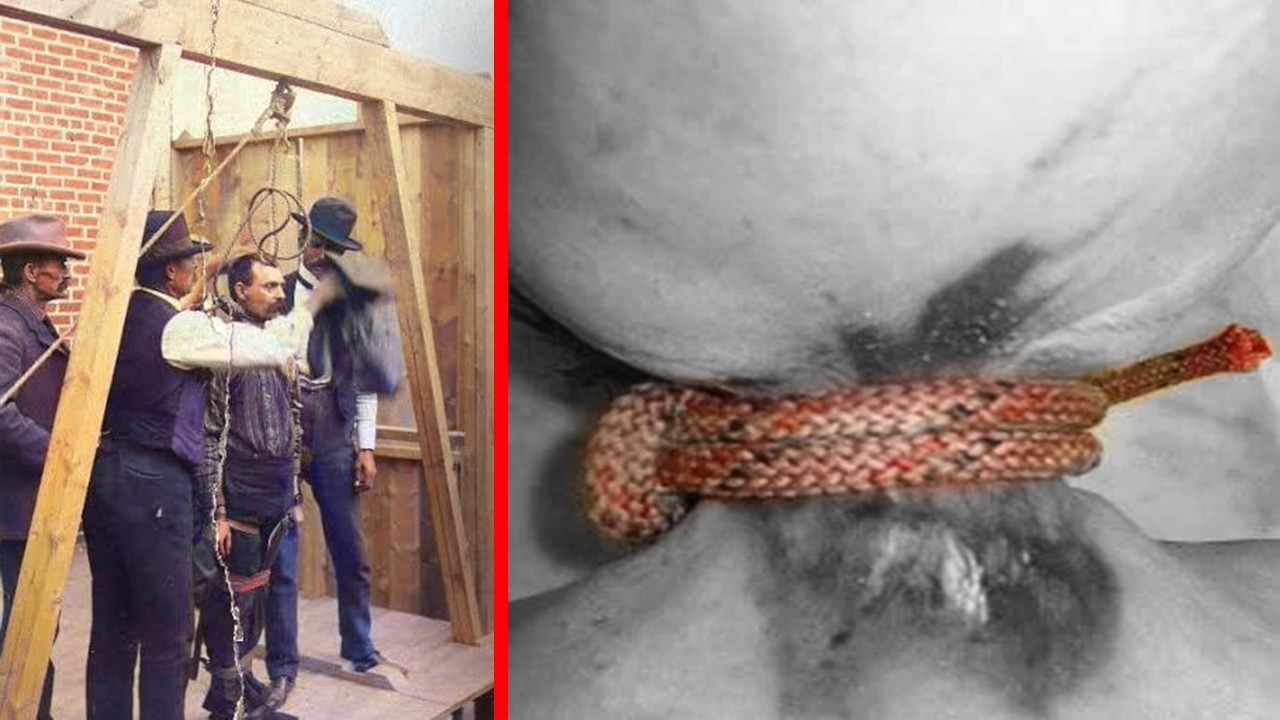 When the brain is deprived of sufficient oxygen, unconsciousness typically occurs within ten to twenty seconds, but losing consciousness is not synonymous with death. The heart can continue to beat, and complete death may take anywhere from four minutes to over fifteen minutes, during which witnesses would often observe the body convulsing, legs kicking, muscles twitching, and the chest heaving violently. These movements were automatic physical reactions to extreme stress and oxygen deprivation, a spectacle grimly known in eighteenth and nineteenth-century England as the “Tyburn jig,” named after the infamous London execution site where public hangings drew massive crowds for centuries.
For a person standing in that crowd, the violent movements of the suspended body might appear as if the individual was consciously fighting for their life, but at this stage, the person had usually already lost consciousness, meaning the movement alone did not tell witnesses whether they were still aware of what was happening. Executioners sometimes tried to hasten the process because the short drop could take several minutes to cause death, and family members or hired assistants would grab the person’s legs and pull them downward, their added weight putting more pressure on the rope and accelerating strangulation. In the modern view, this seems barbaric, but people of that time may have seen it as an act of mercy rather than cruelty, believing they were speeding up the death of a suffering individual.
This system remained in use in Britain, colonial America, and much of Europe for centuries because hanging was cheap, required little equipment, and was deeply embedded in the legal systems of many nations, but there was a significant problem. The short drop method gave authorities little control over the speed of a person’s death, as there was no precise way to predict how each individual body would react. Then, in the 1870s, a shoemaker from Lincolnshire began trying to change that, a man named William Marwood who would revolutionize execution methods and leave a lasting, controversial legacy.
Born in 1820 in Goulsby, a small village in Lincolnshire, England, Marwood had no connection to government or the prison system for most of his life, working as a cobbler making and repairing shoes. However, he became fascinated with the mechanics of hanging, specifically what happens to the human body when falling at the end of a rope, and believed the current method could be made faster and more predictable. In 1872, at the age of fifty-two, he successfully applied to become an assistant executioner, and two years later, in 1874, he was appointed the official hangman for the City of London and Middlesex County, where he would implement his revolutionary ideas.
Marwood believed the short drop was outdated because it often left the condemned to die slowly from strangulation, so his solution was a new system known as the long drop. Instead of dropping a person only a foot or two, the long drop method allowed them to fall several feet before the rope stopped them, with Marwood sometimes using drop distances of six to eight feet. The crucial part was not just making the drop longer, but calculating the correct drop length based on the person’s body weight, because a heavier person would generate more force during the fall than a lighter one, and the goal was to generate enough force to cause serious injury to the neck.
The target was the cervical vertebrae, the chain of bones forming that part of the spine, specifically fractures around the second and third cervical vertebrae near the top of the spinal column, with the intended result being massive damage to the spinal cord. If that injury occurred as planned, it could lead to almost immediate unconsciousness, and Marwood created drop tables, which were calculation charts linking a person’s body weight, rope length, and the fall distance needed for execution. The idea was to take something that was previously highly unpredictable and turn it into a repeatable system, where if a prisoner’s weight was known, the hangman could look up the table and determine the recommended drop distance.
 Marwood continued to refine these calculations throughout his career, and between 1874 and his death in 1883, he personally carried out 176 executions using his method, gaining such a strong reputation that the phrase “to be Marwooded” briefly became English slang for hanging. Other British executioners began using the long drop system, which eventually became the standard method across the British Empire, spreading to territories in Africa, Asia, and the Caribbean where local prison and execution systems increasingly followed British practices. American states also began changing their hanging procedures and using weight-based drop tables influenced by Marwood’s approach, and initially, the long drop seemed like the solution to a centuries-old problem.
However, there was a serious problem lurking within all those carefully calculated numbers, as the human body did not always behave the way the tables predicted, and the method depended almost entirely on the accuracy of the calculations. Every prisoner was different, and while drop tables could reduce these differences, they could never perfectly account for every individual, and if the drop distance was too long for a person’s weight, the force could be severe enough to cause decapitation, completely severing the head from the body. This happened in a well-documented case in the American West when Thomas Edward Ketchum, known as Black Jack Ketchum, a train robber executed in Clayton, New Mexico Territory on April 26, 1901, had a rope that was too long for his body weight, and when the gate opened and he fell, the force was enough to cut his head off instantly in front of witnesses.
Newspapers across the country reported what happened, making the execution one of the most failed hangings in American history, but the opposite problem could be equally serious, and perhaps worse for the person being executed. If the drop distance was too short, the neck might not break properly, and instead, the person might end up being strangled, just as in the old short drop system, while also suffering from the physical trauma of the fall. Reports from various American executions in the late nineteenth and early twentieth centuries describe prisoners taking ten minutes or more to die in these cases, their bodies writhing and struggling against the rope while witnesses and prison officials stood nearby waiting for the execution to end.
British executioners continued trying to reduce these problems after Marwood, with James Berry, who worked as a hangman in England and Ireland during the 1880s, publishing his own improved drop tables. Berry’s goal was to find a better balance between the two dangers, and his calculations, followed by later revisions from executioners like James Billington, became standard references for British prison officials and remained in use into the twentieth century. But even after decades of adjustments, hanging was not an exact science, as there were simply too many variations between bodies for a table of numbers to guarantee the same result every time, and even when things went as planned and the neck broke cleanly, death was not necessarily as immediate as most people imagined.
When the vertebrae break and the spinal cord is severely damaged, the brain loses most of its ability to communicate with body parts below the neck, usually causing immediate unconsciousness, but the heart works differently than most other organs. It has its own electrical system, known as the cardiac conduction system, which controls the heartbeat, and thanks to this system, the heart can continue to beat for some time even when the brain is no longer sending signals to the rest of the body. Forensic pathologists who studied executions during the twentieth century, including renowned British forensic expert Keith Simpson who performed autopsies on executed prisoners in England, documented cases where the heart continued to beat for ten to twenty minutes after the drop, even though the person showed no external signs of consciousness.
 This created an unsettling gray area for forensic medicine, as prison doctors would sometimes stand beside the body with a stethoscope on the chest, waiting and listening while the body appeared completely still, having to monitor the heartbeat until it finally stopped. At the same time, there was a question of whether the person had felt anything, including pain, in the brief moment between the fall and the spinal cord damage before losing consciousness. Some forensic experts argued that the movements seen after the fall, such as muscle twitching or brief convulsions, were merely automatic reflexes, and from this viewpoint, the spinal cord could produce these movements even though it had lost its normal connection to the brain, meaning the movements were not evidence of conscious suffering.
Other researchers were less certain, pointing out that consciousness does not necessarily disappear in one perfectly measurable moment just because the spinal cord is severely damaged, and this uncertainty was no longer just a medical or scientific debate. It became part of a much larger controversy over whether hanging should continue to be used as a method of execution, and in the United States, doctors, lawyers, politicians, and prison officials were increasingly forced to confront the fact that hanging, even when successful, might be more complicated than it appeared on the surface. The method remained a legal form of execution in the United States until the late twentieth century, even as most states moved toward methods they considered more modern, starting with the electric chair and later moving to lethal injection.
A few states kept hanging legal for much longer than most people realize, with Washington being one of them, and on May 27, 1994, Charles Rodman Campbell was executed by hanging at Washington State Penitentiary in Walla Walla. Campbell had been convicted of killing three people, including a woman and her young daughter in 1982, and his execution received significant national media attention, partly because very few living Americans had ever seen or covered an actual hanging. Journalists present described an execution that took several minutes from the moment the trap door opened until officials officially declared Campbell dead, and Delaware retained hanging even longer, although only in certain cases based on when the prisoner’s original sentence was handed down.
On January 25, 1996, Billy Bailey was executed by hanging at the Delaware Correctional Center near Smyrna, having been convicted of killing an elderly couple, Gilbert and Clara Lamberson, in 1979. His case was unusual because he had the legal option to choose lethal injection after Delaware changed its execution method, but he chose hanging instead, and his execution became the last judicial hanging carried out in the United States. After Bailey’s execution, hanging effectively disappeared as an active method of execution in America, although a few states technically kept it as a backup option, especially for cases where lethal injection drugs were unavailable or that method was deemed unconstitutional, but no one has been legally hanged in the United States since 1996.
While America was slowly abandoning hanging, other countries were moving faster to give up the method entirely, with the United Kingdom, the nation that spent decades turning hanging into a precisely calculated system by executioners like Marwood and Berry, eventually abandoning it. In 1965, Britain passed the Murder (Abolition of Death Penalty) Act, which suspended capital punishment for murder, and in effect, the last hangings in Britain had already taken place a year earlier on August 13, 1964. Two men, Peter Anthony Allen and Gwynne Owen Evans, were hanged at the same time in two different prisons, Walton Prison in Liverpool and Strangeways Prison in Manchester, both convicted of killing a man named John Alan West, and Canada followed in 1976 when it abolished hanging as a method of execution and removed the death penalty from its criminal code for most offenses.
 Other countries took similar paths during the late twentieth century, many citing the same problems that had existed since Marwood’s time, that hanging could lead to inconsistent results, with a miscalculation potentially causing severe injury or even decapitation, and doctors still could not definitively answer whether unconsciousness actually occurred instantly. There is a strange aspect to this history, as Britain was the country that took hanging and turned it into a precisely calculated system using weight, rope length, and drop distance in an attempt to make executions more predictable, yet within about a century of developing and refining this system, Britain abandoned hanging entirely. But it did not disappear from the world when Britain, Canada, and the United States moved to other methods, and as of the mid-2020s, several countries still use hanging as an actual method of execution, including Iran, Iraq, Japan, Singapore, and Egypt.
While the exact procedures vary from country to country, hanging remains part of the legal execution system in each of these places, with Japan’s system particularly similar to the long drop method developed by Britain in the nineteenth century. Executions are typically carried out inside detention centers, including the Tokyo Detention House where prisoners are held before their execution, and one of the most notable features of Japan’s system is its secrecy, as prisoners are often given little warning before their execution, sometimes only a few hours, and their families are often informed only after it has already happened. Japan also uses a specific system designed to reduce the psychological responsibility placed on the officers who carry out the execution, with several officers standing at multiple buttons at the same time, but only one of those buttons actually opens the trap door, and because the officers do not know which button is connected to the mechanism, no single officer can be certain that they personally caused the trap door to open.
Iran carries out a large number of hangings every year, responsible for more executions by hanging than almost any other country in recent years, according to monitoring by international human rights organizations such as Amnesty International, although the exact number is difficult to verify independently because Iranian authorities do not always publish complete records of each execution. However, reports from human rights groups have documented hundreds of hangings in Iran in recent years, and the fact that hanging continues to be used in these countries means that many of the questions that troubled reformers for over a century remain relevant today. Modern equipment and standardized procedures can make the process more disciplined, but they cannot remove the fundamental questions about consciousness, pain, and what happens inside the body, and when looking at nearly two centuries of hanging use, a clear pattern begins to emerge.
It starts with the slow strangulation of the short drop era, then moves to the carefully calculated drop tables of William Marwood, and time and again, people tried to turn hanging into a precise, predictable process, and time and again, the human body refused to behave exactly as the calculations predicted. Every human body is different, and no drop table, no matter how carefully designed, could accurately predict what would happen to each individual body, with Marwood trying to solve this problem using mathematics, and Berry and Billington trying to make those calculations more accurate. American prison officials adopted similar tables and adjusted them for over a century, yet the results were never entirely consistent, and this is one of the main reasons why many countries ultimately chose to abandon this method altogether, leaving the legacy of the long drop as a testament to the limits of trying to impose order on the chaotic reality of human physiology.
