The nose twitch was a lie. For eight years, Elizabeth Montgomery convinced millions of Americans that a magical being named Samantha Stephens could fix any domestic disaster with a flick of her face, but the woman behind the spell was trapped in a far darker narrative, one where the magic never worked and the men she loved were the monsters she couldn’t escape. She spent four decades fighting a psychological war against the ghost of her powerful father, chasing salvation in the arms of alcoholics, abusers, and older men who promised to fix her but only broke her further.
The cameras stopped rolling on May 18, 1995, when she died at just 62 years old, but the real tragedy is that the woman who commanded the screen was a fiction, a beautiful illusion that masked a life of relentless pain and a final, brutal eight-week descent into the grave.
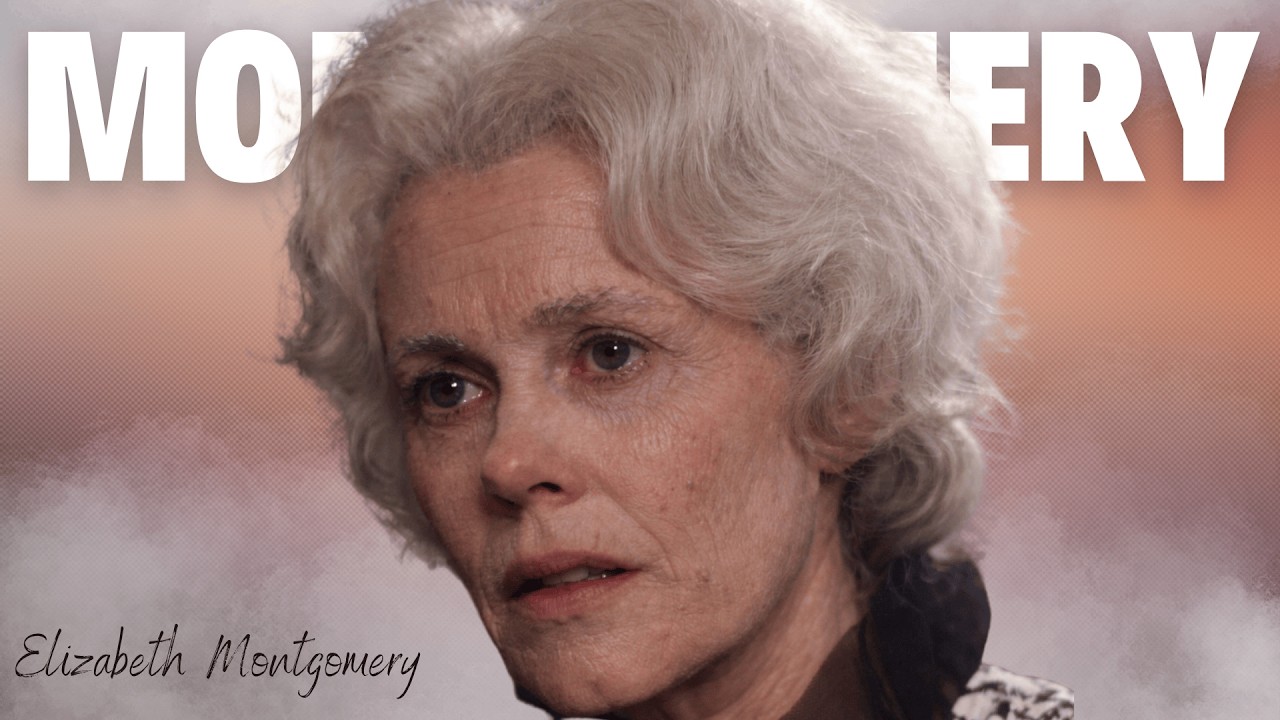 Elizabeth Victoria Montgomery was born on April 15, 1933, at the very center of the Hollywood chessboard, a child of immense privilege and immense pressure. Her father, Robert Montgomery, was a man of staggering influence, a movie star who served as president of the Screen Actors Guild and later became a sharp-witted advisor to President Eisenhower. Her mother, Elizabeth Brian Allen, was a Broadway beauty who understood the glare of the spotlight as well as anyone in the business.
For young Liz, growing up meant navigating a world of private schools, high-stakes social circles, and the crushing weight of a father who expected nothing less than perfection. By 18, while most girls were navigating clumsy dates and first loves, Elizabeth was making her television debut on her father’s Emmy-winning show, Robert Montgomery Presents. She wasn’t just daddy’s girl; she was his protégé, a talented young woman who looked at her father’s authority and decided she wanted to conquer it rather than shrink from it.
This is where the narrative gets messy, because Elizabeth wasn’t a victim of her father’s success; she was intoxicated by it. She grew up surrounded by men who ruled rooms, men with old money gravitas and the scent of expensive cigars, and she developed a lifelong appetite for that specific brand of silver fox energy. The trouble was that Elizabeth didn’t just want to be with these powerful, often troubled men; she wanted to fix them.
She looked at the stoic, iron-willed masculinity of her father and spent the next two decades trying to find a version of it that she could finally crack open and heal. She was drawn to the weight of their years and the darkness in their eyes, and a man close to her own age was a bore. She wanted a challenge, someone who carried the same heavy, complicated weather as Robert Montgomery, a high-wire act of seeking approval through attraction.
This craving for authority led her into a series of marriages and flings that the public, who later saw her as the perfect housewife Samantha, could never have imagined. She was a woman who could navigate the most sophisticated circles in New York and LA, but behind closed doors, she was often the only one trying to hold together men who were coming apart at the seams. She had the money, the pedigree, and the talent to leave, yet she possessed a silent, stubborn pride, the kind of grit she likely inherited from her father, that made her stay and endure long after the magic had faded.
She wanted to prove she could handle the tigers that everyone else was afraid of, and that stubbornness would cost her nearly everything. In 1954, at just 21 years old, Elizabeth did exactly what a good society girl was supposed to do; she married the right name, Frederick Gallatin C. Even the name sounds expensive, doesn’t it?
He was New York royalty, old money, the kind of guy who looked perfect on a resume.
On paper, it was the ultimate match, the daughter of a Hollywood king marrying a prince of Manhattan, but the honeymoon ended before the bags were even unpacked. Frederick didn’t want an actress; he wanted a trophy, someone to quit the business, sit in their Park Avenue apartment, and play the role of the silent, elegant wife. But he made a fatal mistake; he underestimated her.
He thought he married a socialite, but he actually married a woman with Robert Montgomery’s blood in her veins. She hated the cage and the boredom, so less than a year later, she ran. She left the money, the status, and the security and headed back to the only place that made sense to her, Hollywood.
But if the first marriage was a mistake of youth, the second was a tragedy of psychology. In 1956, she met Gig Young, and this is where the story gets heavy.
Gig was a star, an Oscar winner, charming, handsome, and incredibly talented, but he was also 25 years older than her, practically her father’s age, and that wasn’t a coincidence. Her father, Robert, was furious and fought the marriage tooth and nail, not because he wanted to protect her, but because he recognized Gig. He saw the same demons in Gig that he saw in the mirror, but Elizabeth didn’t see a warning sign; she saw a project, a broken man that she and only she could fix.
They were married for seven years, and to the public, they were Hollywood royalty, but behind closed doors, it was a nightmare. Gig wasn’t just a heavy drinker; he was a tortured soul who turned mean when the bottle was empty. Elizabeth spent her 20s not building her own life, but managing his, becoming the caretaker, the nurse, the punching bag for his insecurities.
There are stories from that time, stories of her covering up bruises with makeup before heading to the set and making excuses for him at parties when he could barely stand up.
She thought if she loved him enough, the darkness would go away, a trap so many women fall into, the idea that love is a cure, but it wasn’t. By 1963, she was 30 years old, exhausted, and broken, and finally, she found the strength to walk away. And here is the most chilling part of it all, the part that makes you realize just how close she came to the edge.
Years later in 1978, the demons finally won. Gig Young, in a drunken rage, shot and killed his new wife, a woman half his age, before turning the gun on himself. It was a murder-suicide that shook Hollywood to its core, and when the news broke, Elizabeth never spoke about it publicly, but she knew.
We all knew that could have been her. She didn’t just get a divorce in 1963; she escaped a bullet. She survived, and she took that pain, that grit, and that survival instinct and channeled it all into a new character, a witch who could solve problems with a twitch of her nose, because she knew better than anyone that in the real world, there are some problems that even love can’t solve.
There is a specific kind of danger that happens when a woman like Elizabeth Montgomery hits her 30s. She stopped looking like the innocent debutant Robert Montgomery raised and started looking like a woman who knew exactly what she wanted, and in Hollywood, that makes people talk. The whisper network in this town is vicious, and in the 1960s, it had a favorite target.
The tabloids loved to paint her as the siren, the maneater who led good men astray, but if you look at the names on her dance card, you start to see a different pattern. She wasn’t breaking homes for sport; she was collecting icons, trying to find one who could match the stature of the man who raised her. Take the rumors about Elvis.
 They met on the set of Kid Galahad, and Elvis, used to women fainting when he walked in the room, saw Elizabeth, who was married to Gig Young at the time, and he didn’t see a wife; he saw a challenge. The crew whispered that Elvis was obsessed with her, circling her like a shark, and Gig Young, usually too drunk to notice anything, actually sobered up enough to call Elvis out to his face.
But notice how the story gets told; the rumors always swirled around Elizabeth’s bewitching eyes tempting the king rather than a powerful man who simply refused to hear the word no. Then there was Gary Cooper. This one hit harder because Cooper was Hollywood royalty, the definition of the silver fox, 30 years her senior, quiet, strong, and visibly aging.
He was exactly her type. The scandal erupted when a stagehand supposedly walked in on them in Cooper’s dressing room during the filming of The Court Martial of Billy Mitchell. The gossip columns went nuclear, painting Elizabeth as the young temptress taking advantage of an old legend, but look closer.
Cooper was the authority figure; he was the one with the power. Elizabeth was just a girl still looking for a father figure who would actually hold her back. And of course, you can’t talk about this era without mentioning the heavy hitters Dean Martin and, if the darkest rumors are true, John F.
Kennedy. With Dean on the set of Who’s Been Sleeping in My Bed? , the chemistry was undeniable.
Dean was the king of cool, another older, untouchable figure, and JFK, well, his reputation needs no introduction. Being linked to the president was the ultimate badge of danger.
But here is the tragedy that got lost in all that ink. The world looked at Elizabeth Montgomery in her prime, radiant, successful, and incredibly beautiful, and they assumed she was having the time of her life. They called her a seducer, but a seducer is in control.
Elizabeth wasn’t in control; she was drifting from one powerful, unavailable man to another, searching for something she couldn’t name. She wasn’t trying to wreck homes; she was trying to build one that felt safe. But every time she got close to that fire, she was the one who got burned, and she was the one the public blamed for striking the match.
In 1964, the world fell under the spell of Bewitched. It was the golden ticket. Americans tuned in every week to watch a woman who could solve any domestic disaster with a wiggle of her nose.
But the cruelest irony of Elizabeth Montgomery’s life is that while she played the ultimate happy housewife on TV, she was dismantling her own marriage brick by brick in real time. Bill Asher wasn’t just her husband; he was the architect of her entire public existence.
He was a brilliant director, a visionary who took Elizabeth’s talent and built a commercial empire around it. He adored her and worshiped the ground she walked on, but there was a fatal flaw in his devotion. To Asher, Elizabeth was the ultimate production value.
He pushed her relentlessly, acting as the showrunner of their marriage, managing her schedule, her image, and her energy with the efficiency of a factory foreman. Does that sound familiar? It should.
He was in many ways a kinder, more loving version of her father, and just like with her father, Elizabeth eventually began to feel less like a partner and more like an employee. By the late 60s, the set of Bewitched had become a pressure cooker. Elizabeth was bored, tired of the scripts, tired of the nose twitch, and tired of being perfect.
She wanted friction and to feel something other than the numb routine of success. And when Elizabeth Montgomery got bored, she became dangerous. Enter Richard Michaels.
Michaels wasn’t a stranger; he was a director on the show, a friend, part of the family, and that is what made the betrayal so devastating.
This wasn’t a fling with a stranger in a hotel bar; this was a coup staged from the inside. Elizabeth and Michaels didn’t just stumble into an affair; they set fire to the production. The chemistry between them was toxic and undeniable, the classic rebellion of the good girl acting out against the controlling father figure Asher by running off with the bad boy Michaels.
They were reckless, and the cast and crew knew the tension on set was thick enough to choke on. You had the husband directing the wife who was sleeping with the colleague all while filming a show about a happy family. It was a farce that would have been funny if the stakes weren’t so tragically high.
 When the truth finally bled out, the fallout was nuclear. This wasn’t just a breakup; it was a demolition. Richard Michaels’s wife divorced him, and William Asher was shattered.
And here is the perspective that most people miss, the tragedy of William Asher. It’s easy to paint him as the workaholic husband who drove her away, but the truth is more heartbreaking. Asher loved Elizabeth with a desperate, all-consuming intensity.
When she left him, it broke him in a way he never truly recovered from.
He lived to be 90 years old, and in his final years, he would still talk about her. He admitted with the clarity that only comes at the end of a life that he had pushed her too hard. He blamed himself and carried the weight of that divorce for decades, wondering if he could have saved the marriage if he had just stopped shouting action and started listening to his wife.
Elizabeth, for her part, didn’t find salvation with Michaels. They stayed together for two and a half years, but a relationship built on the ruins of two broken marriages rarely has a strong foundation. It crumbled just as the others had.
When the dust settled on the Bewitched explosion in 1972, Elizabeth Montgomery made a conscious decision. She was done being America’s sweetheart. She had spent eight years twitching her nose to please an audience and decades trying to please the men in her life.
Now she wanted to scream, and in 1975, she found the perfect way to do it. She took the role of Lizzie Borden, the historical figure accused of hacking her father and stepmother to death with an axe. This wasn’t just a career pivot; it was an exorcism.
Critics were stunned. How could Samantha be so cold, so dead behind the eyes? They didn’t know the backstory.
When Elizabeth told her father, Robert, that she was taking the role, he didn’t offer encouragement. He looked at her with that familiar, icy detachment and said, “You’d be capable of doing that to me.” It was a chilling moment of clarity.
She poured every ounce of her lifelong resentment toward him into that performance. And here is the cosmic irony that no one knew at the time; genealogists later discovered that Elizabeth and the real Lizzie Borden were actually distant cousins. The rage was quite literally in her DNA.
She wasn’t acting; she was channeling a family legacy of repression and violence. After that role, Elizabeth retreated into a different kind of life. For nearly 20 years, she refused to marry.
The scars from Gig Young and William Asher were too deep. She adopted a try-before-you-buy philosophy, guarding her independence fiercely. But old habits die hard, and the ghost of her savior complex had one final performance left.
In the early 80s, she met Alexander Godunov. He was a Soviet ballet dancer who had defected to the US, a superstar, wild, charismatic, and deeply damaged.
He was the classic tortured artist, and once again, Elizabeth felt the pull. She loved him and tried to stabilize him, but Godunov was fighting demons that even her love couldn’t silence. He drank heavily, spiraling into a self-destructive haze that mirrored the worst days of her marriage to Gig Young.
But this time, Elizabeth was older and wiser. She realized she couldn’t save a man who didn’t want to be saved, so she walked away. But the tragedy followed her.
Godunov never recovered from the breakup or his own addictions. He died alone in his apartment shortly after she passed away, a final casualty of the toxic patterns she had spent a lifetime trying to break. It was only after the storm of Godunov that the waters finally calmed.
Enter Robert Foxworth. He was different. He was nine years younger than her, a break from the father figure pattern.
 He wasn’t a superstar vying for dominance; he was a working actor, steady, grounded, and kind. For the first time in her life, Elizabeth wasn’t with a man she needed to fix, nor a man she needed to impress. She was just with him.
They lived together quietly for nearly two decades before finally marrying in 1993.
It was a private ceremony done on their own terms. There were no cameras, no scandals, no drinking binges, just two people who had survived the wars of Hollywood, finding peace in each other’s company. Friends said she had never been happier.
She had finally exorcised the ghost of her father, stopped chasing the bad boys, and found a partner who loved Elizabeth, not the star, not the daughter of a legend. But life, it seems, has a wicked sense of timing. Just as Elizabeth Montgomery finally secured the peace she had chased for 60 years, a loving marriage with Robert Foxworth and a quiet life away from the tabloids, the clock abruptly ran out.
In the spring of 1995, Elizabeth was doing what she always did, working. She was filming a television movie with the eerily prophetic title, Deadline for Murder. On set, she wasn’t herself.
She was exhausted, losing weight, and suffering from nagging flu-like symptoms that wouldn’t go away. But she didn’t complain or call in sick. She viewed illness as a weakness, a flaw in the performance.
So she pushed through the pain, ignoring the alarm bells ringing inside her own body.
It wasn’t until filming wrapped in late March that she finally allowed herself to be checked. The diagnosis was not just bad; it was a catastrophe: colon cancer. And because she had waited, because she had prioritized the work over the warning signs, it had already metastasized to her liver.
And this is where we see the true steel of Elizabeth Montgomery. She didn’t rage or turn it into a public spectacle. She made a decision that was as controlling as it was heartbreaking.
She chose to go home. She refused aggressive treatment that would only prolong the inevitable. She wanted to control her final scene.
She retreated to her Beverly Hills estate and closed the gates. She didn’t want the world to see Samantha Stephens withering away. She didn’t want the tabloids to feast on her frailty.
She wanted to be remembered as she was, vibrant, sharp, and beautiful. The decline was terrifyingly fast, a scorched earth progression. In just eight weeks, less time than it takes to film a season of television, she was gone.
On the morning of May 18, 1995, Elizabeth Montgomery took her final breath. She was 62 years old. Robert Foxworth was by her side, holding the hand of the woman he had waited a lifetime to marry, only to lose her 26 months after their wedding day.
The world woke up to the news in shock. They thought she was invincible. They didn’t know she had been sick, and that was her final victory.
She kept her suffering private, leaving us with the illusion of magic while she faced the harsh, cold reality of mortality entirely on her own terms. She died as she lived, fighting for control in a world that tried to take it away from her. In those last quiet years with Robert Foxworth, she found the acceptance she had starved for since childhood.
It was brief, but it was real. Her legacy is not defined by the scandals or the sadness, but by the joy she gave to millions while carrying her own burdens with such quiet dignity. She remains America’s sweetheart, not because she was perfect, but because she was profoundly, beautifully human.
When you remember Elizabeth today, we hope you see the strength behind the sparkle. The magic was never in the twitch of her nose; it was in her ability to endure the unendurable and still smile for the camera, a true performance that outshines any role she ever played on screen.
