The roar of the crowd at the Dorothy Chandler Pavilion in 1985 was deafening, but the words that tumbled from Sally Field’s trembling lips cut through the noise with a raw, desperate clarity that would echo for decades. “I can’t deny the fact that you like me. Right now, you like me.”
It was a moment of triumph, a second Oscar for her role in Places in the Heart, but for those watching closely, it was not a moment of victory. It was a confession. It was the sound of a woman who had spent her entire life convinced she was invisible, unworthy, and unlovable, finally hearing the world tell her she was wrong.
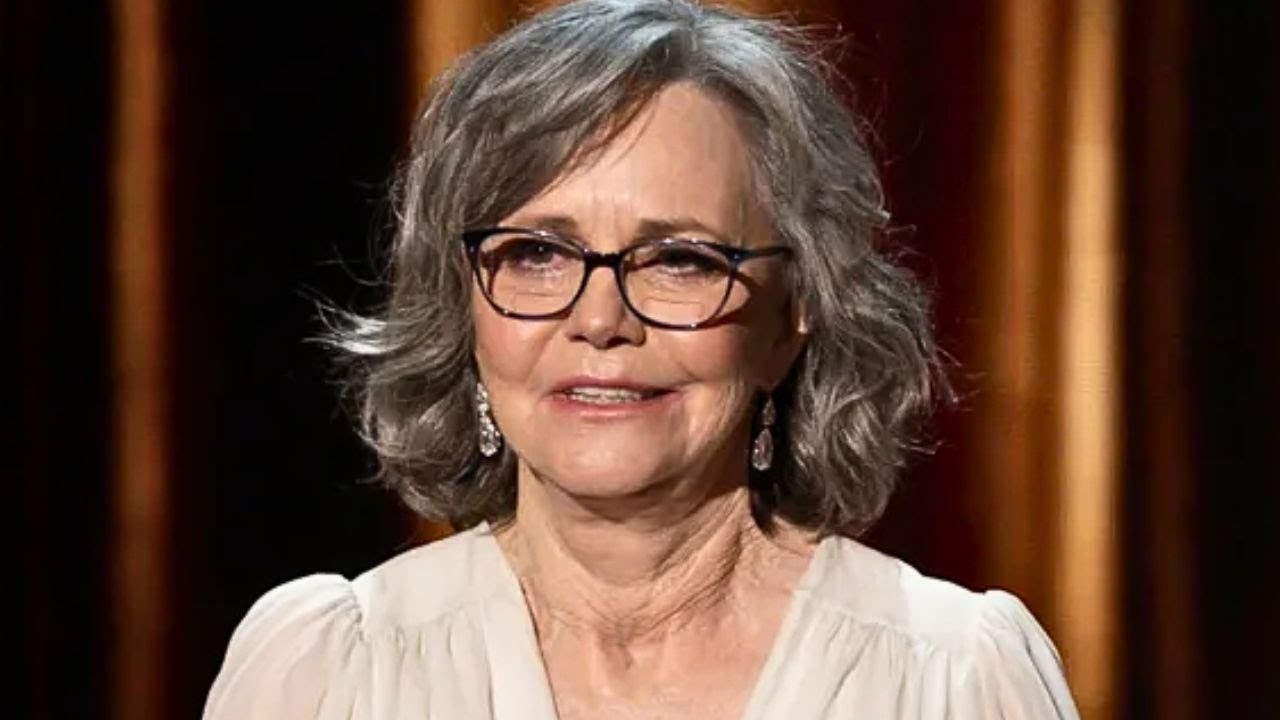 But the road to that stage was paved with a trauma so profound, so deeply buried beneath the sunny smile of America’s sweetheart, that its revelation decades later would redefine her legacy entirely.
The public had met Sally Field as Gidget, the perky, surf-loving teenager with a perpetual grin, and then as Sister Bertrille, the flying nun whose habit caught the wind and captured the nation’s imagination. She was the embodiment of 1960s innocence, a girl who seemed to float through life without a care. Yet, behind the camera, the reality was a nightmare.
In her 2018 memoir, In Pieces, Field shattered her own porcelain image, revealing that from the age of five until she was fourteen, she was sexually abused by her stepfather, the stuntman Jock Mahoney. The abuse was not a secret kept from her mother; it was a horror that her mother, actress Margaret Field, knew about and failed to stop. The silence in that household was a cage, and young Sally learned early that her voice did not matter, that her body was not her own, and that the adults who were supposed to protect her were the source of her deepest fear.
That sense of isolation and betrayal metastasized into a desperate act of survival when she was just seventeen. Pregnant and terrified, with no financial support and no emotional safety net, Field was driven by a family friend to Tijuana, Mexico, for an abortion. It was not a clinic; it was a shabby building on a grim street, a place where she was given an envelope of cash and told to go inside alone.
What awaited her was a procedure performed without anesthesia, a physical agony that was compounded by a violation so sickening it would haunt her forever. As she later recounted, a technician molested her during the operation, and she had to physically push him away with her hand while enduring the procedure. When it was over, she was screamed at to leave, given no aftercare, no compassion, and left to carry the shame of that day in silence for the rest of her life.
It was a trauma that would define her relationship with her own body and her own worth for years to come.
 Just months after that harrowing experience, Field stepped onto the set of Gidget. The irony was cruel: a girl who had just been stripped of her agency in the most brutal way was now being paid to play the epitome of carefree American girlhood. She smiled, she laughed, she surfed (after a rushed lesson), and the nation fell in love.
But inside, she was a hollow shell, desperately seeking the approval she never received at home. The role of Sister Bertrille in The Flying Nun only deepened her sense of being a puppet. Suspended on wires for hours, she later said she felt like “a flying body,” not a person.
The show was a hit, but it boxed her into a corner of Hollywood’s casting office, labeled as a lightweight, a television actress without the depth for serious cinema. The industry, like her family, saw only the surface, and Sally Field was drowning in the shallows.
Her escape came through the discipline of the Actors Studio, where Lee Strasberg forced her to dig into the pain she had spent her life burying. The result was the 1976 television film Sybil, a harrowing portrayal of a woman with dissociative identity disorder stemming from childhood abuse. It was a role that mirrored her own hidden reality, and her performance was so raw, so terrifyingly authentic, that it earned her an Emmy and shattered the “cute girl” label forever.
But even as her career ascended, her personal life remained a battlefield. Her first marriage to Steven Craig, entered into out of panic when he threatened to marry another woman, was a desperate grab for stability that failed. She was a mother by twenty-three, trapped in a union she never truly wanted, and the emptiness inside her only grew.
 Then came Burt Reynolds. The man who would become the great love of her life and the source of her deepest public wounds. They met on the set of Smokey and the Bandit, and Reynolds, who had to fight producers to cast her, saw a fire in her that he wanted to possess.
Their relationship was a whirlwind of passion and control, a toxic dance where Reynolds demanded her presence, discouraged her career moves, and publicly denied her in the press, treating her more as a possession than a partner. He encouraged her to take the role of Norma Rae, the factory worker who fights for union rights, but when she won the Oscar for it in 1980, he was not there to celebrate. He was threatened by her success.
Field, still carrying the wounds of her childhood, accepted this treatment because she had been conditioned to believe that love required sacrifice, that her worth was contingent on a man’s approval. She later admitted that she didn’t feel good enough unless a man loved her, a devastating confession that explained years of acquiescence to his demands.
The breaking point came when her grandmother sent her tabloid clippings of Reynolds with other women. It was the final blow to her denial. She left him quietly in 1982, without drama, simply walking away from a man who would later admit in his memoir that he lost “the best thing I ever had.”
Their relationship was a scar that never fully healed, a reminder of the years she spent trying to become someone else to be loved. Her second marriage, to producer Alan Greisman, was a conscious attempt to choose safety over passion. It was a “good” marriage, but it lacked the emotional empathy she craved, and after nearly a decade, she initiated a divorce, realizing that avoiding pain did not automatically bring happiness.
 She was learning, slowly and painfully, that no external love could fill the void that had been carved into her soul as a child.
Through it all, her work remained her salvation. She followed Norma Rae with Absence of Malice, Steel Magnolias, and the iconic role of Mrs. Gump in Forrest Gump, proving time and again that her range was limitless.
But the public never knew the cost. They didn’t see the plane crash in 1988 that she miraculously survived, nor did they see the years of depression that she fought in private. They only saw the awards, the accolades, and the seemingly effortless grace.
It wasn’t until she published her memoir at the age of 71 that the full weight of her story was revealed, and the world finally understood that the line “You like me” was not a quirky acceptance speech, but the desperate plea of a woman who had never believed she was worthy of being liked at all.
Now, at 78, Sally Field has found a peace that eluded her for so long. She has become a fierce advocate for women’s rights, speaking openly about her abortion in the context of the ongoing fight for reproductive freedom, and she has become a vocal supporter of the LGBTQ+ community, inspired by her youngest son, Sam. She no longer seeks the spotlight, but when she steps into it, it is on her terms.
She has three sons who adore her, a career that is the envy of her peers, and a legacy that transcends the screen. She is not just an actress; she is a survivor, a testament to the human capacity to endure the unendurable and emerge with grace. The tragedy of Sally Field is not that she suffered, but that she suffered in silence for so long, believing she was alone.
The triumph is that she finally found the strength to speak, to reclaim her story, and to tell the world that she is enough. And this time, she knows it is true.
