The fall of Singapore in February 1942 was not merely a military defeat; it was a cataclysmic psychological blow that shattered the myth of British imperial invincibility in the Far East. While the bravery of individual soldiers was never in question, the strategic incompetence displayed by a cadre of Allied commanders turned potential victories into staggering routs, costing hundreds of thousands of lives and prolonging a global conflict. From the malarial jungles of Malaya to the sun-baked hills of Italy, a pattern of catastrophic decision-making emerged, driven by outdated doctrine, personal vanity, and a profound failure to grasp the nature of modern warfare.
The list of commanders who failed their troops is long, but a select few stand out for their sheer, almost unbelievable ineptitude. These were not men lacking in courage or personal bravery; many had served with distinction in the First World War. However, the Second World War was a conflict of rapid movement, combined arms coordination, and audacious maneuver, and these generals were tragically, fatally, stuck in the past.
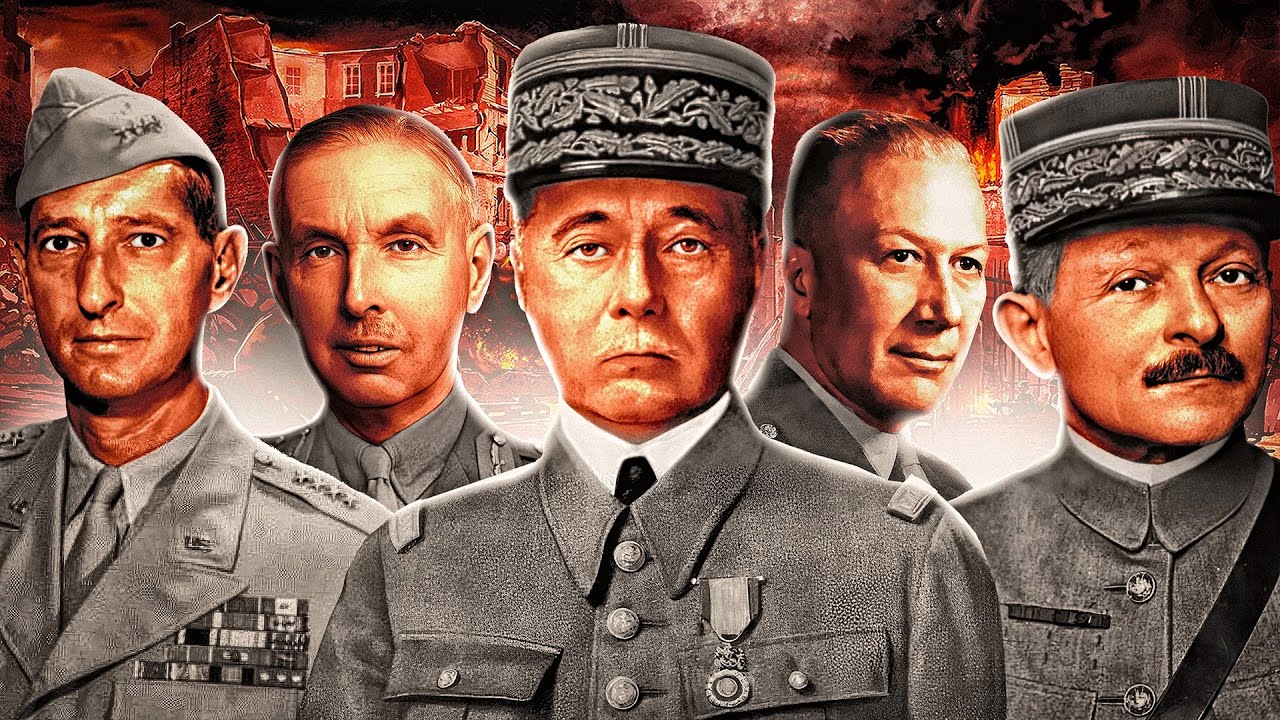 Their failures were not isolated incidents but systemic flaws in leadership that had devastating consequences on the battlefield.
General Arthur Percival, the man tasked with defending the “impregnable fortress” of Singapore, embodies this tragic disconnect. His command during the Malayan campaign and the subsequent fall of Singapore remains a textbook example of how to lose a battle despite overwhelming numerical superiority. Percival’s forces outnumbered the attacking Japanese by a ratio of two to one, a margin that should have allowed for a robust defense.
Yet, from the very beginning, his strategic vision was clouded by a gross underestimation of his enemy’s capabilities and a stubborn adherence to pre-war assumptions about the terrain and the Japanese soldier.
Percival’s initial errors were foundational. He dismissed the threat of a Japanese advance through the dense Malayan jungle, believing the terrain to be impassable for a large, mechanized force. This assumption was fatal.
The Japanese, under the audacious General Tomoyuki Yamashita, moved with breathtaking speed and agility, using bicycles and light tanks to outflank British roadblocks and defensive positions that were oriented to face a seaborne invasion. Percival’s refusal to construct strong defensive fortifications, fearing it would damage morale, meant his troops were constantly caught in the open, unprepared for the onslaught that was coming their way.
The British command structure under Percival was a mess of confusion and miscommunication. He spread his forces too thinly across the peninsula, preventing them from supporting one another and allowing the Japanese to penetrate the lines with ease. The British high command often had no idea where the main body of the Japanese army was, while simultaneously overestimating its size.
This intelligence failure led to a reactive, disjointed defense that ceded the initiative entirely to Yamashita, who drove his men relentlessly, accepting heavy casualties to maintain the momentum of his attack.
When the British were finally pushed back to the island of Singapore, the situation was already hopeless, but Percival’s leadership made it worse. The island’s formidable coastal guns, a key part of its defensive strategy, were pointed south towards the sea, useless against an attack from the north across the Johor Strait. Percival and his predecessors had dismissed the possibility of an assault from the Malayan mainland, a catastrophic oversight that left the island’s rear completely vulnerable.
 The brief pause in the Japanese advance was not a sign of British resistance but a period of regrouping and resupply for Yamashita, who knew the island was ripe for the taking.
The final surrender was a scene of utter humiliation. Percival, looking gaunt and inept in his tropical uniform, walked under a white flag to meet Yamashita, who bluntly demanded an immediate and unconditional surrender. The image of the British general capitulating to the Japanese was broadcast around the world, a potent symbol of the collapse of Western power in Asia.
Winston Churchill called it “the worst disaster and largest capitulation in British history.” While Percival endured immense hardship as a prisoner of war, his legacy remains forever tarnished by the preventable disaster he oversaw, a disaster born of indecision, poor planning, and a fundamental misunderstanding of the enemy he faced.
Moving from the Far East to the European theater, the collapse of France in 1940 offers another stark example of catastrophic leadership. Generals Maurice Gamelin and Maxime Weygand, both revered veterans of the First World War, were utterly outclassed by the German military’s revolutionary new tactics. Gamelin, the Supreme Commander of French forces, was a man of intellect but his thinking was frozen in the static warfare of 1914-1918.
He believed that the Maginot Line and a series of fixed fortifications would hold the German advance, allowing the French to fight a war of attrition they were confident they could win.
Gamelin’s mindset was fundamentally incompatible with the reality of the German Blitzkrieg. He dismissed the ideas of forward-thinking military theorists like Charles de Gaulle, who advocated for massed, concentrated armored formations. Instead, Gamelin dispersed his tanks across the front line as infantry support, a fatal error that neutralized their offensive potential.
When the Germans launched their main attack through the Ardennes forest, a region Gamelin and his staff had deemed impassable for tanks, the French high command was caught completely off guard. The speed and ferocity of the German advance shattered the French defensive lines in a matter of days.
 The logistical and communication failures under Gamelin were staggering. His headquarters was located in a chateau ten miles from the front, and it famously had no radio. Believing radio communications to be insecure, Gamelin relied on personal couriers and carrier pigeons to transmit orders.
In the chaos of the German offensive, many of these couriers could not even locate the units they were meant to command, as those units were already retreating or had been destroyed. The French army, despite having brave and capable soldiers, was effectively leaderless, a giant paralyzed by a command structure that was decades out of date.
When Gamelin was finally relieved of duty, he was replaced by the 73-year-old Weygand, who proved to be no better. Weygand’s first act was to cancel the counter-offensive that Gamelin had finally approved, a move that might have slowed the German advance. Instead of focusing on the military crisis, Weygand spent precious days meeting with diplomats and dignitaries in Paris, seemingly believing that the German attack would stall as it had in the previous war.
During those 48 critical hours, the Germans regrouped and resupplied, consolidating their breakthrough. Weygand’s failure to act decisively in the face of a rapidly deteriorating situation sealed France’s fate, leading to its capitulation in a mere six weeks.
Across the Atlantic, the American military was not immune to producing commanders of questionable competence. General Lloyd Fredendall, who commanded U. S.
forces in North Africa, is a prime example of a leader whose arrogance and lack of tactical skill led to a humiliating defeat. Fredendall’s command style was a bizarre mix of micromanagement and complete disconnection from his troops. He established his headquarters a staggering 100 miles behind the front lines, living in a luxurious trailer that was buried deep underground, prioritizing the installation of air conditioners over the maneuvering of his forces.
This physical distance mirrored a profound psychological distance from the realities of combat.
 Fredendall’s orders were a masterpiece of confusion. He had a habit of inventing his own codes and using vague, nonsensical references that his subordinates could not understand. One infamous order directed a unit to “have your boss report to the French gentleman whose name begins with J at a place which begins with D which is five grid squares to the left of M.”
This kind of communication breakdown was catastrophic in the fluid environment of the desert war. When the German commander Erwin Rommel struck the unprepared American forces at the Kasserine Pass, Fredendall’s troops were scattered, poorly equipped, and utterly bewildered. The defeat was a serious blow to American morale and exposed the deep flaws in their leadership.
The final general on this list, Mark Clark, presents a more complex case. He did not lose a major battle and even liberated Rome, but his cautious, often arrogant leadership prolonged the brutal Italian campaign unnecessarily. Clark’s command was characterized by a lack of audacity and a tendency to blame others for his own mistakes.
At the Anzio landings, he and his subordinate, General John Lucas, failed to exploit the initial surprise and breakout from the beachhead, allowing the Germans to regroup and bottle up the Allied forces in a bloody stalemate. Both men were overly cautious, believing they needed more troops, while the Germans were frantically rushing reinforcements to contain them.
Clark’s decision-making at the Battle of Monte Cassino was equally flawed. The campaign to take the famous monastery became a series of costly frontal assaults against a well-entrenched enemy, a tactic that played directly into German strengths. A more audacious commander might have used flanking maneuvers or airborne drops to bypass the position, but Clark opted for a grinding, attritional approach that cost thousands of Allied lives.
His focus seemed to be on the glory of capturing Rome rather than on the most efficient way to defeat the German army. His pompous demeanor and tendency to take credit for successes while deflecting blame for failures made him deeply unpopular with his peers and subordinates.
In the final analysis, the worst generals of World War II shared a common thread: they were leaders who failed to adapt. They were prisoners of their own past experiences, unable to grasp the revolutionary changes in warfare that the conflict demanded. Their failures were not just tactical errors but strategic catastrophes that resulted in the deaths of hundreds of thousands of soldiers and civilians.
They were men who cracked under pressure, who prioritized their own comfort and reputation over the welfare of their troops, and who, in the face of a dynamic and ruthless enemy, proved to be tragically, and unforgivably, out of their depth. The lessons of their failures remain a stark warning about the cost of military incompetence.
