Joseph Beyrle, a man whose life reads like the most improbable of war novels, passed away quietly on December 12, 2004, at the age of 81 in his Michigan home. He was a retired shipping supervisor, a father of three, and a grandfather to seven. But sixty years earlier, this unassuming man accomplished a feat so singular that military historians still struggle to categorize it.
He was the only soldier in the entire Second World War to fight for both the United States Army and the Soviet Red Army, a journey that began with a parachute drop into hell and ended with him standing before the most feared marshal in the Soviet Union.
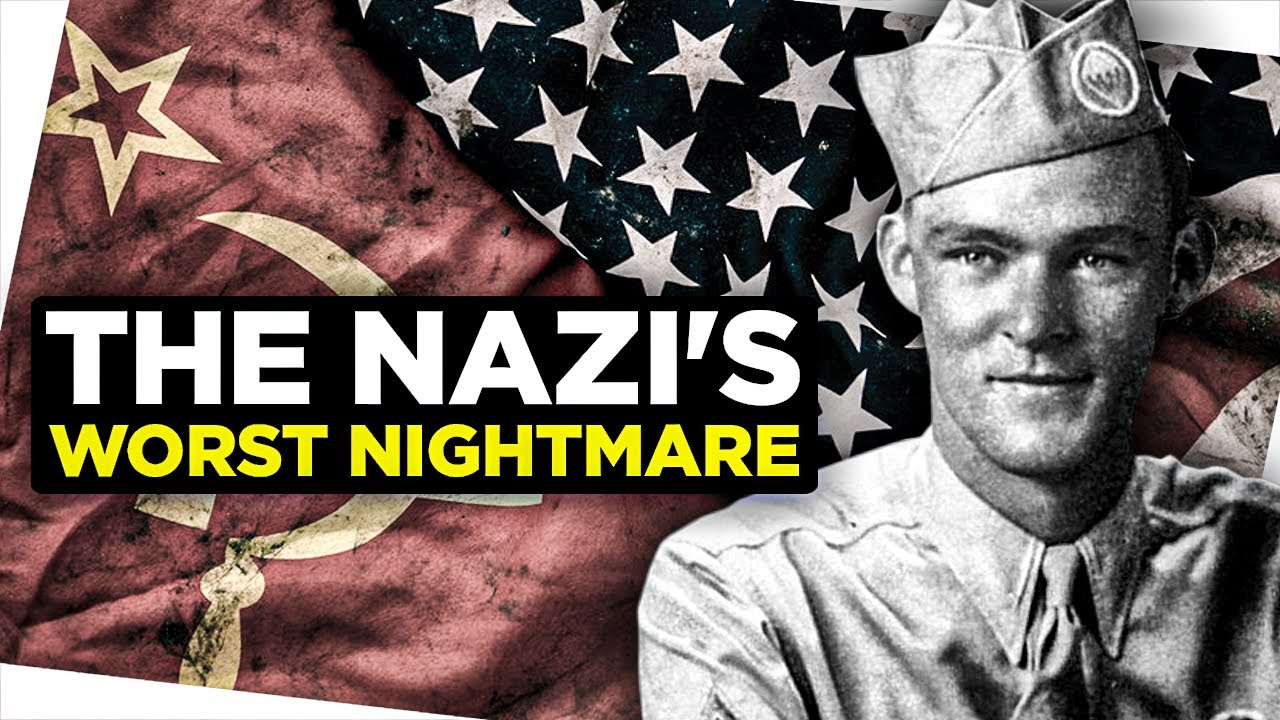 Born on August 25, 1923, to German immigrant parents in Muskegon, Michigan, Beyrle grew up in the shadow of the Great Depression. His family stood in breadlines, and his older brothers left high school to join the Civilian Conservation Corps, sending their meager wages home to keep the family afloat. The Depression forged a resilience in young Joe that would later prove invaluable.
He was a senior in high school when Japanese bombers struck Pearl Harbor on December 7, 1941, and within six months, he had volunteered for the U. S. Army, turning down a full scholarship to the University of Notre Dame to do so.
On his second day at Fort Custer, an officer asked for volunteers for a new, experimental branch of the service: the paratroopers. The pitch was simple—extra pay, guaranteed action, and the toughest training the army could devise. Beyrle was one of eleven men from his unit to step forward.
That decision sent him to Camp Toccoa, Georgia, the crucible that would forge the 101st Airborne Division. Assigned to Company I of the 506th Parachute Infantry Regiment, Beyrle endured the brutal regimen that would later be immortalized in the miniseries “Band of Brothers”: endless push-ups, thirty-mile forced marches in the Georgia heat, and the infamous up-and-down runs of Mount Currahee.
Beyrle’s training did not stop at standard infantry tactics. He was selected for specialized instruction as a radioman and in demolitions, skills that would soon mark him for a mission far beyond the scope of a standard paratrooper. After shipping to England in September 1943, he underwent additional training with British commandos, earning both American and British jump wings—a rarity in itself.
Then came the assignment that remains shrouded in secrecy: Beyrle volunteered for special duty, parachuting into occupied France with two heavy bandoliers of gold coins destined for the French Resistance. He completed this mission twice, moving through safe houses and evading German patrols, all before the main invasion of Europe had even begun.
On June 6, 1944, D-Day, Beyrle’s plane was struck by German anti-aircraft fire as it approached the Normandy coast. Forced to jump from a dangerously low altitude of just 400 feet, he landed on the roof of a church in Sainte-Côme-du-Mont, directly above a firefight raging in the streets below. He managed to disentangle himself and drop into the chaos, immediately moving toward his unit’s objective: blowing up two bridges.
But his combat time with the 101st was brutally short. While crawling through the dark, he stumbled directly into a German machine-gun position and was taken prisoner, beginning an odyssey that would defy all odds.
What followed was a nightmare of escapes, recaptures, and brutal interrogations. Beyrle was shelled by Allied planes, beaten unconscious for insulting a German officer, and eventually shipped to a POW camp deep in Germany. He escaped again, hopping a train he believed was heading toward Poland, only to discover it was bound for Berlin.
In the city’s marshalling yards, a sympathetic worker hid him, but the Gestapo eventually found him. Tortured and accused of being a spy because of his German surname, Beyrle was saved only by the intervention of a German army officer who demanded the return of his prisoners. He was sent to Stalag Luft III, where he spent a week in solitary confinement on bread and water.
January 1945 found Beyrle in another camp, but this time, he had a secret radio. He knew the Soviet Red Army was advancing, only fifty miles away. With a few fellow prisoners, he devised an escape plan using a farmer’s cart and barrels.
He was shot at, chased by dogs, and forced to travel only at night, stealing food from farms to survive. On the third day, hiding in a hayloft, he heard the unmistakable sound of tank engines. Peering through the slats, he watched Soviet armor roll into the farmyard.
 He climbed down, raised his hands, and shouted the only words he knew: “Amerikanski tovarish!” —American comrade.
The commander of that Soviet unit was Captain Alexandra Samusenko, the only female tank commander in the Soviet First Guards Army, a decorated veteran of the pivotal Battle of Kursk. She commanded an American-made Sherman tank, provided under the Lend-Lease program. Beyrle, armed and given a place in her unit, fought alongside the Red Army in several firefights, including the liberation of his own POW camp—a moment of profound irony that left many prisoners stunned.
Captain Samusenko was killed in action shortly thereafter, and Beyrle was wounded in the leg, ending up in a Soviet military hospital.
Word of the American fighting with the Red Army spread quickly. Beyrle received a visit from Marshal Georgy Zhukov, the most celebrated Soviet commander of the war, who listened intently to his story. Eventually evacuated to Moscow, Beyrle made contact with the U.
S. Embassy, where he learned a devastating truth: the U. S.
Army had listed him as killed in action in Normandy, and his parents had held a funeral for him in the summer of 1944. His journey home took him through Odessa, Turkey, Egypt, Italy, and England. In 1946, he married his boyhood sweetheart in the same church where his memorial service had been held.
Beyrle’s post-war decorations include the Purple Heart, the French Croix de Guerre, the Soviet Order of the Red Banner, and the Medal for the Liberation of Warsaw. His story, which remained largely unknown for decades, has since become a testament to the chaos, courage, and improbable alliances of the Second World War. He was a man who fought for two armies, survived the Gestapo, and returned from the dead to live a quiet life in Michigan.
Joseph Beyrle did not just witness history; he became a singular footnote in it, a living bridge between the Western Allies and the Soviet Union at the very moment their alliance was reaching its zenith.
The details of his escape from the Gestapo remain harrowing. After being tortured, Beyrle was certain he would be executed. The intervention of the Wehrmacht officer was a stroke of luck that he credited with saving his life.
At Stalag Luft III, the treatment for escaped prisoners was notoriously brutal, and his week in solitary confinement was just the beginning of the psychological warfare waged by his captors. Yet Beyrle’s resolve never cracked. He studied the movements of the guards, memorized patrol schedules, and waited for the opportune moment to make his final break.
When he finally linked up with the Red Army, the initial encounter was tense. Soviet soldiers, wary of a stranger in a tattered American uniform, trained their weapons on him. But his shouted words and the sheer absurdity of his situation convinced Captain Samusenko to take him in.
 She was a formidable figure, known for her bravery at Kursk, and she treated Beyrle as a fellow soldier rather than a curiosity. He fought alongside her crew, manning a machine gun and throwing grenades, until a German artillery shell ended her life and wounded him. The loss of Samusenko affected him deeply; he spoke of her with reverence for the rest of his days.
The liberation of his own POW camp was a surreal moment. Beyrle, riding with the Soviet vanguard, watched as the gates swung open and his former fellow prisoners stared in disbelief. Some thought he was a ghost, given the reports of his death.
Others simply could not comprehend how an American had ended up on the other side of the front lines. Beyrle later recalled the confusion and joy of that day, but also the grim reality of the Soviet advance—the scorched earth, the atrocities, and the sheer scale of destruction that marked the Eastern Front.
His meeting with Marshal Zhukov was equally extraordinary. Zhukov, the man who had defeated the German army at Stalingrad and Berlin, was intrigued by the story of the American paratrooper. He asked detailed questions about Beyrle’s training, his escape, and his experiences with the Red Army.
For Beyrle, it was a moment of surreal validation—a recognition from one of history’s greatest military minds that his journey was not just a personal ordeal, but a significant event in the larger tapestry of the war.
The news of his survival reached his family in Michigan in a most unusual way. After his funeral, his mother had kept his room exactly as he had left it, refusing to believe he was gone. When a telegram arrived from the U.
S. Embassy in Moscow confirming he was alive, she reportedly collapsed in relief. Beyrle’s return to the United States was a slow process, as he had to navigate the bureaucratic maze of two different armies and two different nations.
He finally arrived home in 1946, a changed man, but one who carried no bitterness.
He married his sweetheart, Jo, in a ceremony that was both a wedding and a celebration of his resurrection. The church where he had been mourned just two years earlier was now filled with joy. Beyrle went on to work as a shipping supervisor, living a life of quiet anonymity.
He rarely spoke of his wartime experiences, preferring to focus on his family and his community. It was only in his later years, as historians began to uncover his story, that he agreed to share the details of his incredible journey.
Beyrle’s legacy extends beyond his own story. He became a symbol of the unlikely cooperation between the United States and the Soviet Union, a bond that would fray into the Cold War just a few years after his return. His friendship with the Soviet soldiers, his respect for Captain Samusenko, and his gratitude toward Marshal Zhukov stood in stark contrast to the animosity that would soon define international relations.
 He often said that the soldiers on both sides were just trying to survive, and that the politics of the war were far above their pay grade.
In 1994, on the 50th anniversary of D-Day, Beyrle returned to Normandy. He visited the church at Sainte-Côme-du-Mont, where a plaque now commemorates his landing. He was greeted as a hero, but he deflected the praise, insisting that the real heroes were the men who never came home.
He also traveled to Russia, where he was welcomed by veterans of the Red Army who remembered the strange American who had fought alongside them. He laid a wreath at the grave of Captain Samusenko, a moment that brought him to tears.
Joseph Beyrle died in 2004, but his story continues to inspire. Books have been written about him, documentaries have been made, and his name is taught in military history courses around the world. He is remembered not just for his extraordinary survival, but for his refusal to let circumstance define him.
He was a man who, when faced with the worst horrors of war, chose to fight, to escape, and to find common ground with the most unlikely of allies. His life is a reminder that even in the darkest times, the human spirit can prevail.
The details of his final days are poignant. Surrounded by his children and grandchildren, he spoke of his experiences with a clarity that surprised even his family. He told them of the gold coins he had carried for the French Resistance, of the cold nights in the German forests, and of the kindness of strangers who risked their lives to hide him.
He also spoke of the guilt he felt for surviving when so many others had not. His family says he never fully escaped the war; it lived with him every day, in the quiet moments and the sleepless nights.
His funeral in 2004 was attended by military officials from both the United States and Russia, a fitting tribute to a man who had served both nations. A Russian delegation presented his family with a flag from the Red Army, and a U. S.
Army honor guard performed a rifle salute. It was a ceremony that bridged the very divide Beyrle had spent his life trying to understand. He was buried with full military honors, his grave marked by a simple headstone that lists his service in both armies.
Beyrle’s story is a testament to the chaos of war, where the lines between friend and enemy can blur in the most unexpected ways. He was a paratrooper who dropped into France with gold for the Resistance, a prisoner who escaped from the Gestapo, and a soldier who fought for the Red Army. He was a man who was declared dead, only to return from the grave.
His life was a series of impossibilities, each one overcome through sheer will and an unshakeable belief in his own survival.
In the annals of World War II history, Joseph Beyrle stands alone. No other soldier can claim his unique distinction. He is a figure of fascination for historians, a hero for his family, and a lesson for all of us about the resilience of the human spirit.
His story, once buried in the chaos of war, is now a permanent part of the historical record. It is a story that reminds us that even in the most desperate circumstances, courage and determination can lead to the most improbable of outcomes.
