The final radio message crackled from the collapsing pocket, a desperate plea for orders that would never come. Inside the basement of the Univermag department store, the commander of the German Sixth Army was about to make a choice that would shatter a centuries-old military tradition and seal the fate of twenty-two of his senior officers. The Red Army was at the door, and the man who had been promoted to field marshal just hours earlier was refusing to obey the unspoken command embedded in his new rank.
Friedrich Paulus was found gaunt and unshaven, surrounded by the remnants of his staff, as Soviet soldiers descended into the fetid cellar. Hitler’s promotion to field marshal had been a cynical signal, a clear directive that no German officer of that rank had ever surrendered alive and that Paulus should take his own life to preserve the Führer’s honor. The promotion was a death warrant disguised as a decoration.
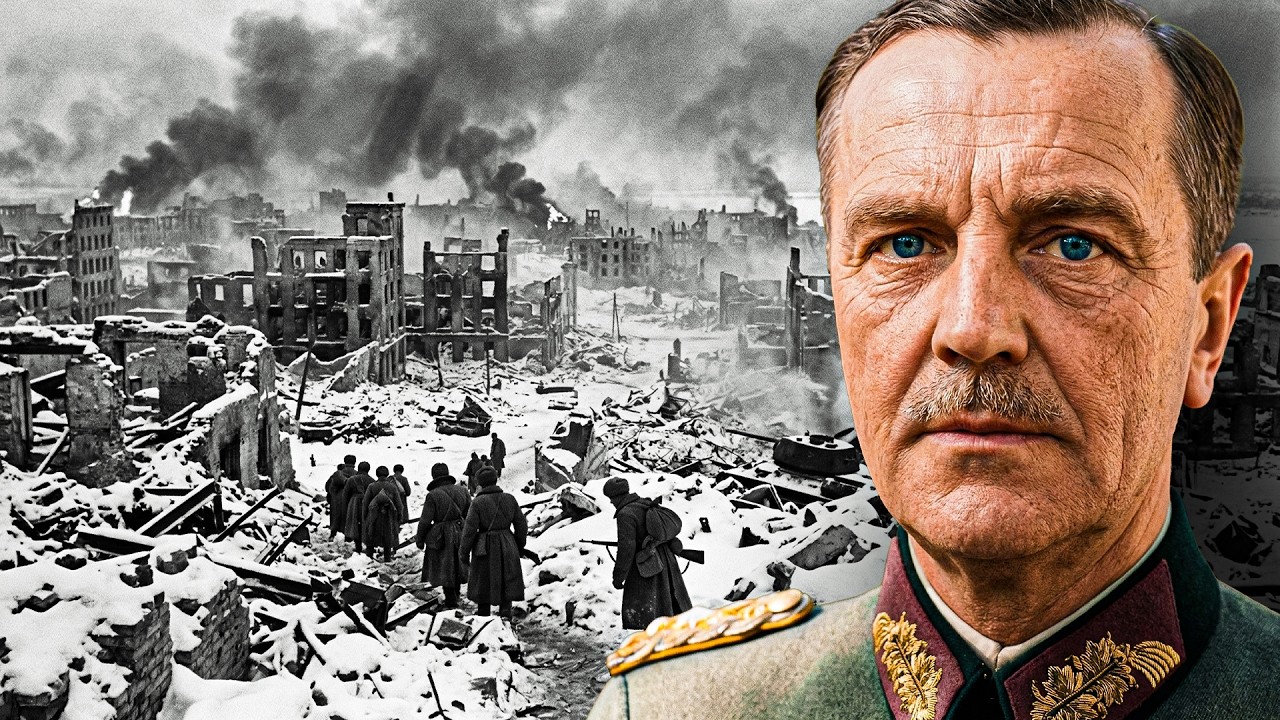 Paulus, however, looked at the pistol and the propaganda and chose a different path, informing a fellow officer that he had no intention of doing the Führer that favor. His surrender on January 31, 1943, was not a formal capitulation but a personal one, a decision that would reverberate through the rest of the war and the Cold War that followed.
The encirclement had been a death sentence for months. Since Operation Uranus snapped shut in November 1942, the Sixth Army had been trapped in a cauldron of steel and ice. The Luftwaffe’s promise of an air bridge had collapsed almost immediately, delivering a fraction of the necessary food, fuel, and ammunition to sustain over 200,000 men.
Field Marshal Erich von Manstein’s relief attempt, Operation Winter Storm, had ground to a halt thirty miles short of the pocket in December, leaving the trapped army to rot. Inside the city, conditions deteriorated into a nightmare of frostbite, starvation, and relentless Soviet bombardment. Wounded men filled every cellar, and ammunition dwindled to the point where soldiers began surrendering in small, desperate groups along the perimeter.
When Paulus refused to die, the dam broke. Within two days, twenty-two German generals followed his lead, surrendering alongside the remnants of their commands. The final holdout, General Karl Strecker, capitulated with the northern pocket near the Barrikady factory on February 2, 1943, ending the Battle of Stalingrad after five months of carnage.
The immediate aftermath was a logistical and humanitarian catastrophe. Soviet troops sorted the prisoners, separating the senior officers from the enlisted men. Paulus, his chief of staff Lieutenant General Arthur Schmidt, and his adjutant Colonel Wilhelm Adam were driven away under heavy escort, their fates sealed as political assets rather than ordinary prisoners of war.
The remaining soldiers, roughly 91,000 men, began the long march into captivity. They were already starving, frostbitten, and riddled with disease, and the columns of ragged men stretched for miles across the frozen steppe. The Soviet guards showed little sympathy for their condition, and the transit camps were overcrowded hellholes where men slept on bare ground without blankets or medical care.
Disease swept through the ranks, and the mortality rate was staggering. Of the 91,000 who surrendered, only around 6,000 would ever see Germany again. The vast majority perished in the first months of captivity, victims of typhus, dysentery, and the brutal conditions of the Soviet labor camp system in Siberia, Central Asia, and the Urals.
The generals, however, were treated differently. By mid-1943, they had been consolidated at Camp No. 48 in Voykovo, a former sanatorium near Ivanovo, roughly 300 kilometers northeast of Moscow.
Nicknamed the castle, it was a relative paradise compared to the Gulag, but it was still a prison. The NKVD maintained a constant surveillance presence, with agents posing as interpreters and orderlies monitoring every conversation. Soviet intelligence had identified these men not just as captives but as potential instruments of a larger propaganda strategy designed to undermine the Wehrmacht’s will to fight.
The strategy took shape in July 1943 with the establishment of the National Committee for a Free Germany, or NKFD, led by German communist exiles and carefully selected prisoners. Its stated purpose was to encourage the overthrow of Hitler, but its real function was to produce propaganda aimed at demoralizing German troops on the Eastern Front. Two months later, a more targeted body emerged: the League of German Officers, or BDO, chaired by General Walther von Seydlitz-Kurzbach.
 Seydlitz had commanded the 51st Army Corps at Stalingrad and had defied Paulus during the final days of the battle by giving his subordinate officers permission to surrender independently. Paulus had stripped him of his command for that insubordination, but the Soviets saw him as a valuable asset.
Under Soviet supervision, the BDO produced radio broadcasts and leaflets urging German soldiers to desert. Seydlitz went further, proposing a 40,000-strong army of German prisoners to fight alongside the Red Army and be airlifted into Germany to spark an uprising. Moscow never approved the plan, but the mere suggestion alarmed the Nazi leadership.
In Germany, the term Seydlitz troops became shorthand for traitors operating behind enemy lines. Hitler’s government sentenced Seydlitz to death in absentia in April 1944 and placed his family under Sippenhaft, the collective detention imposed on relatives of accused traitors.
Paulus, however, initially refused all cooperation. For over a year, he insisted he remained loyal to Germany despite growing pressure from his Soviet handlers. The turning point came after the failed assassination attempt on Hitler on July 20, 1944.
The execution of officers Paulus had known personally, including Field Marshal Erwin von Witzleben, shook his resolve. On August 8, 1944, Paulus addressed German officers on Free Germany radio, declaring that the war was lost and that Germany must renounce Hitler. The Nazi government retaliated by placing his wife, Elena, and his daughter under Sippenhaft.
The field marshal who had once obeyed every order from Berlin had now turned against the regime entirely.
The most dramatic moment of Paulus’s captivity came on February 11, 1946, at the Nuremberg trials. Defense attorneys for the Nazi leadership had dismissed his earlier written testimony as fabricated under Soviet pressure and demanded he appear in person, confident the Soviets would never produce their prized captive. When presiding judge Geoffrey Lawrence asked Soviet chief prosecutor Roman Rudenko how long it would take to bring the witness to Nuremberg, Rudenko replied calmly that it would take about thirty minutes.
Paulus was already in the Soviet delegation’s residence just outside the courthouse, having been smuggled across occupied Germany in a decoy convoy with a double in a second car to deter assassination attempts.
His appearance caused a sensation. Paulus testified that planning for the invasion of the Soviet Union had begun as early as September 1940, while he served as deputy chief of the General Staff. He described the operational drafts he had worked on in detail and confirmed that senior leaders, including Wilhelm Keitel and Alfred Jodl, had been directly involved in preparations for Operation Barbarossa.
 His testimony contributed to the conviction of both men, who were later executed. For the defendants sitting across the courtroom, many of whom had last seen Paulus as a loyal field commander, the moment was devastating.
After the trial, Paulus returned to the Soviet Union, where his captivity continued under improved conditions. He lived in a guarded villa outside Moscow, receiving better food and limited freedom of movement. Meanwhile, other Stalingrad generals faced sharply different outcomes.
Arthur Schmidt, Paulus’s chief of staff, refused every Soviet attempt at cooperation. When interrogators offered better conditions in return for statements against the regime, Schmidt reportedly told them he would rather stay in prison than break his oath. He held that line for twelve years until his release in 1955.
General Ernst Walter Heitz, who had ordered his men to fight to the last bullet, died in Soviet captivity on February 9, 1944, barely a year after being taken prisoner.
Other generals who had cooperated with the NKFD went on to build the new East German state. Otto Korfes, who had commanded the 295th Infantry Division at Stalingrad and was among the first senior officers to join the committee, took charge of military archives at the East German Interior Ministry after his release in 1948. By 1952, he held the rank of major general in the Kasernierte Volkspolizei, the armed police force that preceded East Germany’s National Army.
Arno von Lenski, who had also cooperated, followed a similar path. Others returned to a West Germany that wanted nothing to do with men who had broadcast Soviet appeals. The label of collaboration versus loyalty would follow those generals for the rest of their lives, splitting families and former comrades along Cold War lines.
In 1953, two years before the last ordinary prisoners returned, Paulus was released from Soviet custody and allowed to move to Dresden in East Germany. He took a position as a civilian chief of the East German Military History Research Institute, a quiet role that kept him close to the regime but out of public view. He lived modestly, gave occasional lectures to military audiences, and avoided the spotlight.
His wife, Elena, had died in 1949 in Baden-Baden, West Germany, without ever seeing him again. Their son, Friedrich, had been lost in action at Anzio, Italy, in February 1944. The family Paulus returned to no longer existed.
Seydlitz’s path proved even harder. Despite years of active cooperation with the Soviets, a Soviet military tribunal sentenced him to death in July 1950 on charges of war crimes committed during his earlier Wehrmacht service. The sentence was commuted within hours to twenty-five years of imprisonment.
 He served five of those years before a diplomatic breakthrough changed his fate. In September 1955, Chancellor Konrad Adenauer traveled to Moscow and negotiated the release of the last approximately 10,000 German prisoners of war still held in the Soviet Union. The event ended history as the Heimkehr der Zehntausend, the return of the 10,000.
Seydlitz was among those released in October.
On October 7, 1955, the first 600 former prisoners arrived at the Friedland transit camp near Göttingen. Crowds lined the roads as families who had waited a decade searched the faces of hollow-eyed, aging men they barely recognized. In exchange for the prisoners’ release, West Germany agreed to establish diplomatic relations with the Soviet Union.
Germans regarded Adenauer’s achievement as a defining moment of his chancellorship. Seydlitz returned to a country that rejected him. Former comrades called him a traitor, and the Bundeswehr denied him military honors.
His Nazi-era death sentence was overturned in 1956, but the stigma remained. He settled quietly in Bremen and lived in near total obscurity until his death on April 28, 1976, at the age of 87. Russia posthumously pardoned him in 1996.
Paulus died in Dresden on February 1, 1957, exactly fourteen years after his surrender at Stalingrad. His body was taken across the border to Baden-Baden and buried beside his wife. Karl Rodenburg, who had commanded the 76th Infantry Division, outlived them all.
He died in 1992 at the age of 98, the last of the Stalingrad generals. Of the roughly 91,000 men who had surrendered with Paulus, only some 6,000 ever made the journey home. The generals had survived.
Most of their soldiers had not. Twenty-two generals walked out of a frozen city and into captivity that lasted longer than the war itself. Their fates were shaped by the same forces that defined post-war Europe: ideology, survival, and the long shadow of choices made under impossible pressure.
