The quiet, unassuming man who walked into the American Counterintelligence Corps headquarters in Salzburg, Austria, in May 1945 was not seeking asylum or making a political statement. He was there to surrender, but his story was so bizarre, so antithetical to the very name he bore, that his captors initially dismissed him as a madman or a masterful liar. This was Albert Göring, the younger brother of Hermann Göring, Hitler’s designated successor and the commander-in-chief of the Luftwaffe.
While the world prepared to hang his brother for crimes against humanity, Albert claimed he had spent the entire war doing the exact opposite, systematically undermining the Nazi regime and saving the lives of its intended victims.
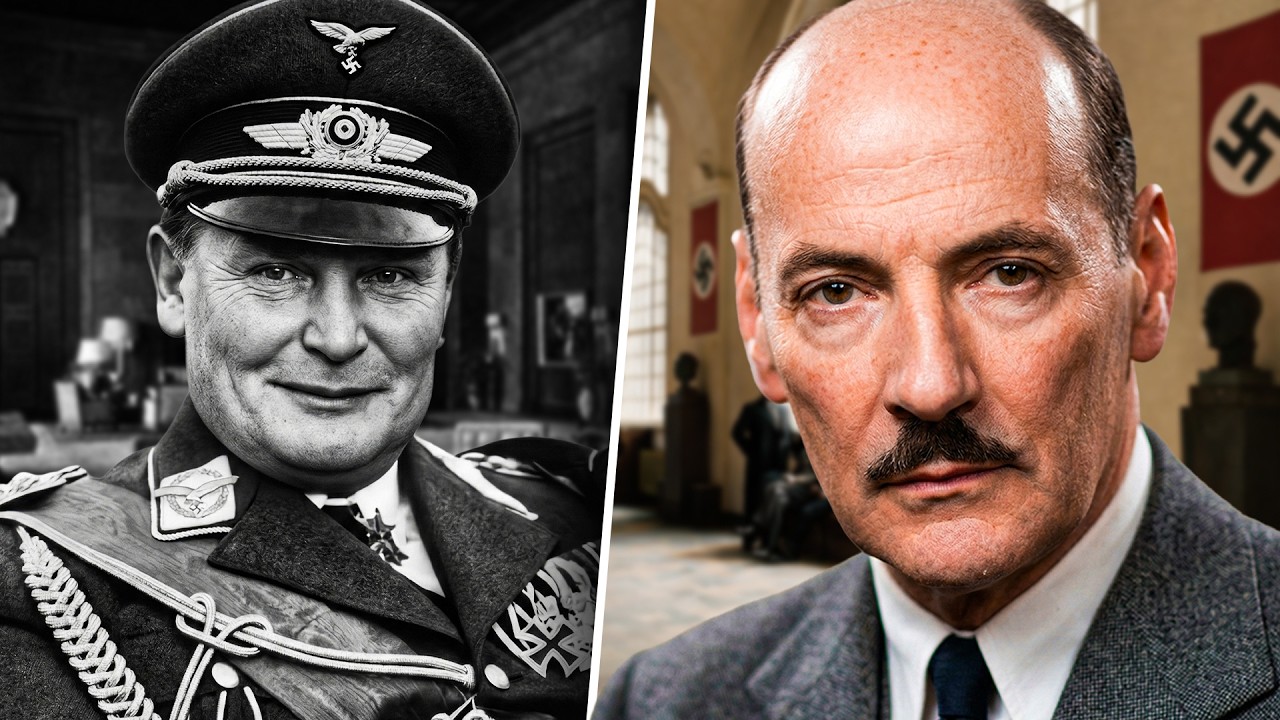 The narrative that emerged from his interrogation and subsequent trial paints a portrait of a man who was not merely a passive opponent of the Third Reich, but an active, reckless, and relentless saboteur of its machinery of death. His weapon was not a gun or a bomb, but his surname—a name that opened doors, commanded fear, and offered a unique form of protection that he wielded with devastating effect against the very system that revered it. The brothers, born just two years apart, were products of the same aristocratic upbringing, yet they became ideological and moral opposites, a dichotomy that would define Albert’s life and nearly cost him it on multiple occasions.
Born in 1895 in Friedenau, a suburb of Berlin, Albert was the fifth child of Heinrich Ernst Göring and his wife Franziska. The family’s circumstances were unusual, shaped by their godfather, Dr. Hermann von Epenstein, a wealthy Austrian physician of Jewish heritage.
Epenstein, who owned two castles and lived lavishly, became a surrogate father figure to the boys. Rumors, never confirmed but persistent throughout Albert’s life, suggested that Epenstein was his biological father, a theory supported by their striking physical resemblance. Both shared a slight build and dark features, a stark contrast to Hermann’s bulky frame and pale blue eyes.
This physical difference mirrored a deeper psychological chasm between the two brothers.
Hermann was the archetypal Prussian militarist, drawn to adventure, combat, and the adulation of the crowd. He became a celebrated fighter ace in World War I, earning the prestigious Pour le Mérite and commanding the legendary squadron once led by the Red Baron. Albert, by contrast, was melancholic, introspective, and preferred the quiet company of books and the piano.
He served in the war as a communications engineer in the trenches, was wounded twice, and earned the Iron Cross, but he returned home with no taste for glory or militarism. While Hermann gravitated toward the nascent Nazi party and its promise of national rejuvenation, Albert sought a quiet life, studying engineering and eventually moving to Vienna in 1927.
The rise of the Nazis in 1933 was a personal catastrophe for Albert. He despised the regime and made his feelings known, formally applying for Austrian citizenship in 1935 as a public rejection of his brother’s world. He found professional success as the technical director of Tobis Sascha, Austria’s largest film studio, and seemed determined to live a life far removed from the political maelstrom brewing in Germany.
 But the Anschluss in March 1938, the forced annexation of Austria, shattered any hope of neutrality. Overnight, Vienna was transformed into a stage for Nazi brutality, and Albert was thrust into the center of a moral crisis he could not ignore.
The first act of defiance that defined his war occurred in those chaotic days. Witnessing Jewish women forced onto their hands and knees to scrub the pavements while SS officers and crowds jeered, Albert did the unthinkable. He removed his jacket, knelt down beside them, and began scrubbing the pavement himself.
When an SS officer demanded his identification, the name on the card caused immediate confusion and fear. The officer, unwilling to risk the wrath of the Reichsmarschall’s brother, ordered everyone to disperse. This incident revealed to Albert the immense power his name held, and he resolved to use it as a weapon against the regime that had made it infamous.
His methods were audacious and varied. He tore a sign reading “I am a Jewish sow” from an elderly woman’s neck, knowing full well he would be arrested. He was, and a single telephone call to Berlin secured his release.
He arranged exit visas for Jewish colleagues, provided travel documents and money, and wrote letters of protection that warned any official who harmed the bearer would answer personally to Hermann Göring. One such letter saved a Jewish doctor named Medvey, who reached London safely. He intervened for high-profile prisoners, including former Austrian Chancellor Kurt von Schuschnigg and Archduke Josef Ferdinand of the Habsburg dynasty.
He even funneled his salary to a Jewish resistance worker in Rome who used the funds to help refugees escape to Lisbon.
 In 1939, Albert accepted a position as export director at the Škoda Works in Pilsen, Czechoslovakia, a massive armaments manufacturer that had been absorbed into his brother’s industrial empire. The appointment was a strategic move by Czech executives who hoped his name would shield the company from the worst of Nazi control. They were right, but not in the way they anticipated.
From his first day, Albert made his loyalties clear, openly criticizing Hitler in front of Czech directors and refusing to give the Nazi salute, opting instead for a simple handshake, an act that his own secretary noted was punishable by death. He used his position to sabotage the war effort from within, looking the other way as workers filled bomb casings with sand and delayed orders.
His most daring scheme involved the concentration camps. Needing labor for the factory, Albert was authorized to request prisoners. He sent trucks to collect them, but ordered the drivers to stop in isolated areas and release the prisoners into the countryside.
No one questioned a requisition signed by Hermann Göring’s brother. He also forged Hermann’s signature on transit documents and used Göring family stationery to demand the release of specific individuals. One such letter pulled Dr.
Josef Charvát, a Jewish physician, off a train bound for Dachau. The commandant, terrified of making a mistake, released two prisoners named Charvát to ensure he had the right one.
By 1942, the Gestapo had opened a file on Albert, documenting his “defeatism” and “anti-national socialism.” His protection was eroding as Hermann’s own star began to fade with the Luftwaffe’s failures on the Eastern Front. By the summer of 1944, a warrant had been issued for his arrest, and a death order demanded his execution on sight.
 Trapped in Bucharest as the Red Army advanced, Albert was forced into hiding. Hermann, himself in disgrace, could no longer protect his brother and advised him to flee. Albert survived the final months of the war in obscurity, emerging only when Germany surrendered.
His voluntary surrender to the Americans was met with profound skepticism. Major Paul Kabala, his interrogator, dismissed his testimony as “a clever piece of rationalization and whitewash.” Imprisoned alongside the very Nazi officials he had opposed, Albert drafted a handwritten document titled “People Whose Lives I Saved at My Own Peril: Three Gestapo Arrest Warrants.”
It listed 34 names, including politicians, doctors, and resistance fighters, along with the specific assistance he had provided. The document was filed away without investigation. His salvation came from a chance encounter.
Major Victor Parker, who took over his case, was the nephew of Sophie Pachkis, a name on Albert’s list. Parker had heard from his aunt that Hermann Göring’s brother had helped Jewish families escape. This corroboration, combined with testimony from former Škoda employees and Czech resistance members, led to his acquittal in a Prague trial in March 1947.
Albert Göring walked out of the courthouse a free man, but his punishment was far from over. He returned to Germany, but his surname made him a pariah. No one would hire him.
He lived on a small pension in a modest Munich flat, largely forgotten. He died in December 1966, just days after marrying his housekeeper so she could inherit his pension. His grave is unmarked.
Decades later, a request to honor him as Righteous Among the Nations at Yad Vashem was denied. Officials acknowledged he had a “positive attitude” toward Jews and helped some people, but concluded there was insufficient primary source evidence. The brother of a war criminal, it seems, could not be a hero.
His story remains a complex, tragic footnote to history, a testament to the idea that even in the darkest of times, individual conscience can defy the most overwhelming of odds, and that the price for such defiance can be a lifetime of obscurity and suspicion.
