The final tally was 352 confirmed kills, a number so staggering it defies the comprehension of modern aerial warfare, yet for Erich Hartmann, the most successful fighter pilot in history, the surrender of Nazi Germany on May 8, 1945, did not signal an end to his personal war. It merely marked the beginning of a new, decade-long battle for survival against the Soviet Union, a struggle that would see him emerge from a gulag only to climb back into a cockpit and face his former captors as a NATO commander. The story of Germany’s top aces after the fall of the Third Reich is not a simple narrative of defeat and obscurity; it is a complex, often contradictory saga of imprisonment, rehabilitation, denial, and a desperate rearmament that saw the hunters of the Eastern Front become the guardians of the West.
Hartmann, known to Soviet airmen as the “Black Devil” for his deadly effectiveness, had deliberately steered his unit toward the American lines in Czechoslovakia, hoping to surrender to the Western Allies and avoid the brutal retribution he knew awaited him in the East. He and his men, along with a group of civilians seeking protection, gathered near the town of Písek, only to be handed over to the Red Army by the Americans within days. This betrayal, as he saw it, condemned him to a decade of captivity where his wartime fame became a curse.
 Accused of war crimes against civilians, he was subjected to relentless pressure to confess, a pressure he steadfastly resisted despite the threat of a 25-year hard labor sentence handed down by a Soviet court in 1949.
The conditions of his imprisonment were designed to break him. He endured solitary confinement, starvation rations, and the psychological torment of being a man whose very name was synonymous with the destruction of Soviet aircraft. He was offered a path to freedom and a senior command in the new East German Air Force, a puppet state’s military, in exchange for his cooperation and a public confession of guilt.
Hartmann refused, a decision that cost him years of his life but preserved his integrity in his own eyes. He was held in a prisoner-of-war camp where he even participated in a revolt against the guards, an act of defiance that only led to further isolation and punishment.
The turning point came not from a change of heart in Moscow, but from the political maneuvering of the Cold War. In September 1955, West German Chancellor Konrad Adenauer traveled to the Soviet Union and negotiated the release of the last 10,000 German prisoners of war, a humanitarian gesture that was also a strategic necessity for the newly sovereign West Germany, which needed experienced men to build its new army. Hartmann was among those finally released, returning to a divided homeland in October 1955.
The man who had been the scourge of the Red Air Force was back, and within a year, he had donned a uniform again, this time for the Bundesluftwaffe, the air force of the Federal Republic of Germany.
In 1956, Hartmann took command of Jagdgeschwader 71 Mölders, the first all-jet fighter wing in the new German military. The irony was profound: the man who had shot down more Soviet aircraft than any other human being was now tasked with training a new generation of German pilots to fly American-made Sabre jets, preparing them to face the very same Soviet Union that had held him captive for a decade. His second career, however, was marked by the same stubborn independence that had defined his wartime service.
He became a vocal and public critic of the American F-104 Starfighter, a supersonic interceptor that he deemed dangerously unstable and ill-suited for the German Air Force’s low-level mission profile. His outspokenness put him in direct conflict with his superiors and the German Defense Ministry, who had staked their reputation on the aircraft, and he was forced into early retirement in 1970, a bitter end to a remarkable military career.
 While Hartmann’s post-war path was forged in the crucible of Soviet captivity, his former superior, Adolf Galland, chose a different route. As the General der Jagdflieger, Galland had been the architect of Germany’s fighter defense, a role that brought him into constant conflict with Hermann Göring over the strategic mismanagement of the air war. Dismissed from his post in early 1945 for his blunt criticism, he formed an elite jet fighter unit, Jagdverband 44, flying the revolutionary Me 262 in the final weeks of the war until he was wounded in action.
Captured by American forces, he was held for extensive interrogation, as the Allies were desperate to extract his knowledge of Germany’s advanced jet technology, a program that had come perilously close to altering the course of the air war.
Released in 1947, Galland found himself in a defeated nation where the very concept of a German air force was forbidden. With no military to join and no aviation industry to employ him, he accepted an invitation from Argentina, where President Juan Perón was aggressively modernizing his military and fostering a domestic aircraft industry with the help of German expertise. For seven years, Galland served as a key advisor, helping to build the Argentine Air Force from the ground up, training its pilots and testing new aircraft.
It was a surreal second act for the man who had once commanded the Luftwaffe’s fighter forces against the Allied bombers, now shaping a foreign air force in a distant land, a role that also provided a haven for other former Nazis seeking to escape prosecution in Europe.
Galland returned to Germany in 1955, the same year West Germany joined NATO, but unlike Hartmann, he chose never to rejoin the military. He instead built a successful career as an aviation consultant and industry adviser, becoming an elder statesman of German aviation. His wartime memoir, “The First and the Last,” became a seminal work on the air war from the German perspective, offering a critical analysis of the Luftwaffe’s failures.
In his later years, Galland forged remarkable friendships with the British and American pilots he had once fought against, attending reunions and framing the conflict as a professional contest between equals. He lived until 1996, having navigated the post-war world with a pragmatism that allowed him to reconcile with his former enemies.
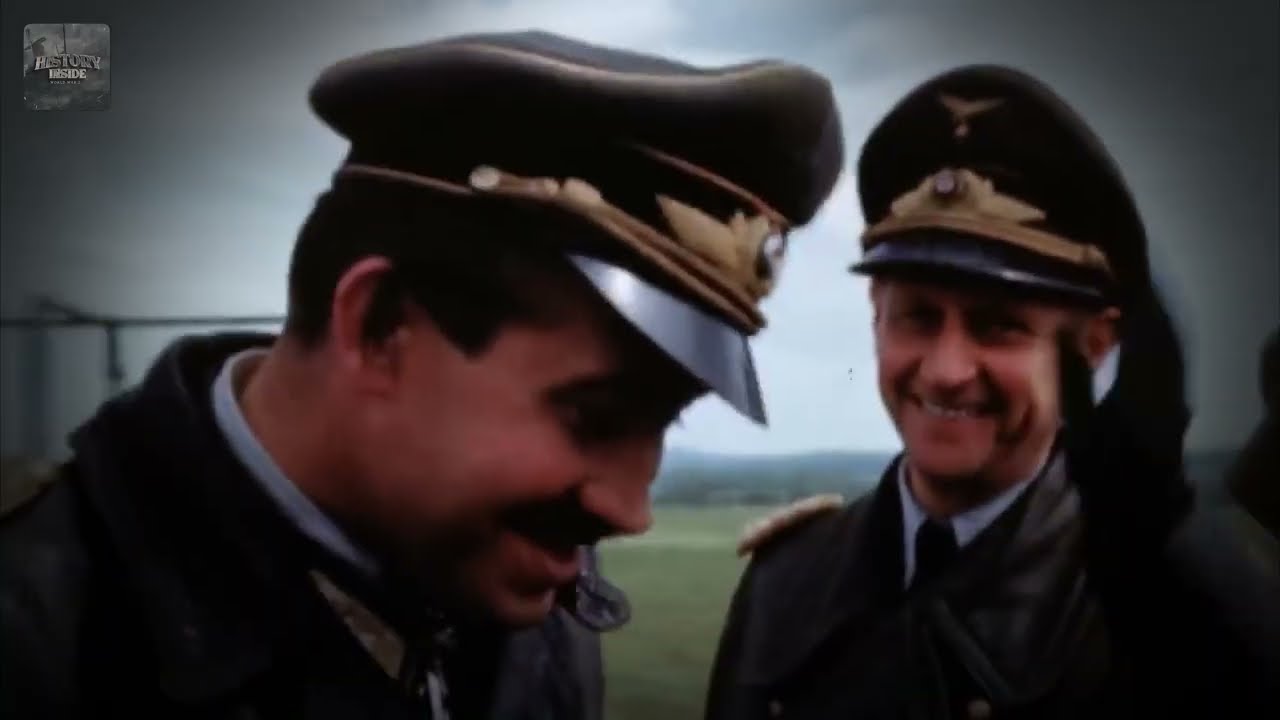 The highest ranks of the new West German military, however, were filled by a different cohort of aces, men who seamlessly transitioned from serving the Third Reich to serving the Atlantic Alliance. Johannes Steinhoff, a highly respected fighter leader with over 170 victories, was one of them. His war ended in a horrific fireball in April 1945 when his Me 262 crashed on takeoff, leaving him with severe burns that disfigured his face and required years of reconstructive surgery.
Despite his injuries, Steinhoff was among the first to help build the Bundesluftwaffe in the 1950s. His rise was meteoric, culminating in his appointment as Chief of Staff of the German Air Force from 1966 to 1970, and then as Chairman of the NATO Military Committee from 1971 to 1974, the highest military post ever held by a German officer in the alliance.
Alongside Steinhoff served Günther Rall, the third-highest scoring ace in history with 275 victories. Rall, who had fought Soviet aircraft relentlessly on the Eastern Front, rose to become the Inspector of the Air Force, the senior officer of the entire West German air arm, and later served as Germany’s representative to NATO’s Military Committee. He was instrumental in the integration of the new German military into the Western defense structure, a man who had once been the enemy now helping to plan the defense of Europe against the Soviet Union.
He lived until 2009, the last of the great German aces to die, a living link to a past that his adopted nation was still struggling to confront.
Gerhard Barkhorn, the second-highest scoring pilot of all time with 301 victories, also joined the new air force in 1956, commanding a fighter-bomber wing and rising to the rank of Major General before finishing his career as chief of staff of a NATO tactical air command. He retired in 1975 and was killed in a car accident in 1983. These men, and others like them, formed the backbone of the new German military, their combat experience deemed invaluable in the face of a new existential threat.
Their shared crisis came with the introduction of the F-104 Starfighter, the very aircraft that Hartmann had condemned. When the jet began to crash at an alarming rate, killing over 100 West German pilots, it was Steinhoff, as Chief of Staff, who grounded the entire fleet in 1966 until the structural and safety issues were rectified, a decision that saved lives but further cemented the aircraft’s infamous reputation as the “Widowmaker.”
 The legacy of the Third Reich, however, was an inescapable shadow that could still destroy a career decades after the war’s end. In the spring of 1976, a West German Air Force wing held a reunion, inviting Hans-Ulrich Rudel, the most decorated German serviceman of the war and an unrepentant Nazi, as its guest of honor. The Defense Ministry was furious, but Rudel came anyway, signing autographs for a line of young airmen.
Two serving Luftwaffe generals, Walter Krupinski and Karl-Heinz Franke, publicly defended Rudel, comparing his Nazi past to the communist past of a leading Social Democrat politician. The comparison caused a political firestorm. Krupinski, a highly decorated Eastern Front ace with 197 victories who had helped train Hartmann and had flown in Galland’s elite jet squadron, was forced into early retirement along with Franke.
His dismissal became a landmark moment in the long and painful German debate over how much of the old Wehrmacht’s traditions its new, democratic military should carry forward.
The fates of these men illustrate the profound moral and political complexities of the post-war era. They were warriors of a genocidal regime, yet their skills were deemed essential for the defense of the very democracies they had fought to destroy. Some, like Hartmann, found their second careers defined by their first, their reputations forever tied to their wartime exploits.
Others, like Galland, chose to reinvent themselves as civilians, bridging the gap between former enemies. And a few, like Steinhoff and Rall, achieved a level of institutional power that would have been unthinkable in 1945, becoming trusted commanders in the alliance that had once been their foe. Their stories are not tales of simple redemption, but rather a testament to the pragmatic, often uncomfortable, alliances forged in the crucible of the Cold War, where the enemy of yesterday became the ally of today, and the ghosts of the past were never fully laid to rest.
