Erich Hartmann, the most successful fighter pilot in history with 352 aerial victories, surrendered to American forces in Czechoslovakia on May 8, 1945, expecting protection. Within days, the Americans handed him and thousands of others to the Soviet Union, beginning a decade of captivity that would test the limits of human endurance.

The story of what happened to Germany’s top fighter aces after World War II is one of the most remarkable and little-understood chapters of the twentieth century. These men, who had dominated the skies over Europe and the Eastern Front, found themselves scattered across continents, imprisoned, or thrust into new roles in a rapidly changing world order that few could have predicted.
Hartmann’s journey from the pinnacle of aerial combat to the depths of Soviet prison camps represents just one thread in a complex tapestry of post-war survival. His surrender near the Czech town of Písek alongside pilots and civilians hoping for Western protection proved futile when American forces transferred the entire group to Soviet custody. For the man Soviet airmen called the Black Devil, a decade behind wire had just begun.
During his years of captivity, Hartmann faced relentless pressure to confess to war crimes he insisted he never committed. Soviet authorities, fully aware of his legendary status, sought to break him through solitary confinement and hard labor. When offered a senior position in the new East German Air Force in exchange for cooperation, he refused.
His defiance came at a terrible cost.
In 1949, a Soviet court sentenced Hartmann to 25 years of hard labor. While Western Allied prisoners returned home within years of the war’s end, German prisoners languished in Soviet camps. The turning point came in September 1955, when West German Chancellor Konrad Adenauer traveled to Moscow and negotiated the release of nearly 10,000 German prisoners of war still held a full decade after fighting stopped.
Hartmann returned to Germany in October 1955 to find his homeland split in two and already raising a new army. In 1956, he put on a uniform again, joining the new West German Air Force, the Bundesluftwaffe. He became the first commander of Jagdgeschwader 71 Mölders, the country’s first all-jet fighter wing, training young German pilots to fly American Sabres on the western side of the Cold War.
The irony was profound. The man who had shot down more Soviet aircraft than anyone alive now faced east once more, this time as part of the NATO alliance that had been formed to counter the very Soviet Union that had held him prisoner for ten years. His second career, however, ended in frustration when he openly criticized the American F-104 Starfighter as dangerous and poorly suited to German needs.
Hartmann’s position put him at odds with his superiors, and he left the service early in 1970. He died in 1993, still remembered as the highest-scoring fighter ace in history. His war had ended in a Soviet cell and began again in a NATO cockpit, a trajectory that captured the strange reality facing Germany’s military elite after 1945.
Another ace never put on a German uniform again at all. Adolf Galland, who had outranked all of them as General der Jagdflieger from 1941, responsible for Germany’s entire fighter force, crossed the ocean instead. His repeated clashes with Hermann Göring over the collapsing air defense of Germany led to his removal from his post in early 1945.

Rather than accept a desk assignment, Galland formed a small elite unit of jet fighters and flew the Me 262 in combat during the final weeks of the war until he was wounded in April 1945. Taken prisoner by the Americans in May 1945, he was held for interrogation because the Allies were eager to learn everything he knew about German jet development. He was released in 1947.
In a defeated Germany, there was no air force for a man like Galland to join. Military aviation was prohibited, and no aircraft industry remained to employ him. When an invitation came from the other side of the world, he took it.
In 1948, Galland traveled to Argentina, where President Juan Perón was racing to modernize his armed forces and build a homegrown aircraft industry.
Perón admired German military skill and his government offered contracts and a welcome to German officers, engineers, and technicians. For some fleeing prosecution in Europe, Argentina also became a refuge. Galland was one of many who found work there, spending seven years helping build the Argentine Air Force, developing its training and flying and testing modern aircraft again.
It was a strange second act for the man who had once led the Luftwaffe’s fighters against the Allies, now shaping a foreign air force half a world away. He returned to Germany in 1955, the same year West Germany joined NATO. But unlike Hartmann, Galland never joined the new Bundesluftwaffe.
He went into business instead, working as an aviation consultant and adviser to industry.
Galland built a second reputation as an elder statesman of German flying. His wartime memoir, The First and the Last, became one of the best-known accounts of the air war written from the German side. In his later years, he did something that would once have been unthinkable, striking up warm friendships with the British and American pilots he had fought over the Channel.
Meeting them at reunions and treating the air war as a contest between professionals, Galland embodied a spirit of reconciliation that many of his former comrades found difficult to embrace. He lived until February 1996, having chosen a civilian life while several of his former comrades went further still, rising to the highest ranks of West Germany’s new air force and of NATO itself.
One of the men who had flown the Me 262 in Galland’s jet unit almost did not survive the war at all. Johannes Steinhoff was already one of Germany’s most respected fighter leaders with more than 170 victories when disaster struck on April 18, 1945. Taking off on one of the last German jet missions, his fighter blew a tire, slewed off the runway, and caught fire.
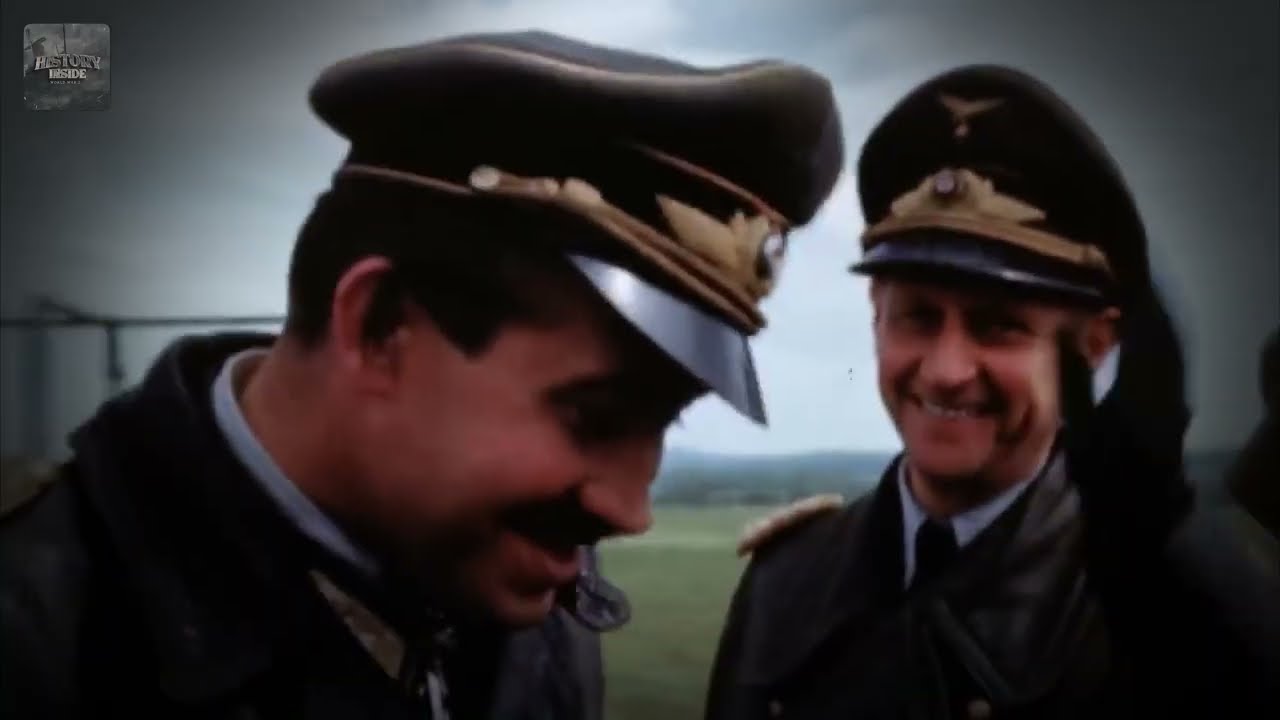
He was pulled from the cockpit alive, but the flames had taken his eyelids and left his face permanently disfigured. He spent the next two years in hospital undergoing a long series of operations as surgeons slowly rebuilt what the fire had destroyed. His face still bore the scars when he returned to uniform.
Steinhoff had been among the first officers to help build the new West German Air Force in the 1950s. He became its chief of staff from 1966 to 1970, and then took one of the highest posts in the Western Alliance as chairman of NATO’s Military Committee from 1971 to 1974. It was the highest post any of them would reach.
He died in 1994.
Alongside him served the third highest scoring pilot in history, Günther Rall, with 275 victories. Rall rose through the new Air Force to become its inspector, the senior officer of the West German air arm, and then the German representative to NATO’s Military Committee. The man who had fought Soviet aircraft over the Eastern Front was now helping plan NATO’s defense against the Soviet Union.
He lived until 2009, the last of the great German aces to die. Gerhard Barkhorn, the second highest scoring pilot of all time with 301 victories, joined the new Air Force in 1956 and commanded one of its fighter bomber wings. He rose to major general and finished his career as chief of staff of a NATO tactical air command, retiring in 1975.
He was killed in a car accident in 1983.
One shared crisis marked their years in command. West Germany bought the American F-104 Starfighter, and Rall helped bring it into service. Hartmann had fought against the aircraft from the start.
When crashes mounted and more than 100 West German pilots had died, it was Steinhoff as chief of staff who grounded the fleet in 1966 until the faults were fixed.
The German press had already named the jet the Witwenmacher, the widow maker. These men had risen to the upper ranks of the alliance they once fought, trusted with its aircraft and its command posts. Arguments over the legacy of the Third Reich, however, were far from over.
Within a few years they would end the careers of two more Luftwaffe generals.
In the spring of 1976, a West German Air Force Wing held a reunion. The unit had taken its traditional name Immelmann from a wartime dive bomber wing and invited the old wing’s last commander as its guest of honor. His name was Hans-Ulrich Rudel.
He had been a Stuka pilot, the most decorated German serviceman of the war, and by the 1970s he was an outspoken and unrepentant supporter of the old regime.
 The Defense Ministry wanted nothing to do with him. He came anyway, signing his books for a line of young airmen, and two serving Luftwaffe generals came to see him. One of them was Walter Krupinski.
Krupinski was no minor figure. He had once been one of the great Eastern Front aces with 197 victories, and he had helped train Erich Hartmann in combat flying.
In the war’s last weeks he had flown the Me 262 in Galland’s elite squadron of aces alongside Steinhoff himself. This was a small circle of men and most of them had known one another for years. Like Hartmann, Krupinski had joined the Bundesluftwaffe after the war and risen to the rank of general.
His post-war career had followed the same path as many of the others until that afternoon.
Afterward Krupinski and a second general, Karl-Heinz Franke, publicly defended Rudel, comparing his Nazi past to the communist past of a leading social democrat politician. The comparison caused an uproar. The Defense Minister Georg Leber moved quickly and forced both men into early retirement.
Three decades after the war, one of Germany’s greatest fighter aces had ended his career defending an unrepentant supporter of the regime he had once served.
Krupinski died in 2000. His dismissal had become a landmark in a long argument in West Germany over how much of the old Wehrmacht’s traditions its new military should carry. The question of legacy would continue to haunt the Bundesluftwaffe for decades, as the men who had once flown for Hitler’s Germany now commanded NATO’s air forces in the heart of Europe.
The remarkable arc of these men’s lives, from the skies over Stalingrad and the English Channel to the corridors of NATO headquarters in Brussels, reflects the extraordinary transformation of Germany itself. Defeated, divided, and occupied in 1945, West Germany became a cornerstone of the Western alliance within a decade, and the very pilots who had once fought against the Allies became instrumental in building the air force that would defend against Soviet aggression.
Their story raises profound questions about redemption, professional duty, and the distance between the soldier and the regime he serves. Hartmann, Galland, Steinhoff, Rall, and Barkhorn were not merely survivors of a lost war. They were architects of a new military order, men whose expertise was deemed too valuable to waste despite the dark chapter of history they had been part of.
The Cold War demanded strange alliances and stranger reconciliations. Former enemies became comrades in arms, and former comrades became adversaries across the Iron Curtain. For Germany’s top fighter aces, the war did not really end in 1945.
It simply changed shape, continuing in new cockpits, new uniforms, and new alliances that would have seemed impossible to the young men who had once soared over Europe in the service of the Third Reich.
Their legacy remains contested, a reminder that history rarely offers clean endings or simple judgments. What cannot be disputed is the extraordinary skill they possessed and the remarkable paths their lives took after the guns fell silent, paths that led from prisoner-of-war camps to the highest councils of the Western world.
